Bishop Basement Model#
Import packages#
[1]:
from __future__ import annotations

%load_ext autoreload
%autoreload 2

import logging
import pathlib
import pickle
import string

import numpy as np
import scipy as sp
import verde as vd
import xarray as xr
from polartoolkit import maps, profiles
from polartoolkit import utils as polar_utils

from invert4geom import (
    inversion,
    optimization,
    plotting,
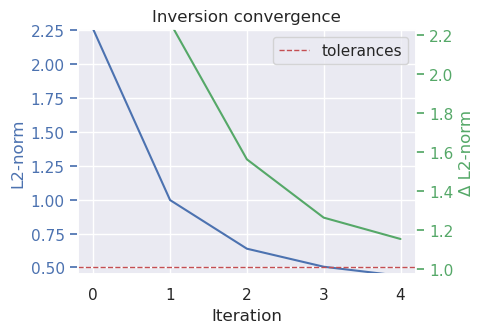
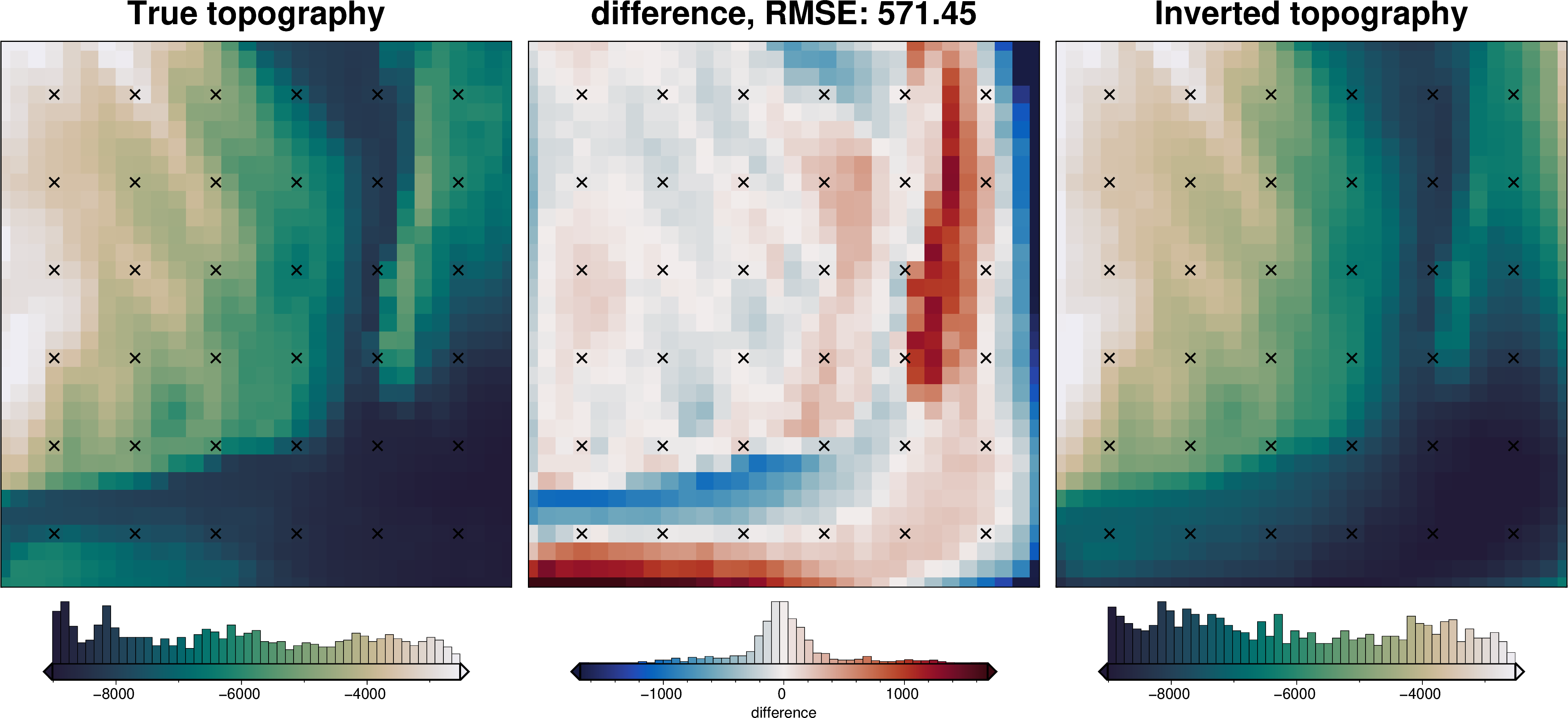
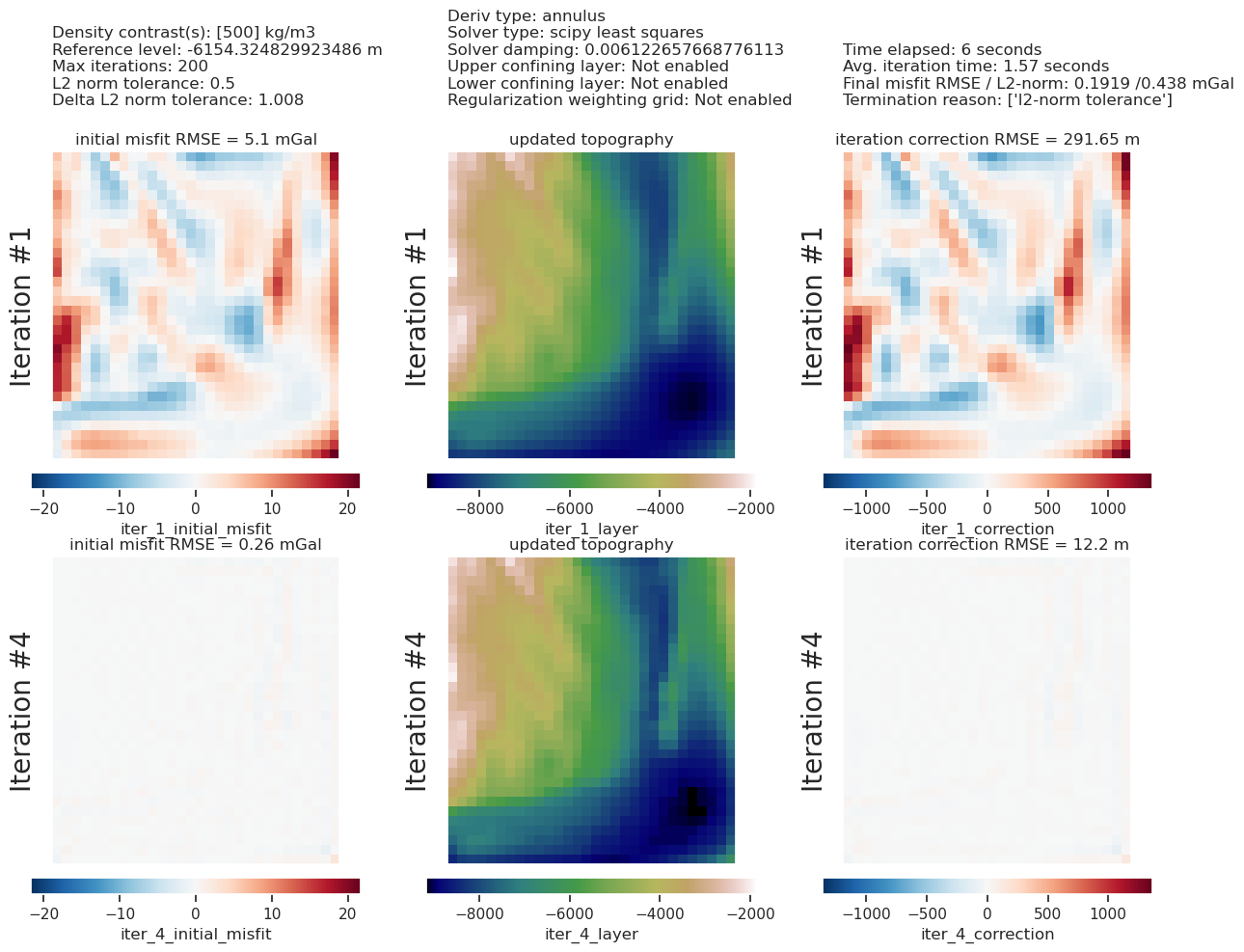
    regional,
    synthetic,
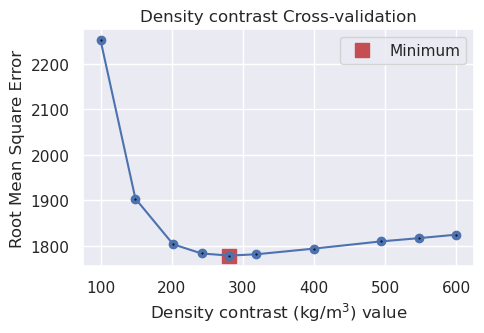
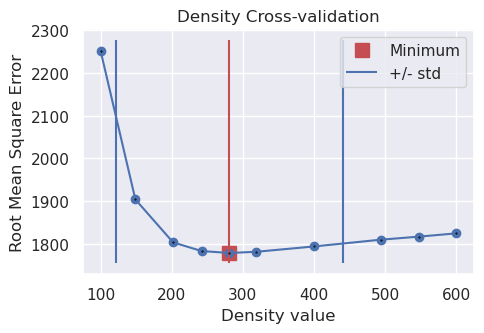
    uncertainty,
    utils,
)

# set up logging to see what's going on
logging.basicConfig(level=logging.INFO)
Get data#
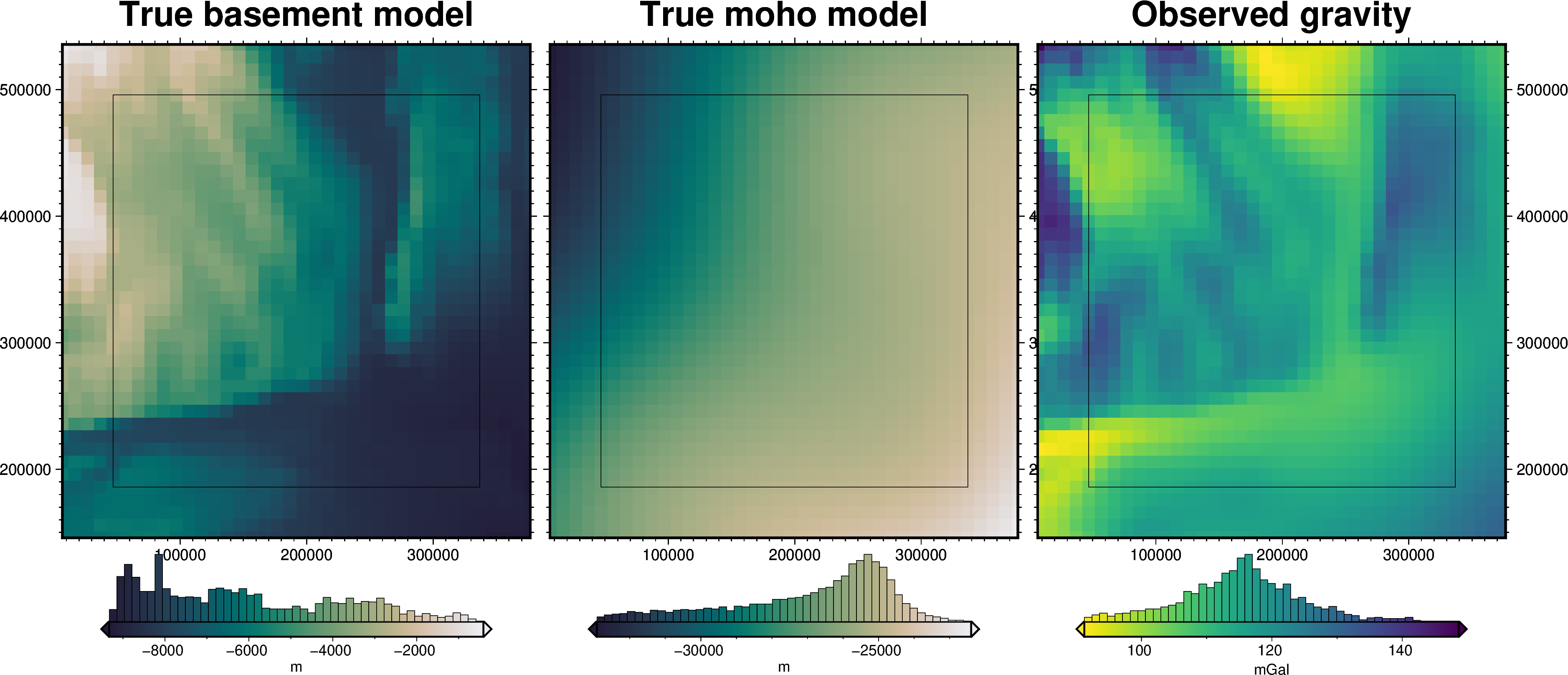
Here we will load a commonly used synthetic gravity and basement topography model, called the Bishop Model. It includes topography of the Moho and the sediment-basement contact, and the forward modelled gravity effect of each, providing a synthetic observed gravity dataset. The forward gravity is calculated with 6 layers of sediment which increase in density from 2100 kg/m3 at 0m to 2600 kg/m3 at the basement surface. Then 3 layers of increasing density from 2700 kg/m3 to 3300 kg/m3 at the
Moho surface.
[2]:
grid = synthetic.load_bishop_model(coarsen_factor=50)
polar_utils.get_grid_info(grid.gravity, print_info=True)
grid
grid spacing: 10000.0 m
grid region: (6900.0, 376900.0, 145900.0, 535900.0)
grid zmin: 91.2694015503
grid zmax: 148.650238037
grid registration: g
[2]:
<xarray.Dataset> Size: 37kB
Dimensions:        (northing: 40, easting: 38)
Coordinates:
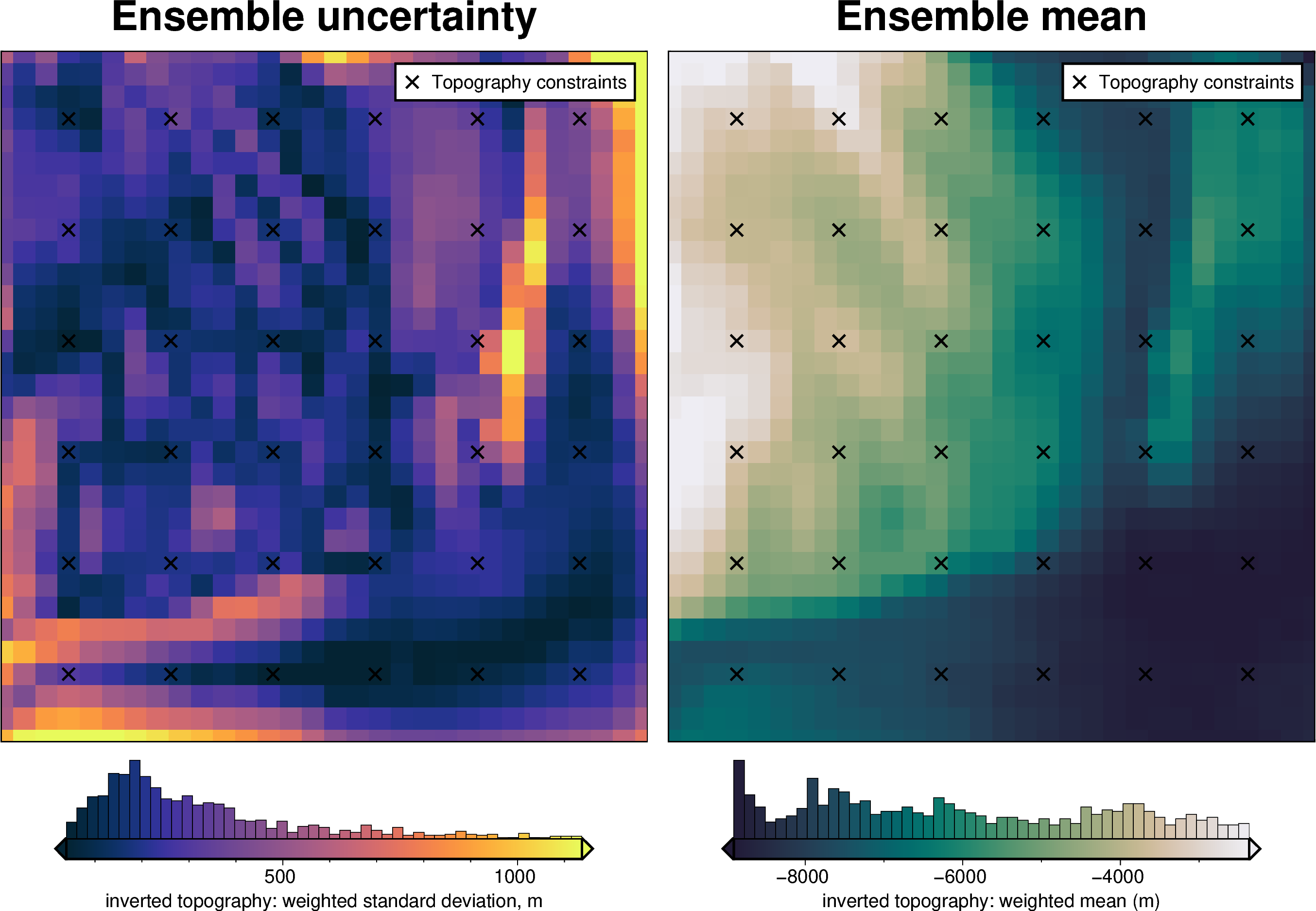
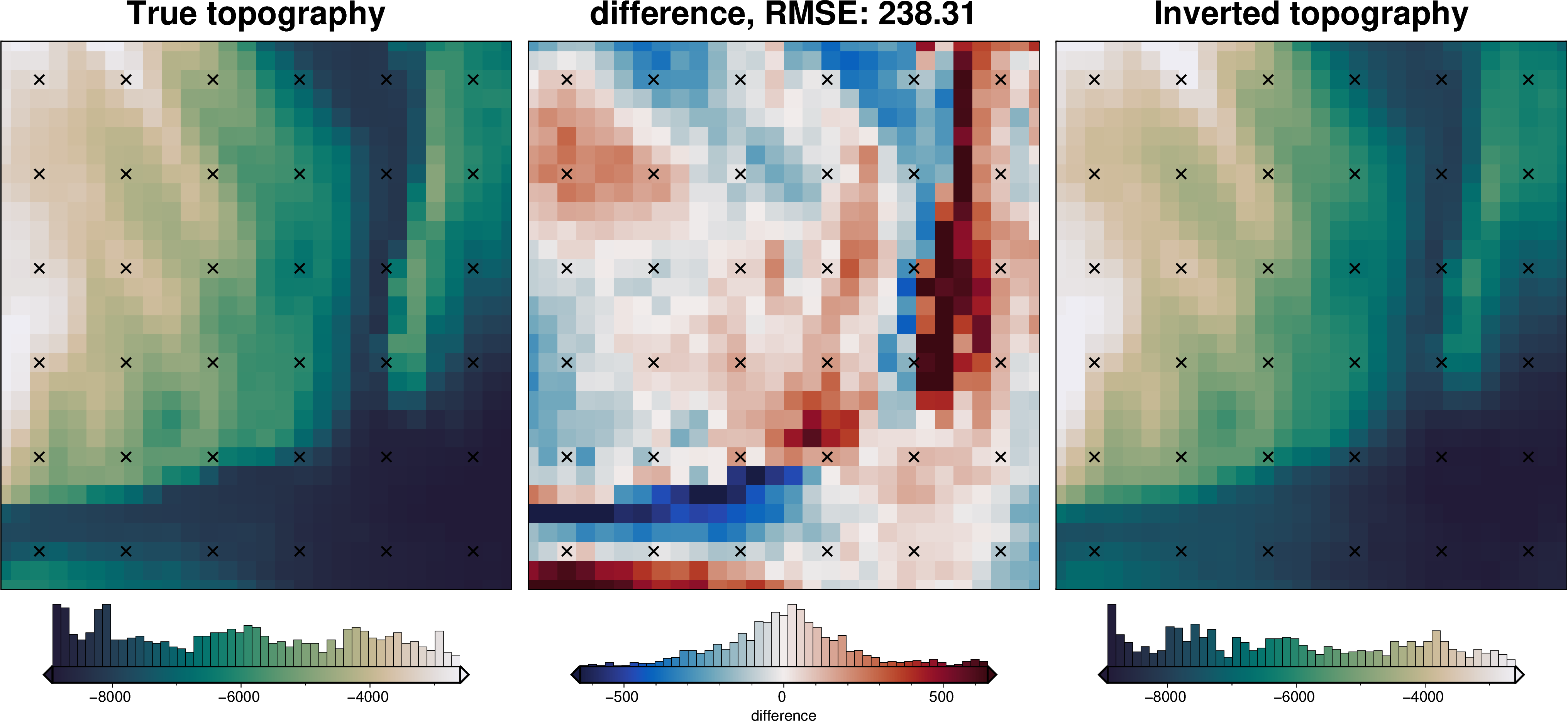
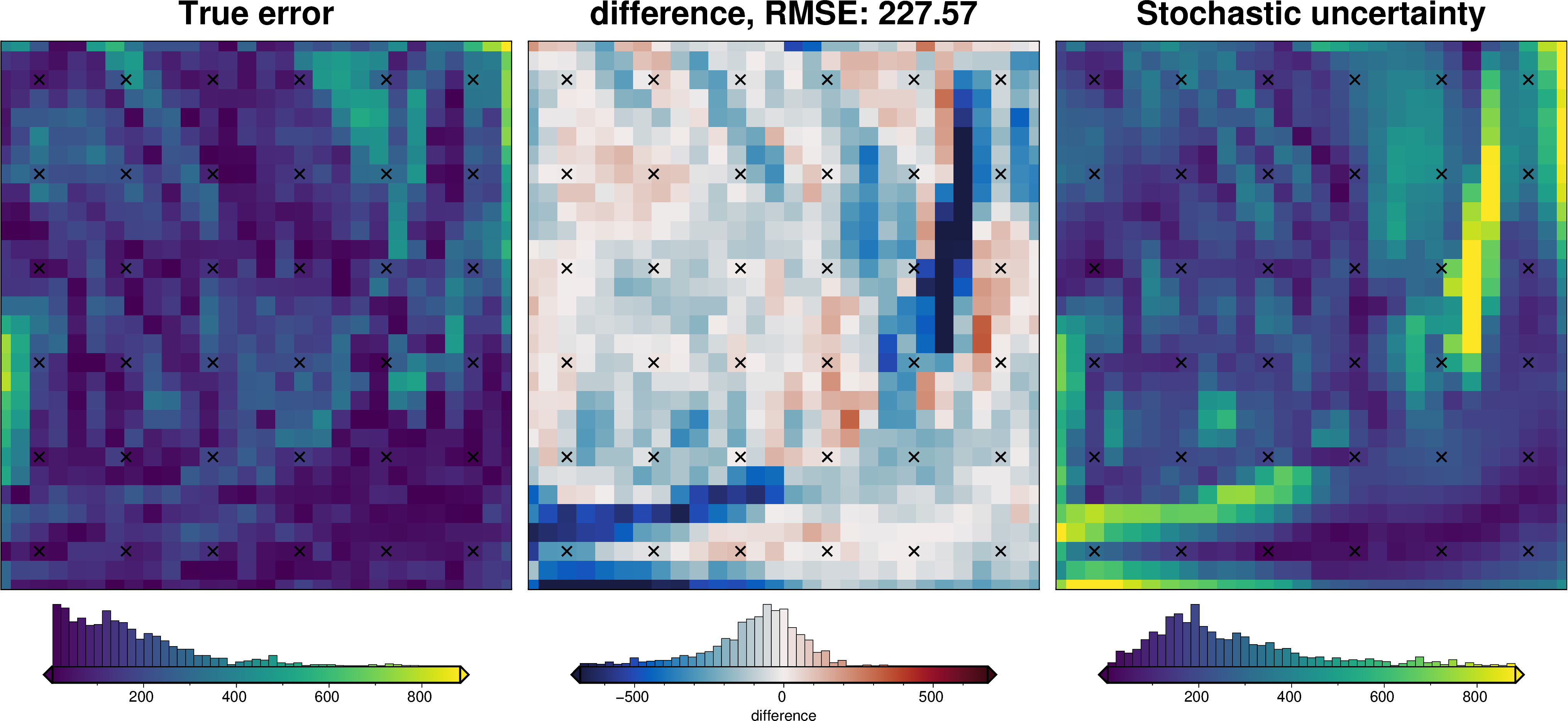
  * easting        (easting) float64 304B 6.9e+03 1.69e+04 ... 3.769e+05
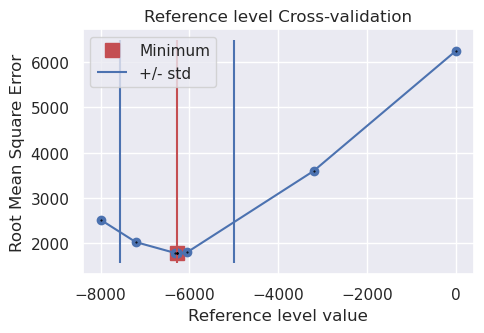
  * northing       (northing) float64 320B 1.459e+05 1.559e+05 ... 5.359e+05
Data variables:
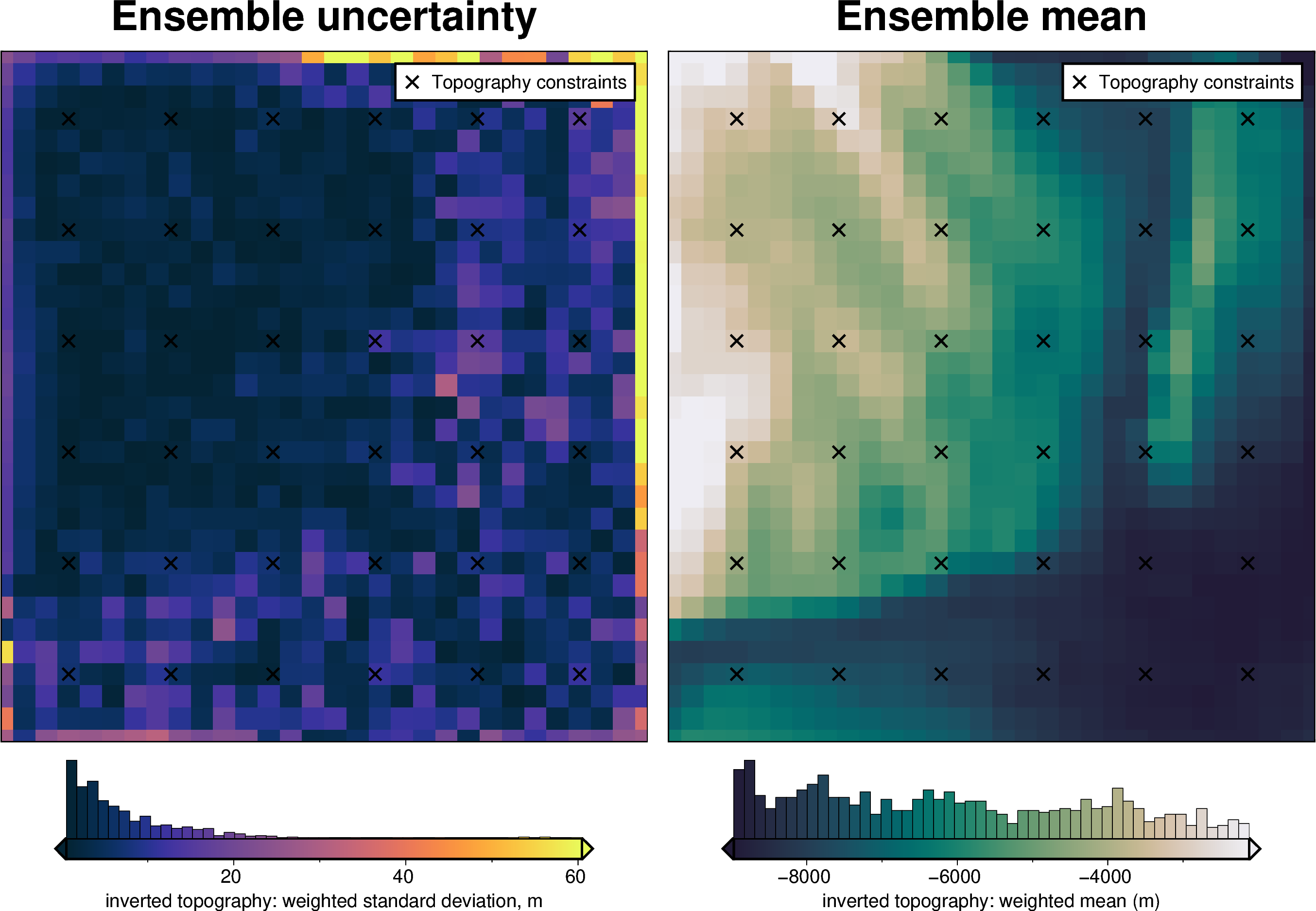
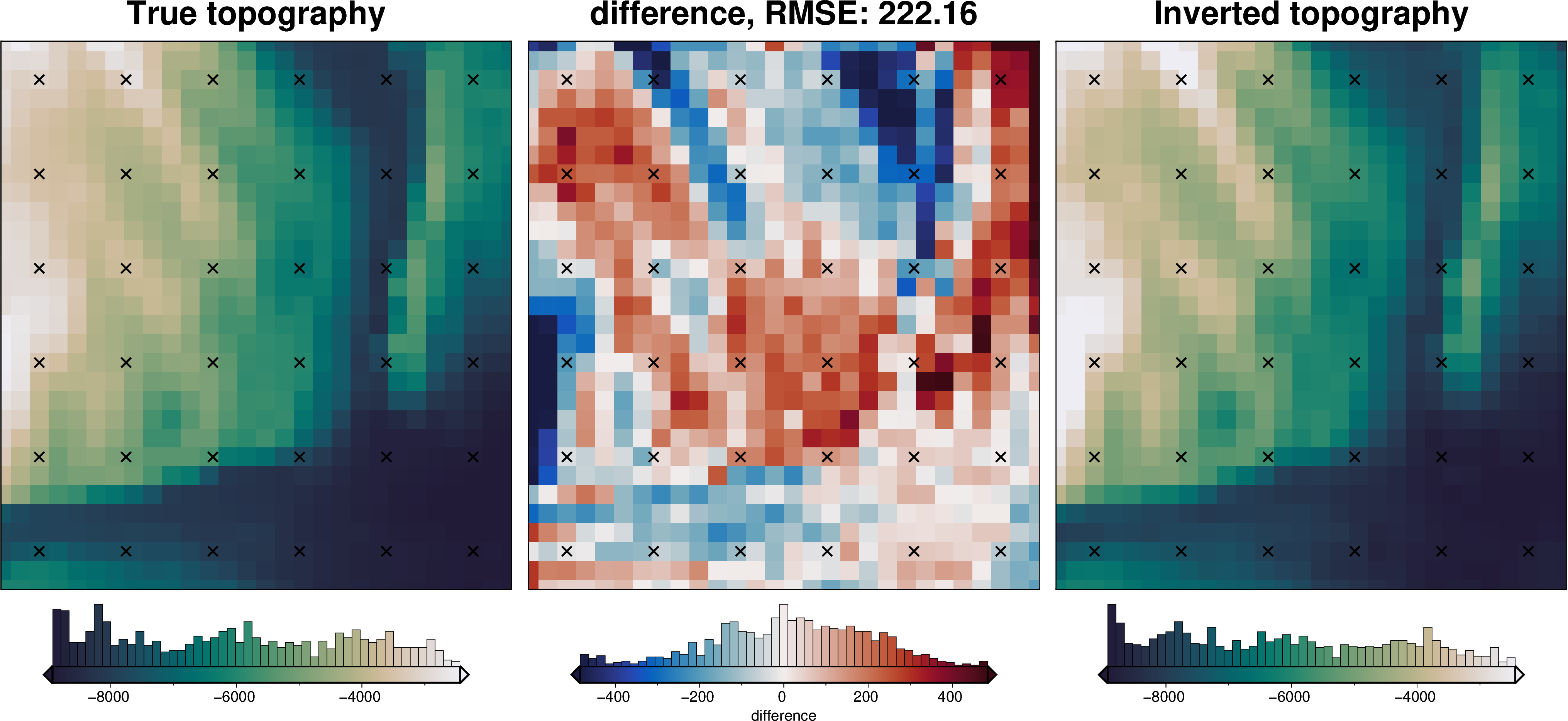
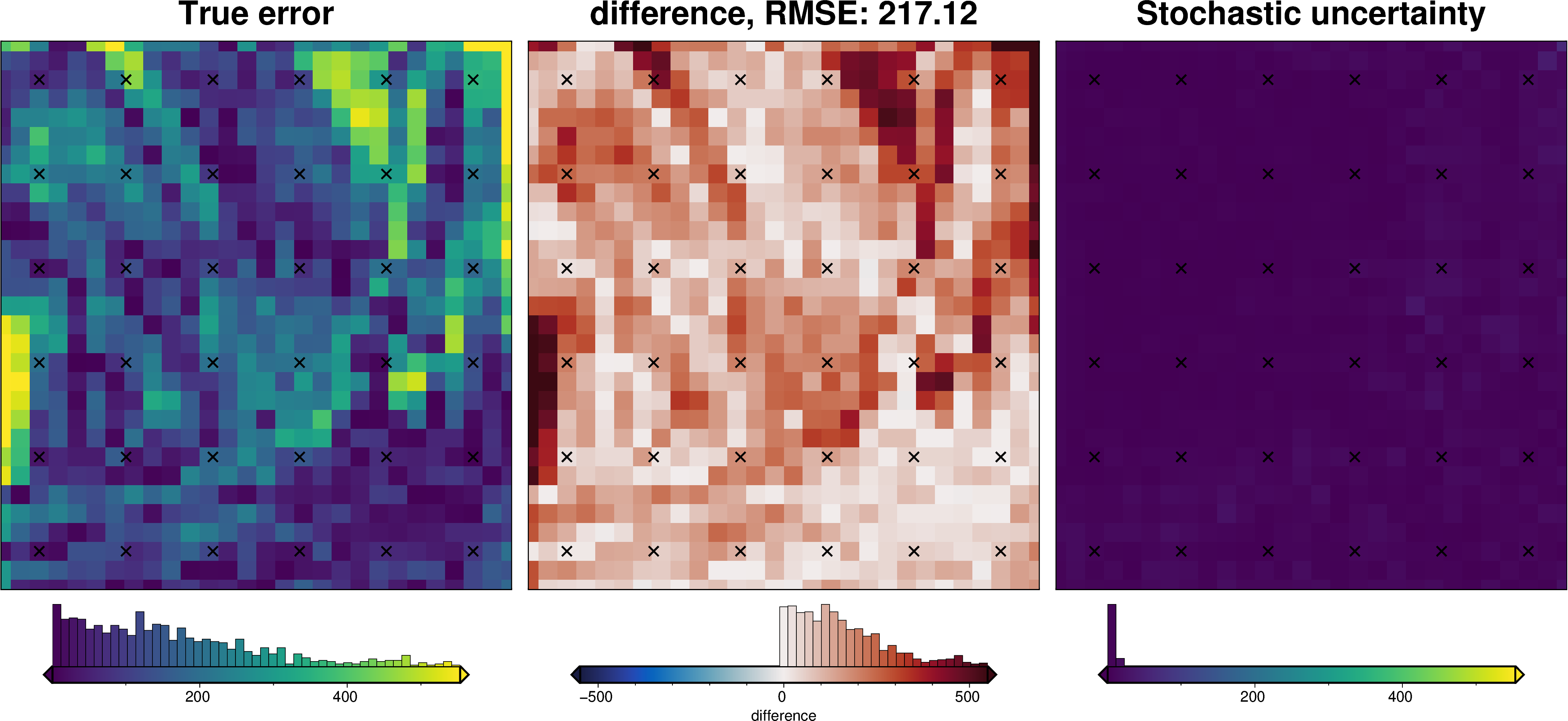
    basement_topo  (northing, easting) float64 12kB -6.199e+03 ... -8.133e+03
    moho_topo      (northing, easting) float64 12kB -2.767e+04 ... -2.548e+04
gravity (northing, easting) float64 12kB 99.08 99.3 ... 108.4 107.0Define model domain parameters#
To account for edge effects (decreasing gravity towards the edge of prism model), we will use a buffer region and a smaller inversion region so the prism model edge is further away from the inversion domain.
[3]:
grav_spacing = polar_utils.get_grid_info(grid.gravity)[0]
topo_spacing = polar_utils.get_grid_info(grid.basement_topo)[0]

buffer_region = vd.get_region(
    (grid.basement_topo.easting.values, grid.basement_topo.northing.values),
)
inversion_region = vd.pad_region(buffer_region, -topo_spacing * 4)

print(f"gravity spacing: {grav_spacing}m")
print(f"topography spacing: {topo_spacing}m")
gravity spacing: 10000.0m
topography spacing: 10000.0m
[4]:
fig = maps.plot_grd(
    grid.basement_topo,
    fig_height=10,
    title="True basement model",
    reverse_cpt=True,
    cmap="rain",
    cbar_label="m",
    hist=True,
    frame=["nSWe", "xaf10000", "yaf10000"],
    show_region=inversion_region,
)

fig = maps.plot_grd(
    grid.moho_topo,
    fig=fig,
    origin_shift="x",
    fig_height=10,
    title="True moho model",
    reverse_cpt=True,
    cmap="rain",
    cbar_label="m",
    hist=True,
    frame=["nSwE", "xaf10000", "yaf10000"],
    show_region=inversion_region,
)

fig = maps.plot_grd(
    grid.gravity,
    fig=fig,
    origin_shift="x",
    fig_height=10,
    title="Observed gravity",
    reverse_cpt=True,
    cmap="viridis",
    cbar_label="mGal",
    hist=True,
    frame=["nSwE", "xaf10000", "yaf10000"],
    show_region=inversion_region,
)

fig.show()
Observed gravity data#
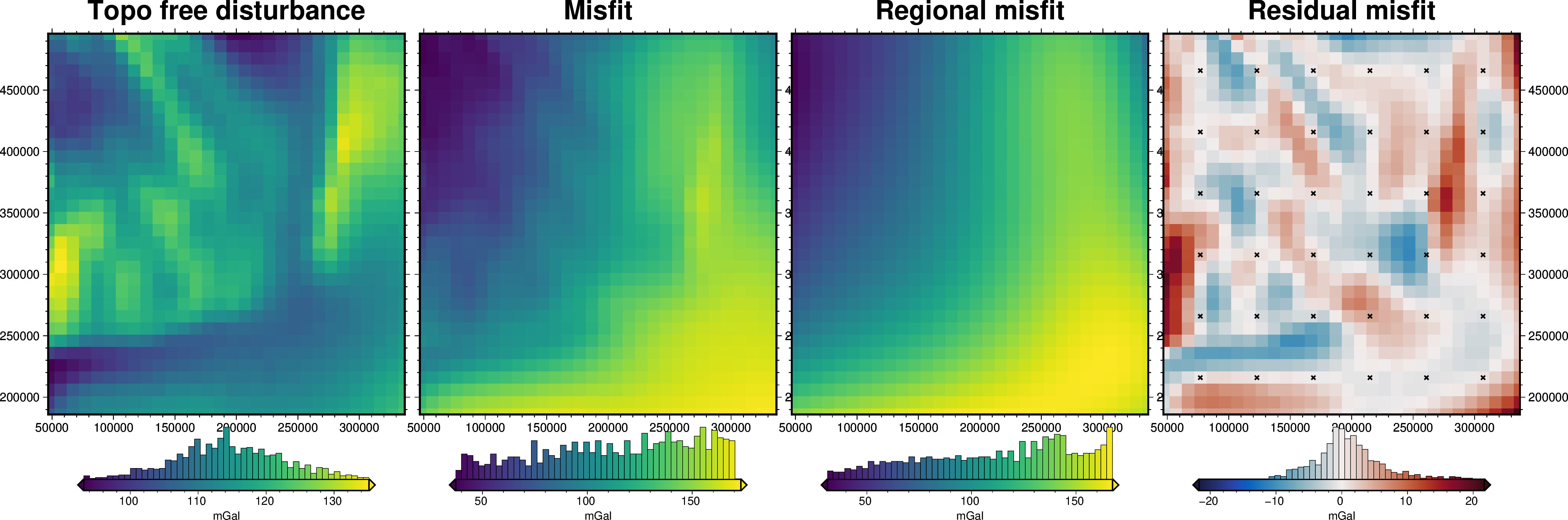
In this scenario, we are treating the area as having no surface topography (surface elevation is flat and equal to the ellipsoid). In this case, there is no terrain mass effect, and therefore the gravity disturbance is equal to the topo-free disturbance.
[5]:
# subset gravity to within inversion region
grav_grid = polar_utils.subset_grid(
    grid.gravity,
    region=inversion_region,
)
grav_df = grav_grid.rename("gravity_anomaly").to_dataframe().reset_index()

# contaminate gravity with 0.2 mGal of random noise
grav_df["gravity_anomaly"], stddev = synthetic.contaminate(
    grav_df.gravity_anomaly,
    stddev=0.2,
    percent=False,
    seed=0,
)
grav_df["uncert"] = stddev

grav_df["upward"] = 10
grav_df
INFO:invert4geom:Standard deviation used for noise: [0.2]
[5]:
| northing | easting | gravity_anomaly | uncert | upward | |
|---|---|---|---|---|---|
| 0 | 185900.0 | 46900.0 | 104.232718 | 0.2 | 10 |
| 1 | 185900.0 | 56900.0 | 107.751812 | 0.2 | 10 |
| 2 | 185900.0 | 66900.0 | 110.337820 | 0.2 | 10 |
| 3 | 185900.0 | 76900.0 | 111.850848 | 0.2 | 10 |
| 4 | 185900.0 | 86900.0 | 112.625426 | 0.2 | 10 |
| ... | ... | ... | ... | ... | ... |
| 955 | 495900.0 | 296900.0 | 123.107794 | 0.2 | 10 |
| 956 | 495900.0 | 306900.0 | 122.626074 | 0.2 | 10 |
| 957 | 495900.0 | 316900.0 | 121.444072 | 0.2 | 10 |
| 958 | 495900.0 | 326900.0 | 120.206503 | 0.2 | 10 |
| 959 | 495900.0 | 336900.0 | 119.462903 | 0.2 | 10 |
960 rows × 5 columns
Create “a-priori” basement measurements#
[6]:
# create grid of 36 points
coords = vd.grid_coordinates(
    region=vd.pad_region(inversion_region, -30e3),
    shape=(6, 6),
)
da = vd.make_xarray_grid(coords, data=np.ones_like(coords[0]), data_names="upward")
constraint_points = vd.grid_to_table(da).drop(columns=["upward"])

# sample true topography at these points
constraint_points = utils.sample_grids(
    constraint_points,
    grid.basement_topo,
    "true_upward",
)

constraint_points["upward"] = constraint_points.true_upward

# re-sample depths with uncertainty to emulate measurement errors
# set each points uncertainty equal to 2% of depth
uncert = np.abs(0.02 * constraint_points.upward)
constraint_points.loc[constraint_points.index, "true_uncert"] = uncert

constraint_points = uncertainty.randomly_sample_data(
    seed=0,
    data_df=constraint_points,
    data_col="upward",
    uncert_col="true_uncert",
)

# create weights column
constraint_points["weight"] = 1 / (constraint_points.true_uncert**2)

# create estimated uncertainty column
uncert = np.abs(0.02 * constraint_points.upward)
constraint_points.loc[constraint_points.index, "uncert"] = uncert

constraint_points.head()
[6]:
| northing | easting | true_upward | upward | true_uncert | weight | uncert | |
|---|---|---|---|---|---|---|---|
| 0 | 215900.0 | 76900.0 | -7238.309570 | -7220.108085 | 144.766191 | 0.000048 | 144.402162 |
| 1 | 215900.0 | 122900.0 | -7554.403734 | -7574.363204 | 151.088075 | 0.000044 | 151.487264 |
| 2 | 215900.0 | 168900.0 | -8016.960820 | -7914.275954 | 160.339216 | 0.000039 | 158.285519 |
| 3 | 215900.0 | 214900.0 | -8420.098477 | -8402.433090 | 168.401970 | 0.000035 | 168.048662 |
| 4 | 215900.0 | 260900.0 | -8748.003562 | -8841.724314 | 174.960071 | 0.000033 | 176.834486 |
Create starting basement model#
[7]:
# grid the sampled values using verde
starting_topography_kwargs = dict(
    method="splines",
    region=buffer_region,
    spacing=topo_spacing,
    constraints_df=constraint_points,
    # dampings=np.logspace(-40, 0, 200),
    dampings=None,
    # weights=constraint_points.weight,
)

starting_topography = utils.create_topography(
    **starting_topography_kwargs,
)
[8]:
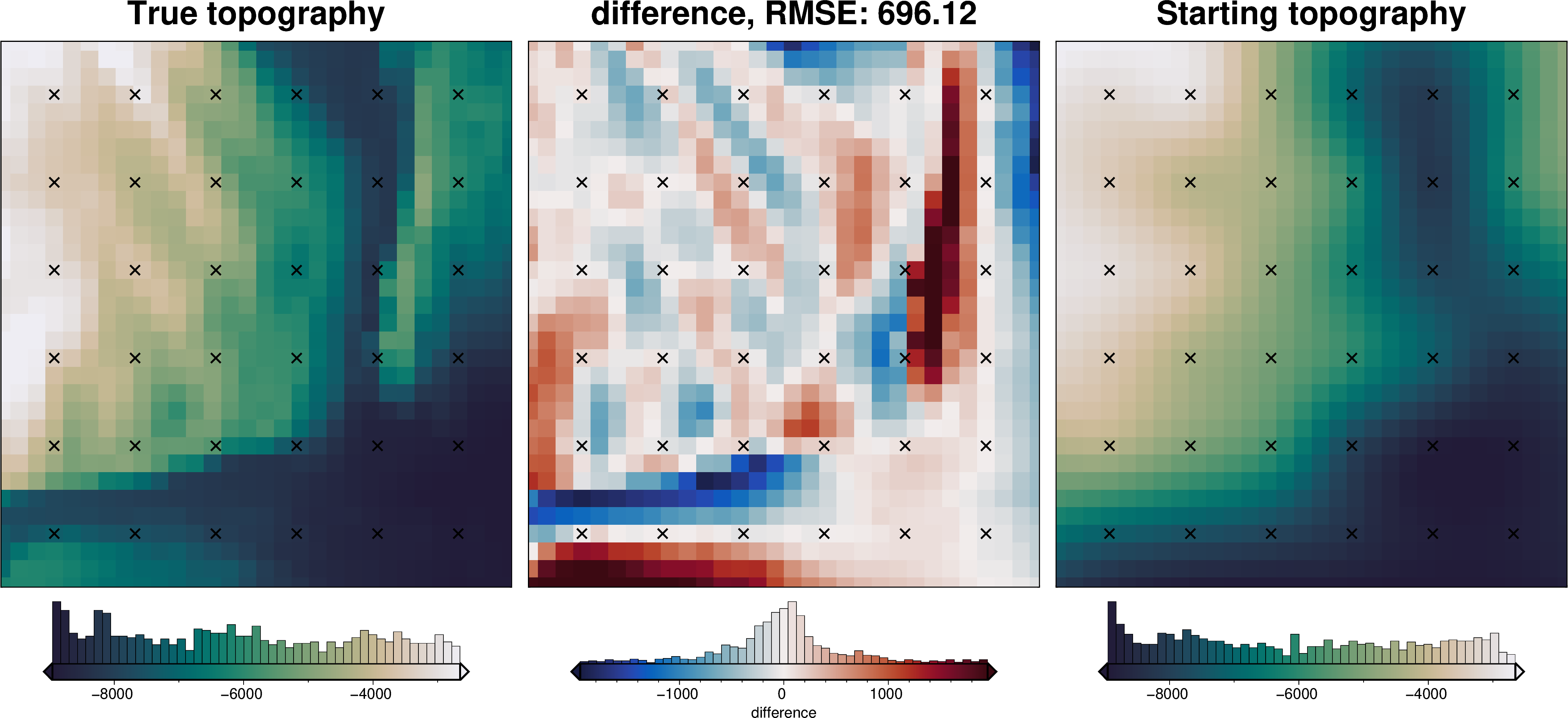
_ = polar_utils.grd_compare(
    grid.basement_topo,
    starting_topography,
    region=inversion_region,
    plot=True,
    grid1_name="True topography",
    grid2_name="Starting topography",
    robust=True,
    hist=True,
    inset=False,
    verbose="q",
    title="difference",
    grounding_line=False,
    reverse_cpt=True,
    cmap="rain",
    points=constraint_points,
    points_style="x.3c",
)
[9]:
# sample the inverted topography at the constraint points
constraint_points = utils.sample_grids(
    constraint_points,
    starting_topography,
    "starting_topography",
)

rmse = utils.rmse(constraint_points.true_upward - constraint_points.starting_topography)
print(f"RMSE: {rmse:.2f} m")
RMSE: 83.74 m
[10]:
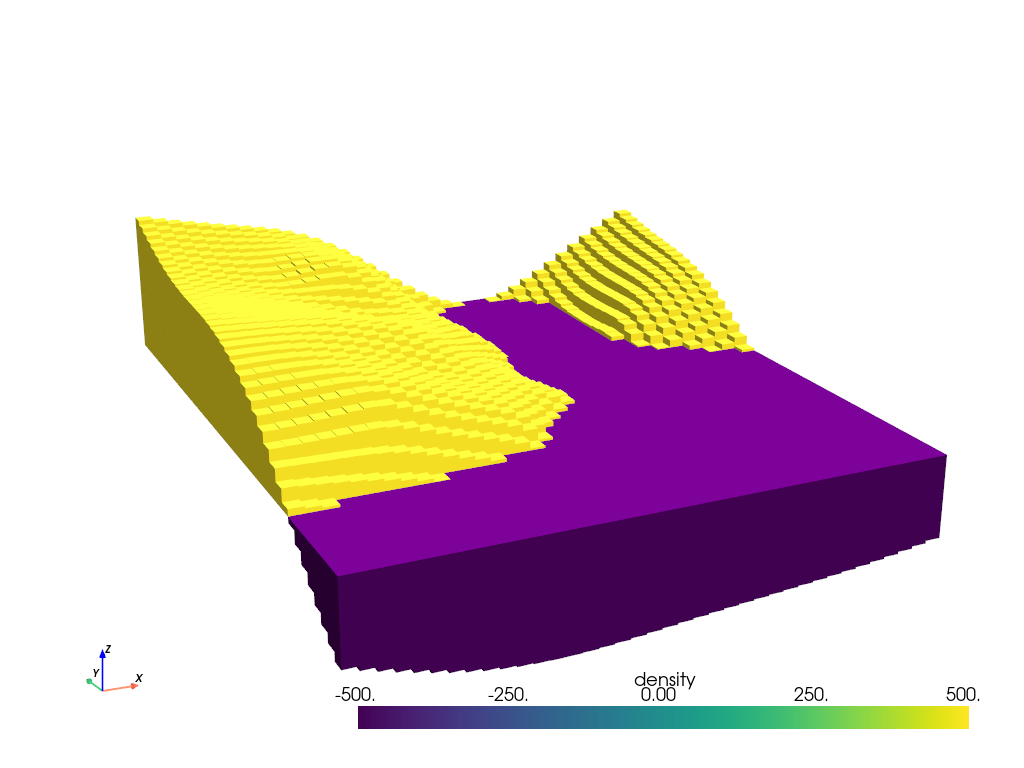
# pick a reference height for the basement
zref = constraint_points.upward.mean()

print(f"zref: {zref:.2f} m")

# pick a density contrast for the basement (crystalline basement - sedimentary rocks)
density_contrast = 2800 - 2300
print(f"density contrast: {density_contrast} kg/m^3")

density_grid = xr.where(
    starting_topography >= zref, density_contrast, -density_contrast
)

# create layer of prisms
starting_prisms = utils.grids_to_prisms(
    starting_topography,
    zref,
    density=density_grid,
)

plotting.show_prism_layers(
    starting_prisms,
    color_by="density",
    log_scale=False,
    zscale=20,
    backend="static",
)
zref: -6154.32 m
density contrast: 500 kg/m^3
MESA: error: ZINK: failed to choose pdev
glx: failed to create drisw screen
Gravity misfit#
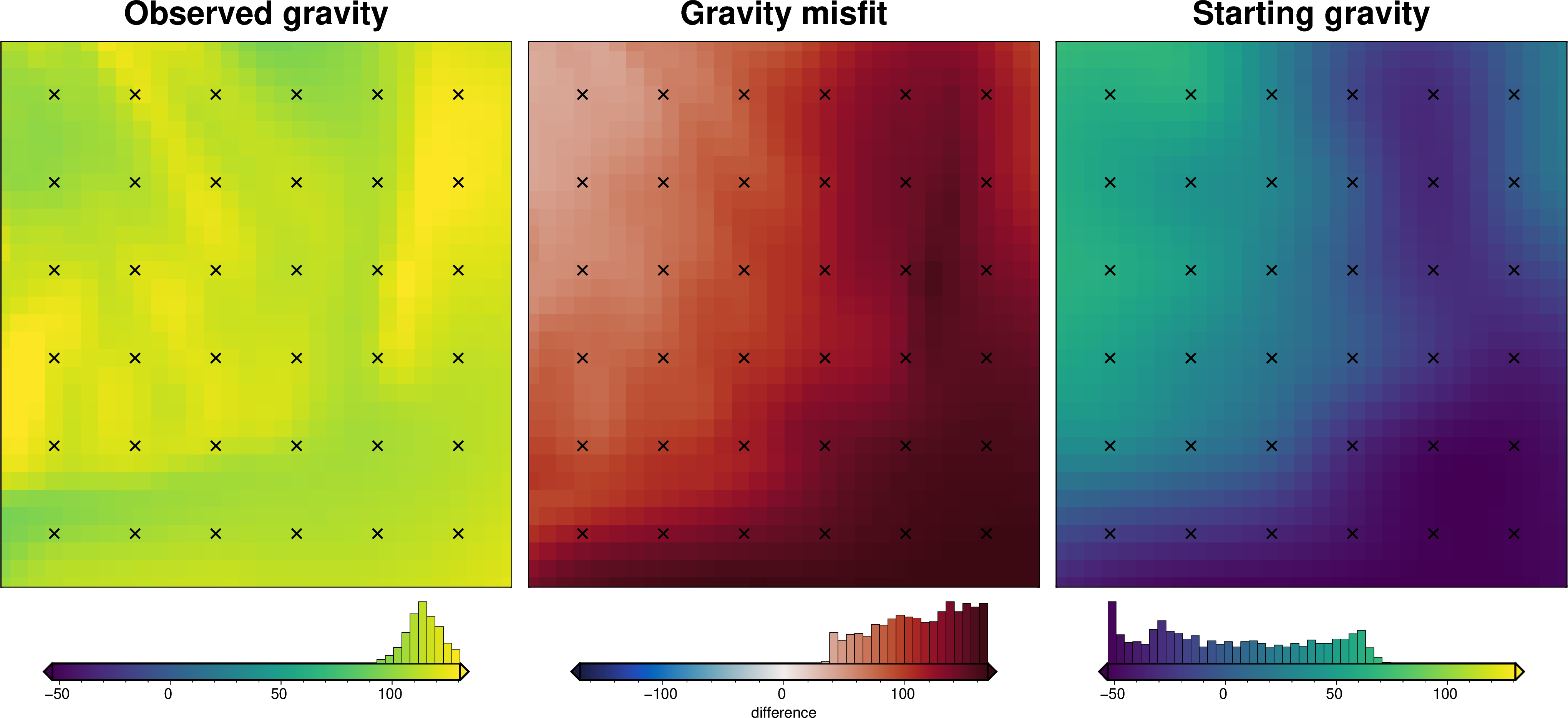
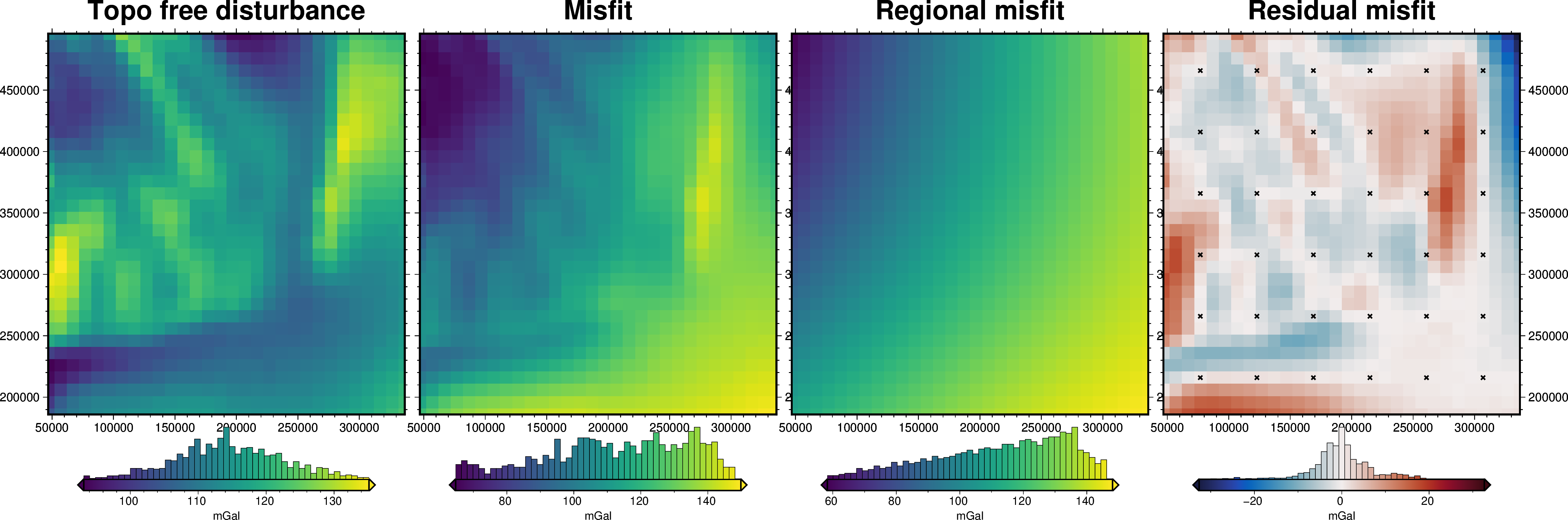
All inversions in Invert4Geom are based on a gravity misfit, not a gravity anomaly. This means before the inversion, we must create a starting prism model, forward model it’s gravity effect, remove it from the gravity anomaly, and get a gravity misfit.
However, if we know nothing about the starting model, it can simply be a flat layer of zero thickness, as we will use here. In this case, the forward gravity would just be zero so there is no need to perform the forward modelling. The misfit is therefore just equal to the topo-free disturbance.
[11]:
# calculate forward gravity of starting prism layer
grav_df["starting_gravity"] = starting_prisms.prism_layer.gravity(
    coordinates=(
        grav_df.easting,
        grav_df.northing,
        grav_df.upward,
    ),
    field="g_z",
    progressbar=True,
)
grav_df.describe()
[11]:
| northing | easting | gravity_anomaly | uncert | upward | starting_gravity | |
|---|---|---|---|---|---|---|
| count | 960.00000 | 960.000000 | 960.000000 | 9.600000e+02 | 960.0 | 960.000000 |
| mean | 340900.00000 | 191900.000000 | 114.520059 | 2.000000e-01 | 10.0 | 0.582511 |
| std | 92379.05319 | 86599.530158 | 7.763839 | 2.777004e-17 | 0.0 | 37.603658 |
| min | 185900.00000 | 46900.000000 | 93.175769 | 2.000000e-01 | 10.0 | -54.212925 |
| 25% | 263400.00000 | 116900.000000 | 109.350741 | 2.000000e-01 | 10.0 | -31.235270 |
| 50% | 340900.00000 | 191900.000000 | 114.195820 | 2.000000e-01 | 10.0 | -3.993163 |
| 75% | 418400.00000 | 266900.000000 | 119.704207 | 2.000000e-01 | 10.0 | 34.417141 |
| max | 495900.00000 | 336900.000000 | 135.144510 | 2.000000e-01 | 10.0 | 70.702624 |
[12]:
# grid the results
grav_grid = grav_df.set_index(["northing", "easting"]).to_xarray()

_ = polar_utils.grd_compare(
    grav_grid.gravity_anomaly,
    grav_grid.starting_gravity,
    plot=True,
    grid1_name="Observed gravity",
    grid2_name="Starting gravity",
    robust=True,
    hist=True,
    inset=False,
    verbose="q",
    title="Gravity misfit",
    rmse_in_title=False,
    grounding_line=False,
    points=constraint_points,
    points_style="x.3c",
)
Regional estimation - constraint point minimization#
[13]:
# use the constraints to find the best regional field
regional_grav_kwargs = dict(
    method="constraints",
    grid_method="eq_sources",
    constraints_df=constraint_points,
    # constraints_weights_column="weight",
    cv=True,
    cv_kwargs=dict(
        n_trials=50,
        damping_limits=(1e-60, 10),
        depth_limits=(100, 1000e3),
        progressbar=False,
        fname="../tmp/regional_sep",
    ),
    # damping=None,
    # depth="default",
    block_size=None,
)

grav_df = regional.regional_separation(
    grav_df=grav_df,
    **regional_grav_kwargs,
)
grav_df.describe()
INFO:invert4geom:using 12 startup trials
INFO:invert4geom:Trial with best score:
INFO:invert4geom:       trial number: 46
INFO:invert4geom:       parameter: {'depth': 586916.1852606771, 'damping': 1.0742729213119551e-10}
INFO:invert4geom:       scores: [0.981924839768461]
[13]:
| northing | easting | gravity_anomaly | uncert | upward | starting_gravity | misfit | reg | res | |
|---|---|---|---|---|---|---|---|---|---|
| count | 960.00000 | 960.000000 | 960.000000 | 9.600000e+02 | 960.0 | 960.000000 | 960.000000 | 960.000000 | 960.000000 |
| mean | 340900.00000 | 191900.000000 | 114.520059 | 2.000000e-01 | 10.0 | 0.582511 | 113.937548 | 112.966558 | 0.970990 |
| std | 92379.05319 | 86599.530158 | 7.763839 | 2.777004e-17 | 0.0 | 37.603658 | 36.916181 | 36.583623 | 5.004875 |
| min | 185900.00000 | 46900.000000 | 93.175769 | 2.000000e-01 | 10.0 | -54.212925 | 37.206869 | 31.156951 | -10.990669 |
| 25% | 263400.00000 | 116900.000000 | 109.350741 | 2.000000e-01 | 10.0 | -31.235270 | 85.587530 | 83.464543 | -1.921848 |
| 50% | 340900.00000 | 191900.000000 | 114.195820 | 2.000000e-01 | 10.0 | -3.993163 | 118.326304 | 119.082364 | 0.489184 |
| 75% | 418400.00000 | 266900.000000 | 119.704207 | 2.000000e-01 | 10.0 | 34.417141 | 145.546220 | 142.563379 | 3.272255 |
| max | 495900.00000 | 336900.000000 | 135.144510 | 2.000000e-01 | 10.0 | 70.702624 | 173.155318 | 167.445540 | 21.684650 |
[14]:
grav_grid = grav_df.set_index(["northing", "easting"]).to_xarray()

fig = maps.plot_grd(
    grav_grid.gravity_anomaly,
    region=inversion_region,
    fig_height=10,
    title="Topo free disturbance",
    cmap="viridis",
    hist=True,
    cbar_label="mGal",
    frame=["nSWe", "xaf10000", "yaf10000"],
)

fig = maps.plot_grd(
    grav_grid.misfit,
    region=inversion_region,
    fig=fig,
    origin_shift="x",
    fig_height=10,
    title="Misfit",
    cmap="viridis",
    hist=True,
    cbar_label="mGal",
    frame=["nSwE", "xaf10000", "yaf10000"],
)

fig = maps.plot_grd(
    grav_grid.reg,
    region=inversion_region,
    fig=fig,
    origin_shift="x",
    fig_height=10,
    title="Regional misfit",
    cmap="viridis",
    hist=True,
    cbar_label="mGal",
    frame=["nSwE", "xaf10000", "yaf10000"],
)

fig = maps.plot_grd(
    grav_grid.res,
    region=inversion_region,
    fig=fig,
    origin_shift="x",
    fig_height=10,
    title="Residual misfit",
    cmap="balance+h0",
    cpt_lims=[-vd.maxabs(grav_grid.res), vd.maxabs(grav_grid.res)],
    hist=True,
    cbar_label="mGal",
    frame=["nSwE", "xaf10000", "yaf10000"],
    points=constraint_points,
    points_style="x.15c",
)
fig.show()
Single inversion#
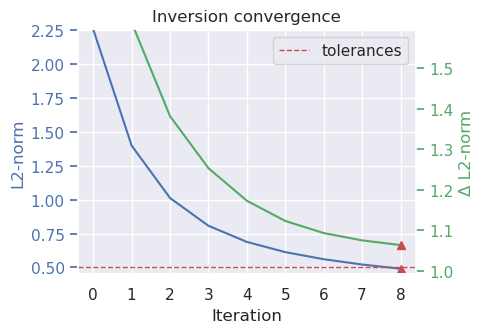
Perform a single inversion to experiment with values of stopping criteria.
[15]:
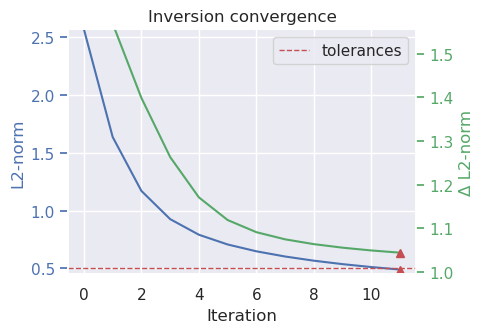
# set kwargs to pass to the inversion
kwargs = {
    # set stopping criteria
    "max_iterations": 200,
    "l2_norm_tolerance": 0.5,
    "delta_l2_norm_tolerance": 1.008,
}

# run the inversion workflow, including a cross validation for the damping parameter
inversion_results = inversion.run_inversion_workflow(
    grav_df=grav_df,
    solver_damping=0.01,
    fname="../tmp/bishop_model",
    starting_prisms=starting_prisms,
    plot_dynamic_convergence=True,
    **kwargs,
)
[16]:
# collect the results
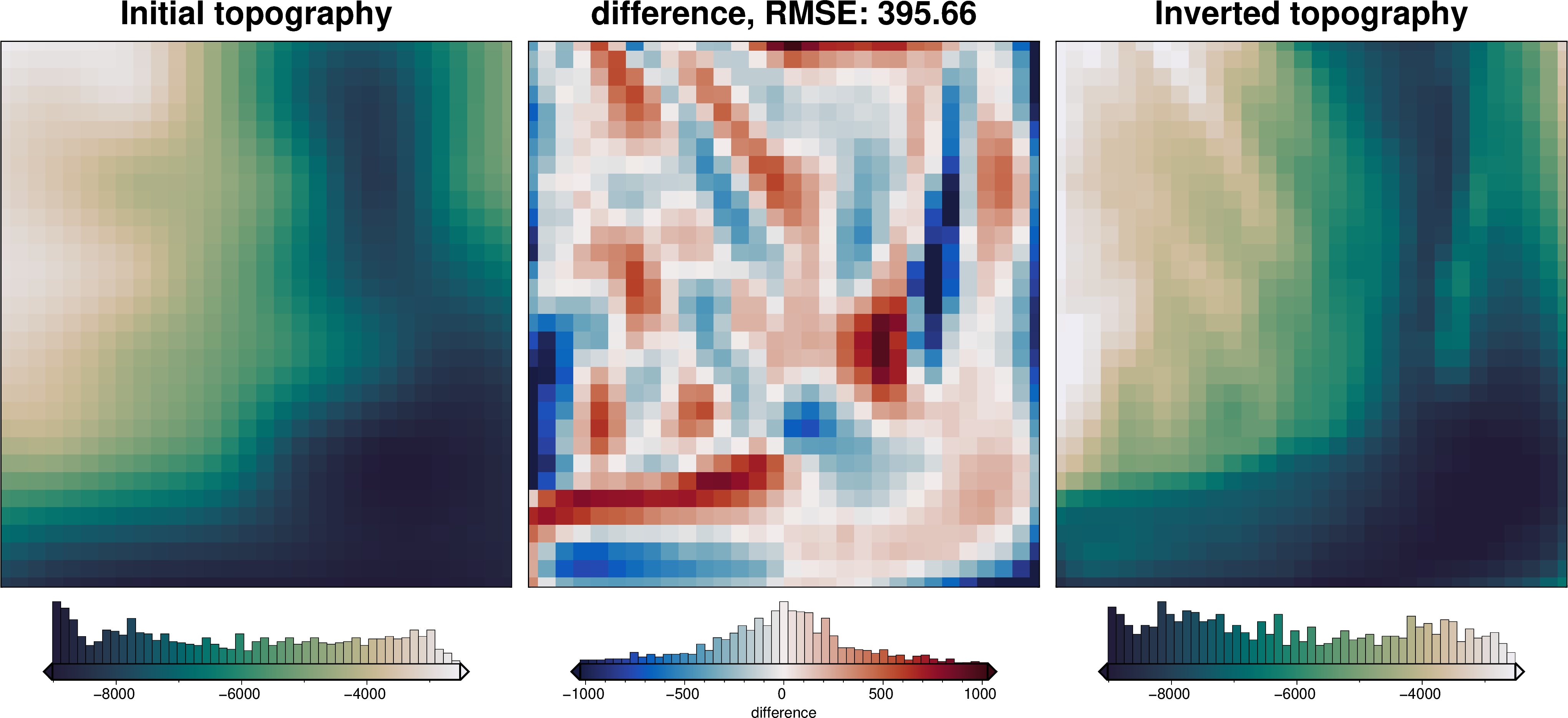
topo_results, grav_results, parameters, elapsed_time = inversion_results

plotting.plot_inversion_results(
    grav_results,
    topo_results,
    parameters,
    inversion_region,
    iters_to_plot=2,
    plot_iter_results=True,
    plot_topo_results=True,
    plot_grav_results=True,
)

final_topography = topo_results.set_index(["northing", "easting"]).to_xarray().topo

_ = polar_utils.grd_compare(
    grid.basement_topo,
    final_topography,
    plot=True,
    region=inversion_region,
    grid1_name="True topography",
    grid2_name="Inverted topography",
    robust=True,
    hist=True,
    inset=False,
    verbose="q",
    title="difference",
    grounding_line=False,
    reverse_cpt=True,
    cmap="rain",
    points=constraint_points,
    points_style="x.3c",
)
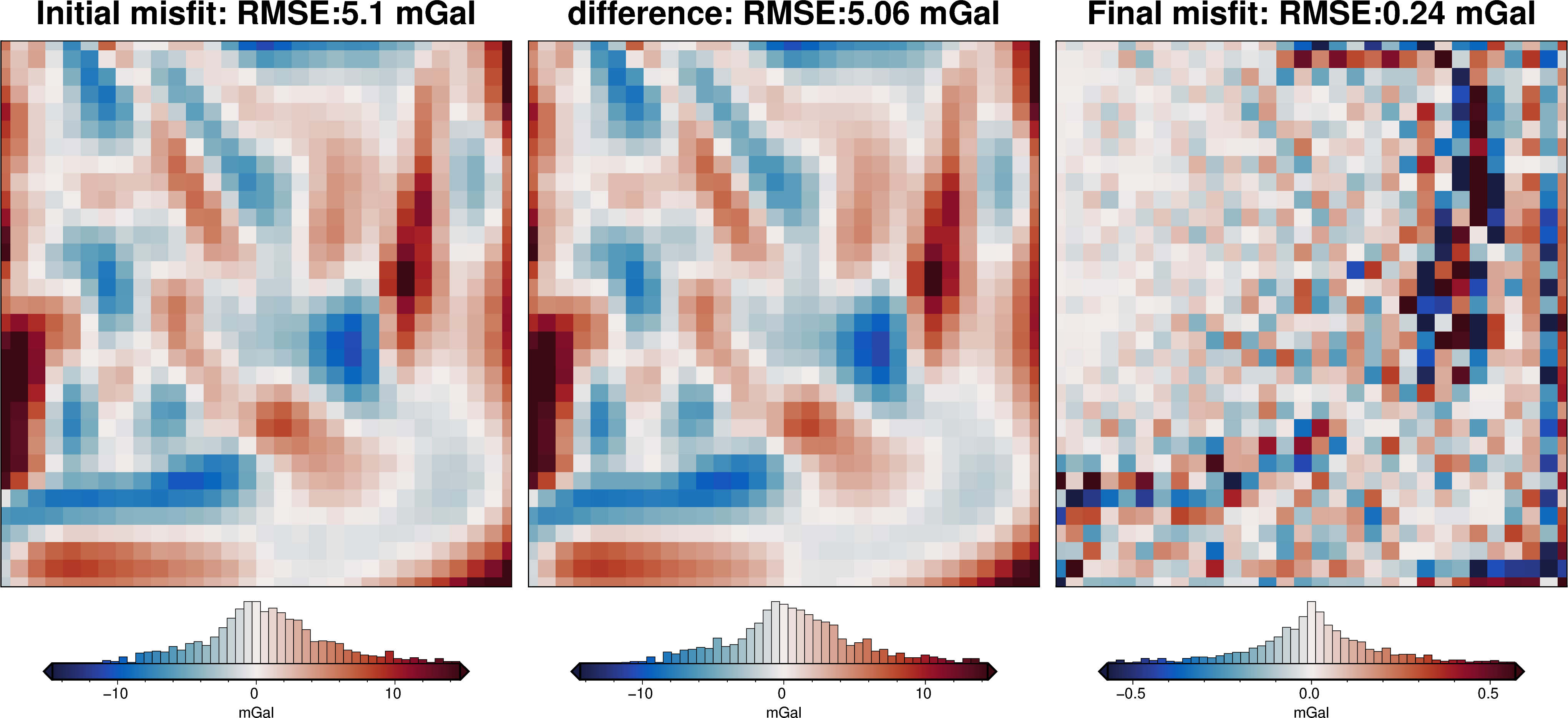
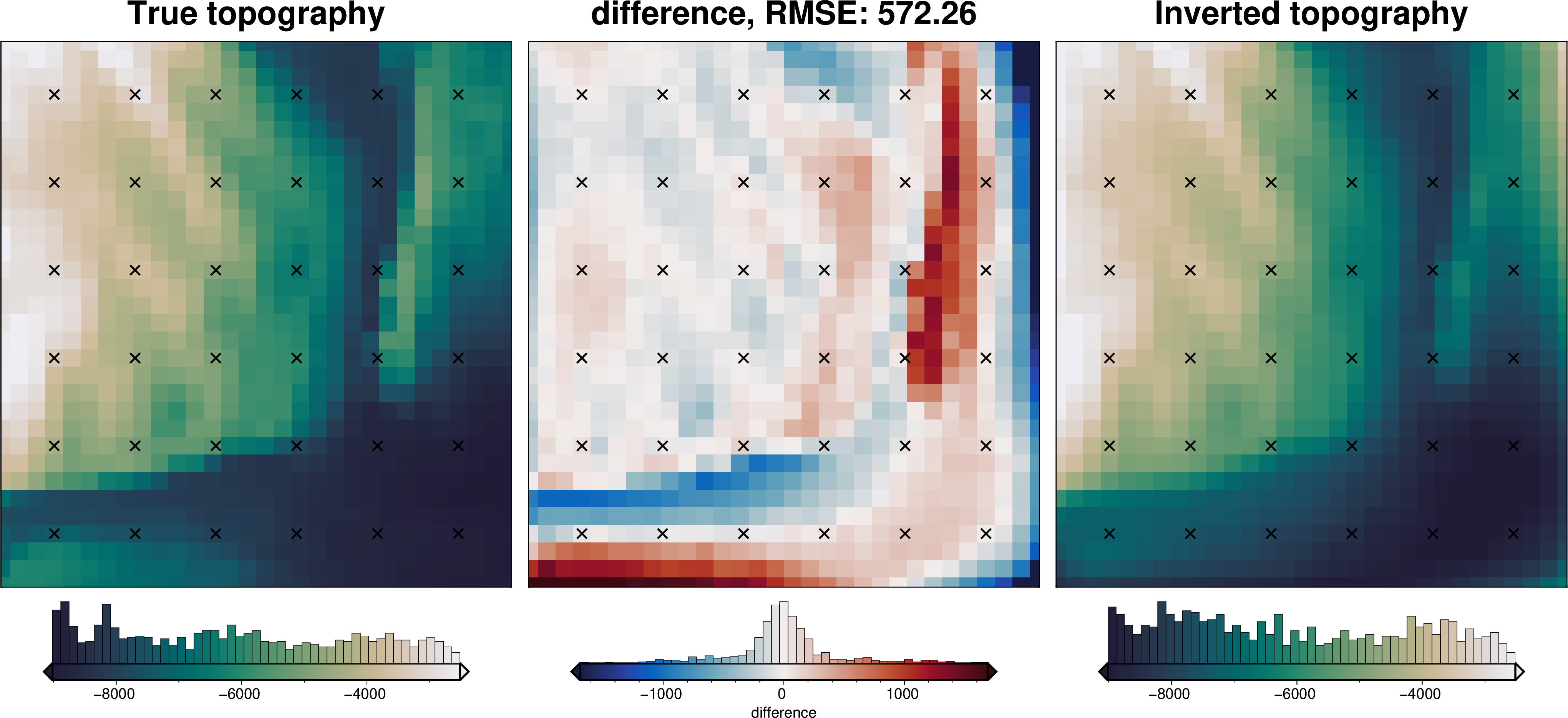
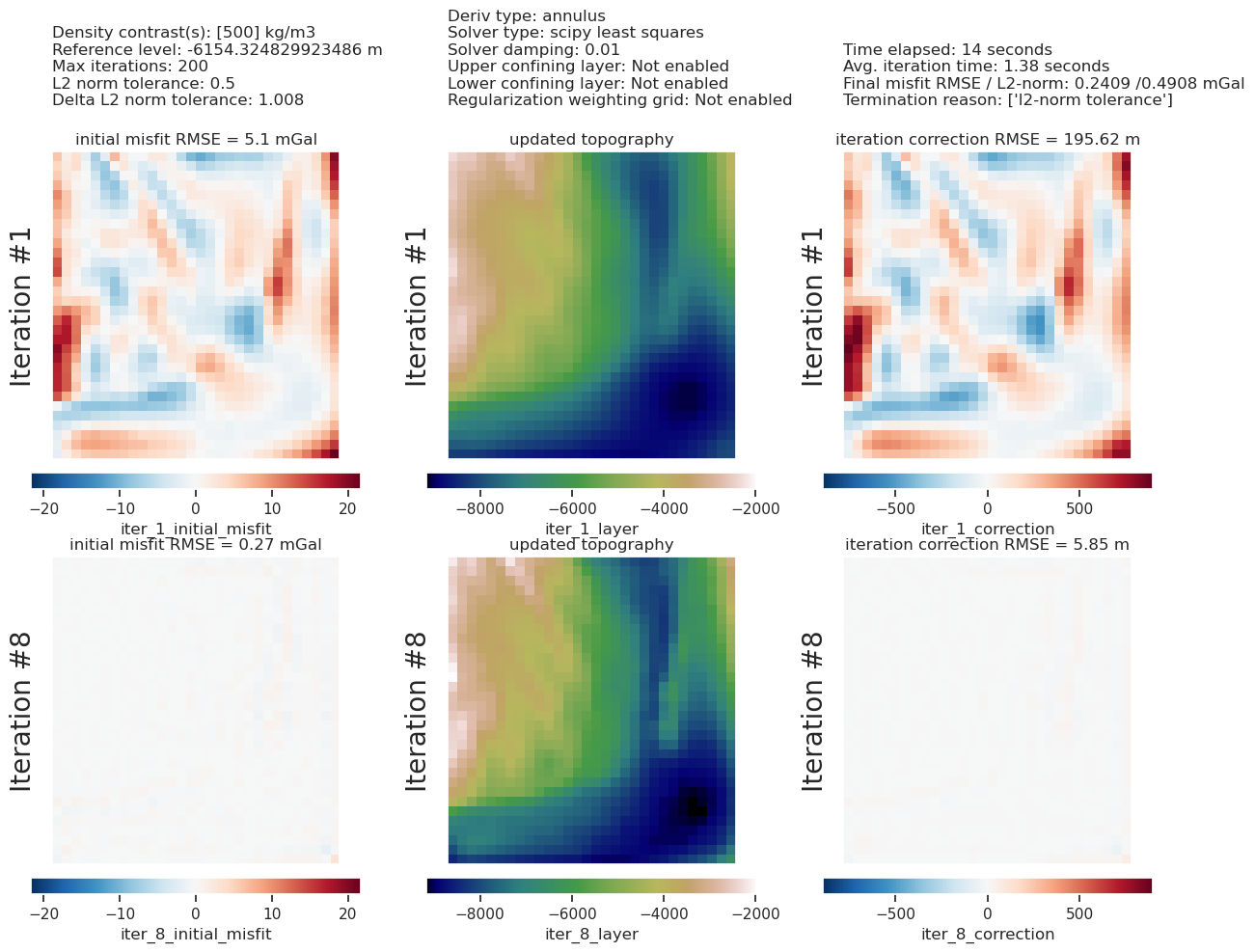
Damping parameter cross validation#
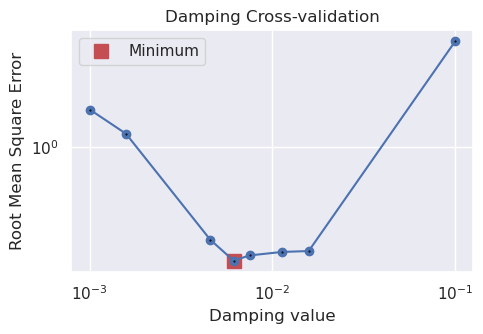
[17]:
# run the inversion workflow, including a cross validation for the damping parameter
inversion_results = inversion.run_inversion_workflow(
    grav_df=grav_df,
    run_damping_cv=True,
    damping_limits=(0.001, 0.1),
    damping_cv_trials=8,
    plot_cv=True,
    fname="../tmp/bishop_model",
    starting_prisms=starting_prisms,
    # score_as_median=True,
    # for creating test/train splits
    grav_spacing=grav_spacing,
    inversion_region=inversion_region,
    **kwargs,
)
INFO:invert4geom:saving all results with root name '../tmp/bishop_model'
INFO:invert4geom:running damping cross validation
INFO:invert4geom:using 4 startup trials
INFO:invert4geom:Trial with best score:
INFO:invert4geom:       trial number: 7
INFO:invert4geom:       parameter: {'damping': 0.006122657668776113}
INFO:invert4geom:       scores: [0.19593615529307418]
INFO:invert4geom:results saved to ../tmp/bishop_model_results.pickle.pickle
[18]:
# to re-load the study from the saved pickle file
with pathlib.Path("../tmp/bishop_model_damping_cv_study.pickle").open("rb") as f:
    study = pickle.load(f)

# to re-load the inversion results from the saved pickle file
with pathlib.Path("../tmp/bishop_model_damping_cv_results.pickle").open("rb") as f:
    inversion_results = pickle.load(f)
[19]:
best_damping = study.best_params.get("damping")

# add best damping parameter to kwargs
kwargs["solver_damping"] = best_damping

best_damping
[19]:
0.006122657668776113
[20]:
# collect the results
topo_results, grav_results, parameters, elapsed_time = inversion_results

plotting.plot_convergence(
    grav_results,
    parameters,
)

plotting.plot_inversion_results(
    grav_results,
    topo_results,
    parameters,
    inversion_region,
    iters_to_plot=2,
    plot_iter_results=True,
    plot_topo_results=False,
    plot_grav_results=False,
)

final_topography = topo_results.set_index(["northing", "easting"]).to_xarray().topo

_ = polar_utils.grd_compare(
    grid.basement_topo,
    final_topography,
    plot=True,
    region=inversion_region,
    grid1_name="True topography",
    grid2_name="Inverted topography",
    robust=True,
    hist=True,
    inset=False,
    verbose="q",
    title="difference",
    grounding_line=False,
    reverse_cpt=True,
    cmap="rain",
    points=constraint_points,
    points_style="x.3c",
)
[21]:
# sample the inverted topography at the constraint points
constraint_points = utils.sample_grids(
    constraint_points,
    final_topography,
    "inverted_topography",
)

rmse = utils.rmse(constraint_points.true_upward - constraint_points.inverted_topography)
print(f"RMSE: {rmse:.2f} m")
RMSE: 141.24 m
Density contrast / Zref cross validation#
Since this cross validation uses the inversion error at constraint points, we can’t use the constraint point minimization technique to estimate the regional field since that inherently sets the inversion error at constraints to zero, invalidating the cross validation scores.
There are two options for how to get around this issue:
use a different regional estimation technique while finding the optimal density contrast value, then use the found optimal values with the constraint point minimization regional estimation technique afterwards.
separate the constraints into testing and training sets, so that only the training set is used during the regional separation, and only the testing set is used for scoring the density contrast cross validation.
Well just use the 1st option below.
Use alternative regional estimation method#
We will use the equivalent sources technique to estimate the regional field, and then perform a cross-validation for the density contrast and reference level values. During this CV, we will use the optimal damping parameter value found above. Once we have found the optimal zref and density contrast values, we will need to use then in a separate inversion which had the regional field estimated with the better constraint point minimization technique.
Density CV#
[22]:
# run the cross validation for density
study, inversion_results = optimization.optimize_inversion_zref_density_contrast(
    grav_df=grav_df,
    constraints_df=constraint_points,
    density_contrast_limits=(100, 600),
    zref=constraint_points.upward.mean(),
    n_trials=10,
    # grid_search=True,
    starting_topography=starting_topography,
    regional_grav_kwargs=dict(
        method="constant",
        # constraints_df=constraint_points,
        constant=grav_df.reg.mean(),
    ),
    # grid_search=True,
    fname="../tmp/bishop_model_density_cv",
    # score_as_median=True,
    **kwargs,
)
INFO:invert4geom:using 4 startup trials
INFO:invert4geom:Trial with best score:
INFO:invert4geom:       trial number: 8
INFO:invert4geom:       parameter: {'density_contrast': 281}
INFO:invert4geom:       scores: [1779.0311244711095]
WARNING:invert4geom:'starting_gravity' already a column of `grav_df`, but is being overwritten since calculate_starting_gravity is True
WARNING:invert4geom:'reg' already a column of `grav_df`, but is being overwritten since calculate_regional_misfit is True
[23]:
# to re-load the study from the saved pickle file
with pathlib.Path("../tmp/bishop_model_density_cv_study.pickle").open("rb") as f:
    study = pickle.load(f)
[24]:
best_density_contrast = study.best_params.get("density_contrast", None)
best_density_contrast
[24]:
281
Zref CV#
[25]:
# run the cross validation for the zref
study, inversion_results = optimization.optimize_inversion_zref_density_contrast(
    grav_df=grav_df,
    constraints_df=constraint_points,
    zref_limits=(-8e3, 0),
    density_contrast=best_density_contrast,
    n_trials=10,
    # grid_search=True,
    starting_topography=starting_topography,
    regional_grav_kwargs=dict(
        method="constant",
        constant=grav_df.reg.mean(),
        # constraints_df=constraint_points,
    ),
    fname="../tmp/bishop_model_zref_cv",
    # score_as_median=True,
    **kwargs,
)
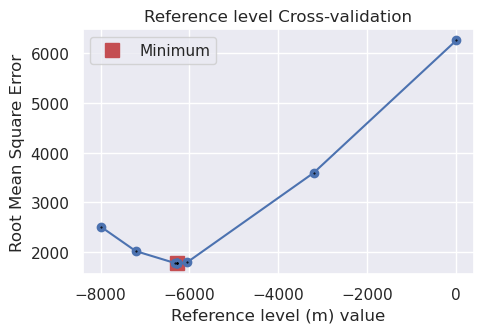
INFO:invert4geom:using 4 startup trials
INFO:invert4geom:Trial with best score:
INFO:invert4geom:       trial number: 9
INFO:invert4geom:       parameter: {'zref': -6282.867295306448}
INFO:invert4geom:       scores: [1774.926646810738]
WARNING:invert4geom:'starting_gravity' already a column of `grav_df`, but is being overwritten since calculate_starting_gravity is True
WARNING:invert4geom:'reg' already a column of `grav_df`, but is being overwritten since calculate_regional_misfit is True
[26]:
# to re-load the study from the saved pickle file
with pathlib.Path("../tmp/bishop_model_zref_cv_study.pickle").open("rb") as f:
    study = pickle.load(f)
[27]:
best_zref = study.best_params.get("zref", None)
best_zref
[27]:
-6282.867295306448
Redo with optimal parameters#
[28]:
zref = best_zref
density_contrast = best_density_contrast

density_grid = xr.where(
    starting_topography >= zref,
    density_contrast,
    -density_contrast,
)
# create layer of prisms
starting_prisms = utils.grids_to_prisms(
    starting_topography,
    zref,
    density=density_grid,
)
grav_df["starting_gravity"] = starting_prisms.prism_layer.gravity(
    coordinates=(
        grav_df.easting,
        grav_df.northing,
        grav_df.upward,
    ),
    field="g_z",
    progressbar=True,
)

grav_df = regional.regional_separation(
    grav_df=grav_df,
    **regional_grav_kwargs,
)
INFO:invert4geom:using 12 startup trials
INFO:invert4geom:Trial with best score:
INFO:invert4geom:       trial number: 9
INFO:invert4geom:       parameter: {'depth': 974124.3677063867, 'damping': 0.0032431101190705755}
INFO:invert4geom:       scores: [0.9742320381477609]
[29]:
grav_grid = grav_df.set_index(["northing", "easting"]).to_xarray()

fig = maps.plot_grd(
    grav_grid.gravity_anomaly,
    region=inversion_region,
    fig_height=10,
    title="Topo free disturbance",
    cmap="viridis",
    hist=True,
    cbar_label="mGal",
    frame=["nSWe", "xaf10000", "yaf10000"],
)

fig = maps.plot_grd(
    grav_grid.misfit,
    region=inversion_region,
    fig=fig,
    origin_shift="x",
    fig_height=10,
    title="Misfit",
    cmap="viridis",
    hist=True,
    cbar_label="mGal",
    frame=["nSwE", "xaf10000", "yaf10000"],
)

fig = maps.plot_grd(
    grav_grid.reg,
    region=inversion_region,
    fig=fig,
    origin_shift="x",
    fig_height=10,
    title="Regional misfit",
    cmap="viridis",
    hist=True,
    cbar_label="mGal",
    frame=["nSwE", "xaf10000", "yaf10000"],
)

fig = maps.plot_grd(
    grav_grid.res,
    region=inversion_region,
    fig=fig,
    origin_shift="x",
    fig_height=10,
    title="Residual misfit",
    cmap="balance+h0",
    cpt_lims=[-vd.maxabs(grav_grid.res), vd.maxabs(grav_grid.res)],
    hist=True,
    cbar_label="mGal",
    frame=["nSwE", "xaf10000", "yaf10000"],
    points=constraint_points,
    points_style="x.15c",
)
fig.show()
[30]:
# re-load the study from the saved pickle file
with pathlib.Path(f"{regional_grav_kwargs.get('cv_kwargs').get('fname')}.pickle").open(
    "rb"
) as f:
    study = pickle.load(f)
reg_eq_damping = min(study.best_trials, key=lambda t: t.values[0]).params["damping"]
reg_eq_depth = min(study.best_trials, key=lambda t: t.values[0]).params["depth"]

new_regional_grav_kwargs = dict(
    method="constraints",
    grid_method="eq_sources",
    constraints_df=constraint_points,
    damping=reg_eq_damping,
    depth=reg_eq_depth,
    block_size=None,
)

reg_eq_damping, reg_eq_depth
[30]:
(0.0032431101190705755, 974124.3677063867)
[31]:
# run the inversion workflow
inversion_results = inversion.run_inversion_workflow(
    grav_df=grav_df,
    fname="../tmp/bishop_model",
    starting_prisms=starting_prisms,
    plot_dynamic_convergence=True,
    **kwargs,
)
[32]:
# to re-load the study from the saved pickle file
with pathlib.Path("../tmp/bishop_model_results.pickle").open("rb") as f:
    inversion_results = pickle.load(f)
[33]:
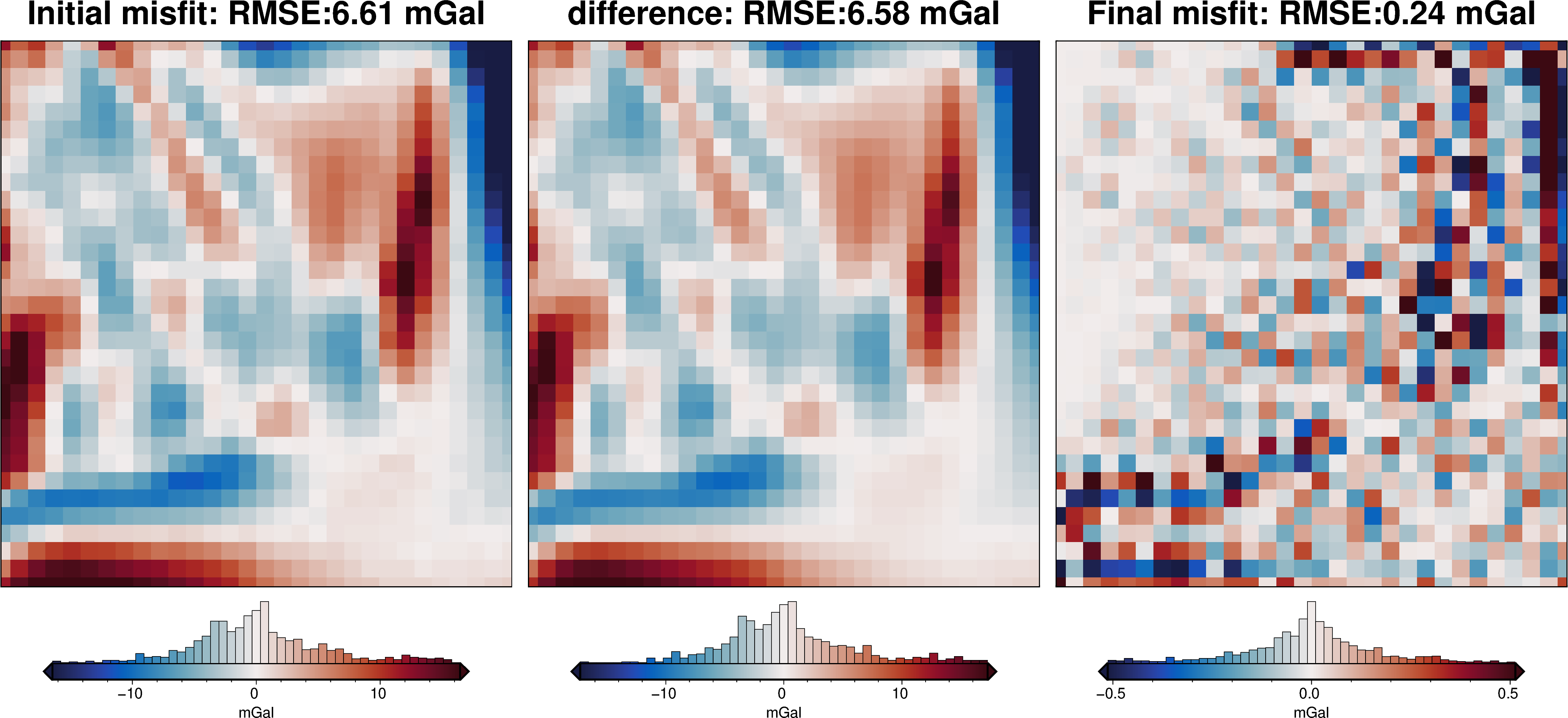
# collect the results
topo_results, grav_results, parameters, elapsed_time = inversion_results

plotting.plot_inversion_results(
    grav_results,
    topo_results,
    parameters,
    inversion_region,
    iters_to_plot=2,
    plot_iter_results=True,
    plot_topo_results=False,
    plot_grav_results=True,
)

final_topography = topo_results.set_index(["northing", "easting"]).to_xarray().topo

_ = polar_utils.grd_compare(
    grid.basement_topo,
    final_topography,
    plot=True,
    region=inversion_region,
    grid1_name="True topography",
    grid2_name="Inverted topography",
    robust=True,
    hist=True,
    inset=False,
    verbose="q",
    title="difference",
    grounding_line=False,
    reverse_cpt=True,
    cmap="rain",
    points=constraint_points,
    points_style="x.3c",
)
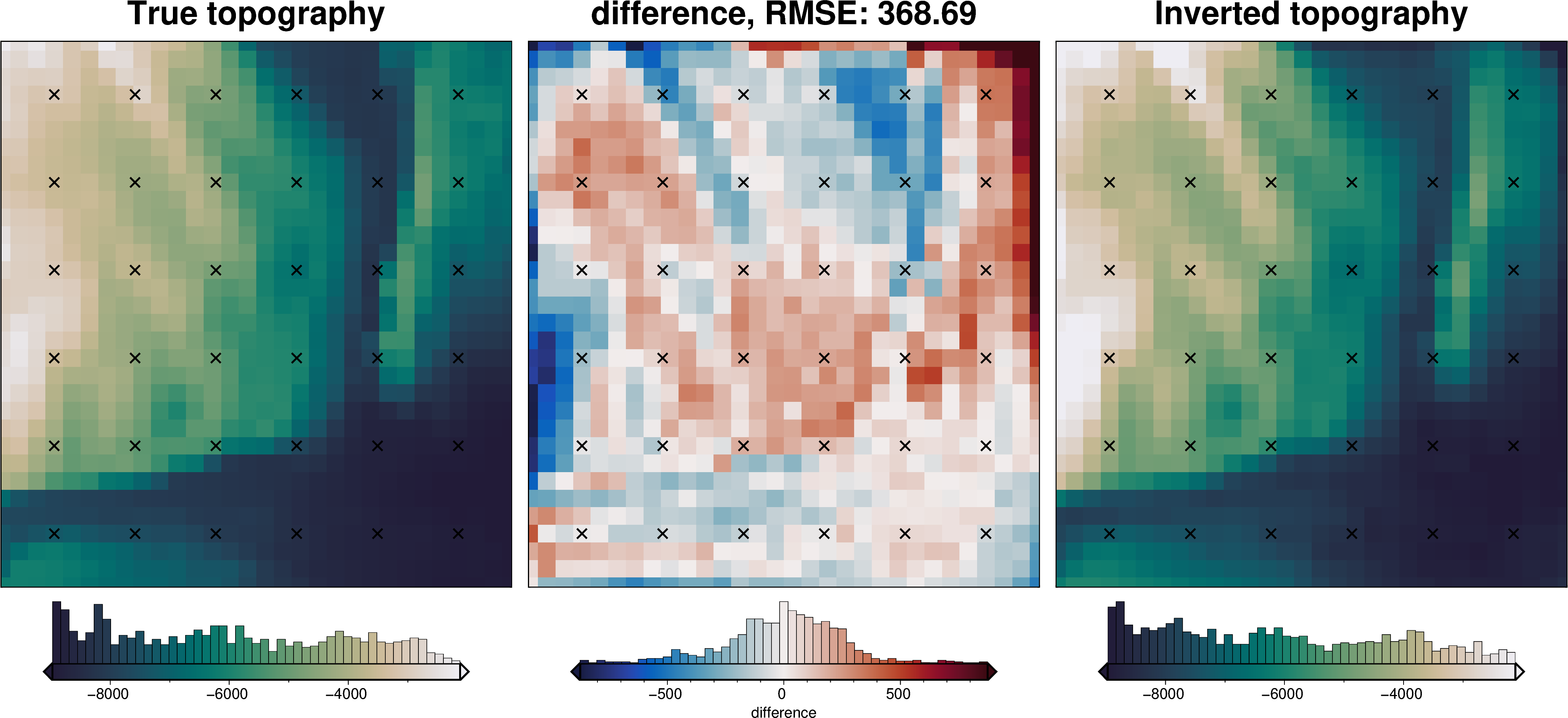
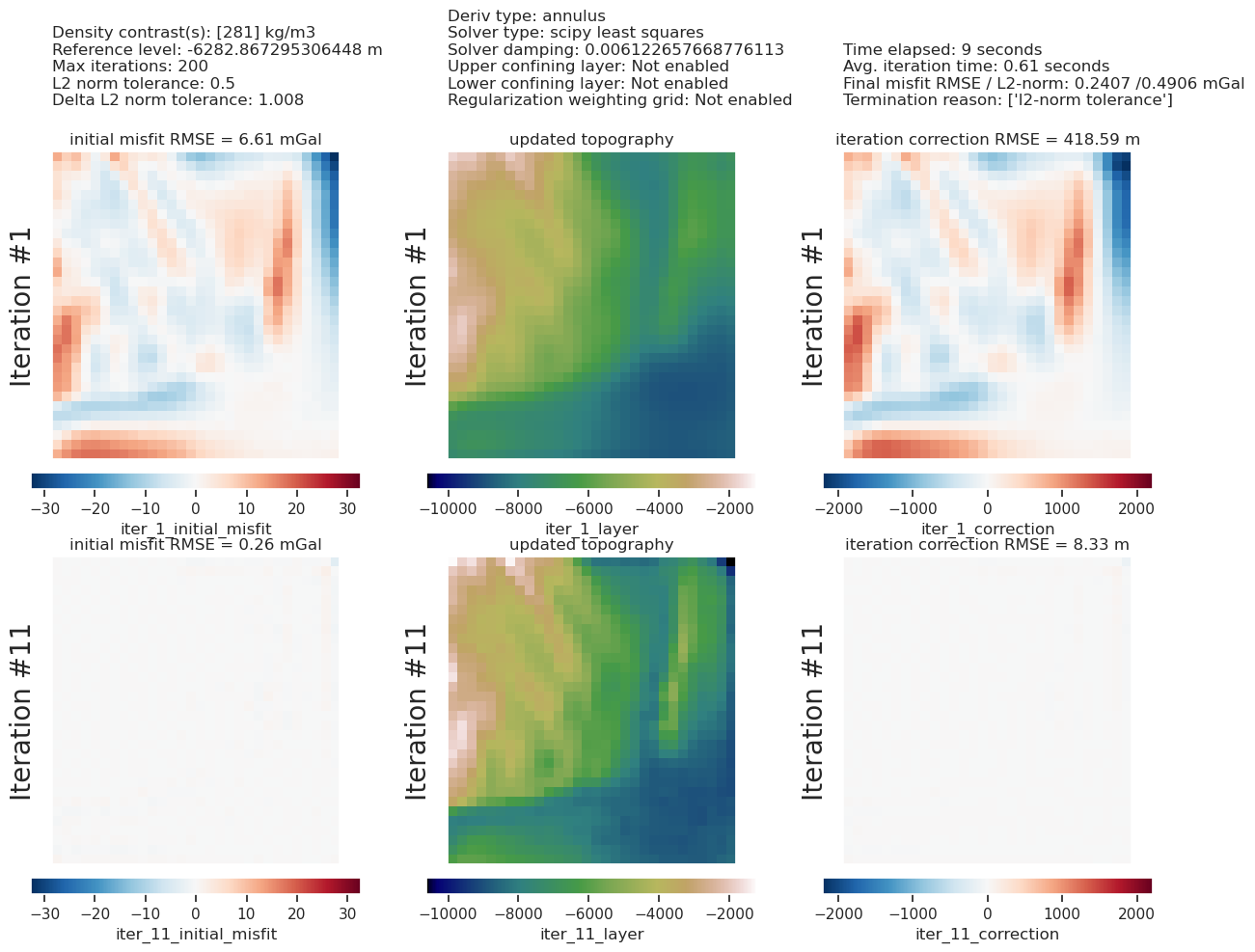
[34]:
# sample the inverted topography at the constraint points
constraint_points = utils.sample_grids(
    constraint_points,
    final_topography,
    "inverted_topography",
)

rmse = utils.rmse(constraint_points.true_upward - constraint_points.inverted_topography)
print(f"RMSE: {rmse:.2f} m")
RMSE: 167.17 m
Uncertainty analysis#
Absolute value of inversion error#
[35]:
inversion_error = np.abs(grid.basement_topo - final_topography)

inner_region = vd.pad_region(inversion_region, -topo_spacing)

fig = maps.plot_grd(
    inversion_error.sel(
        {
            "easting": slice(*inner_region[:2]),
            "northing": slice(*inner_region[2:]),
        }
    ),
    hist=True,
    cmap="thermal",
    title="Absolute value of inversion error",
    robust=True,
)
fig.show()
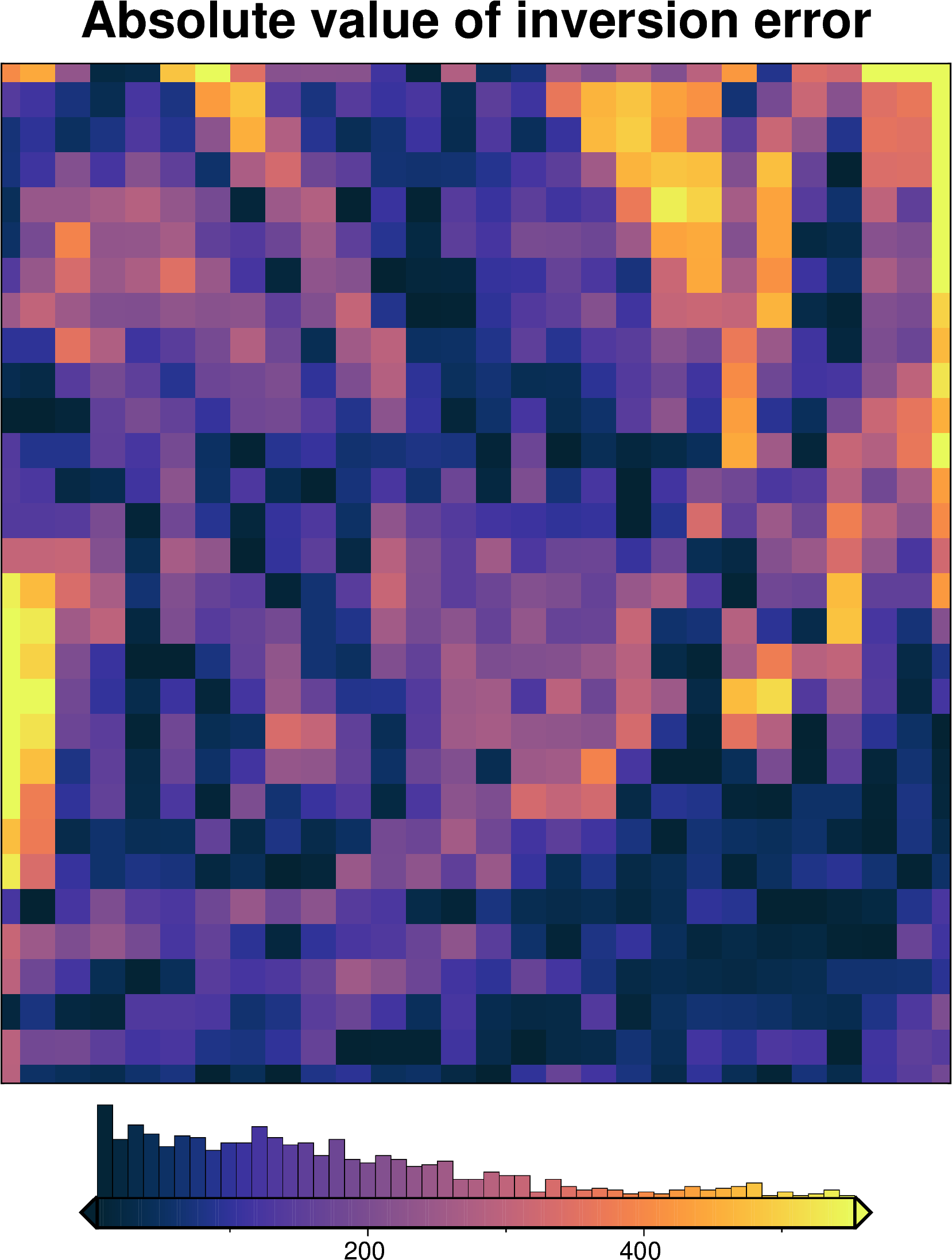
Regional field estimation uncertainty#
We will do the same thing for the regional estimation procedure. First we will re-separate the regional to see what equivalent source gridding parameter values were determined optimal. We then estimate an uncertainty distribution for these parameter values, and create an ensemble of regional models which each randomly sample both the parameter values and the gravity data.
[36]:
regional_misfit_parameter_dict = {
    # "depth": {
    #     "distribution": "uniform",
    #     "loc": 2 * mean_constraint_distance,  # lower bound
    #     "scale": 5 * mean_constraint_distance,  # range, 2+5=7
    # },
    "depth": {
        "distribution": "normal",
        "loc": reg_eq_depth,  # mean base 10 exponent
        "scale": 2 * reg_eq_depth,  # standard deviation of exponent
    },
    "damping": {
        "distribution": "uniform",
        "loc": np.log10(reg_eq_damping),
        "scale": 2,
        "log": True,
    },
}

# regional_kwargs = dict(
#     grav_df=grav_df,
#     constraints_df=constraint_points,
#     method="constraints",
#     grid_method="eq_sources",
#     # damping=reg_eq_damping,
#     # depth=reg_eq_depth,
#     block_size=None,
# )

regional_misfit_stats, _ = uncertainty.regional_misfit_uncertainty(
    runs=40,
    parameter_dict=regional_misfit_parameter_dict,
    plot_region=inner_region,
    grav_df=grav_df,
    **new_regional_grav_kwargs,
)
INFO:invert4geom:Sampled 'depth' parameter values; mean: 974124.3677063871, min: -3392685.6619006884, max: 5340934.397313465
INFO:invert4geom:Sampled 'damping' parameter values; mean: 0.06968051942416478, min: 0.0034352764747856658, max: 0.30616933809015123
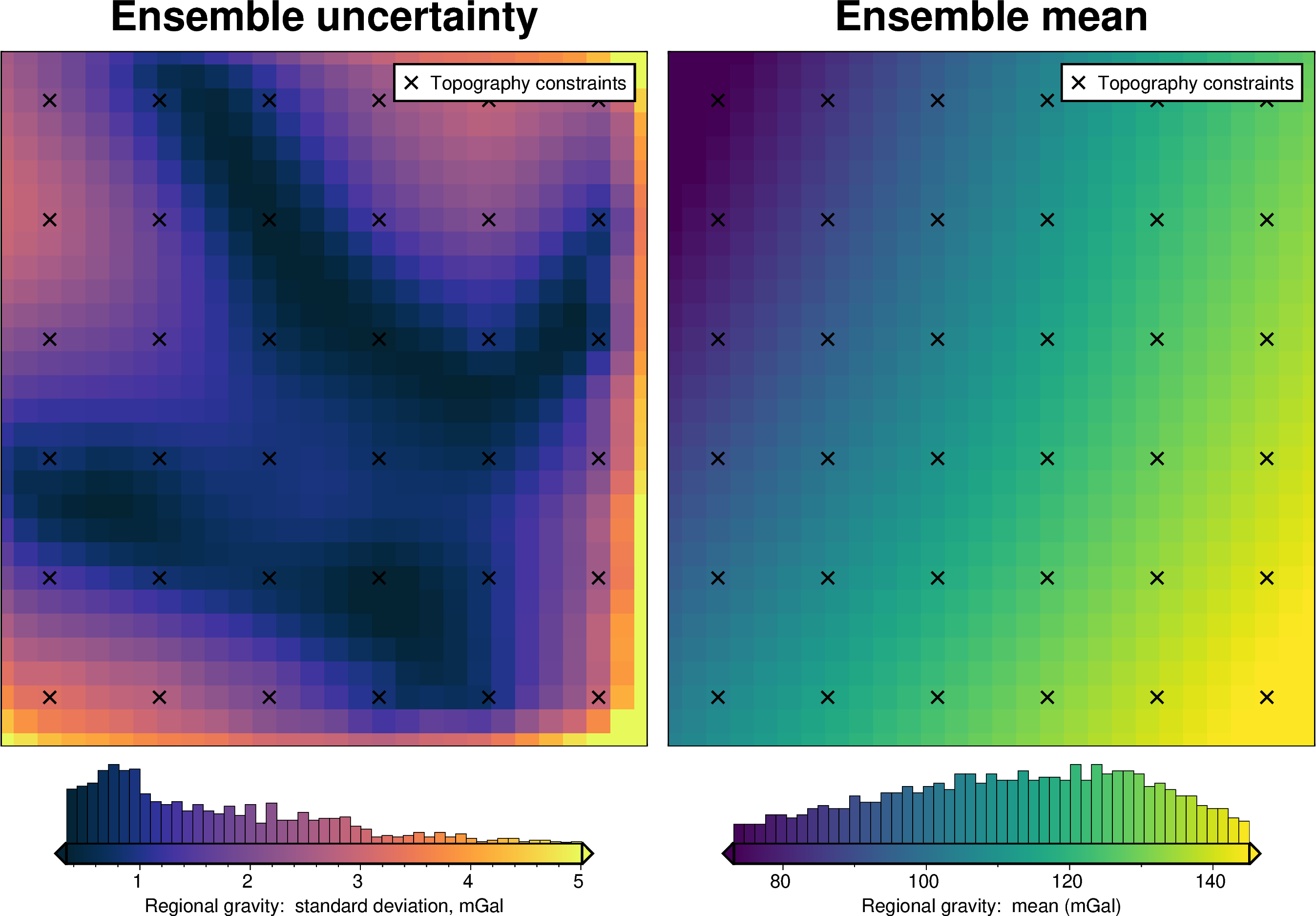
Sensitivity Analysis#
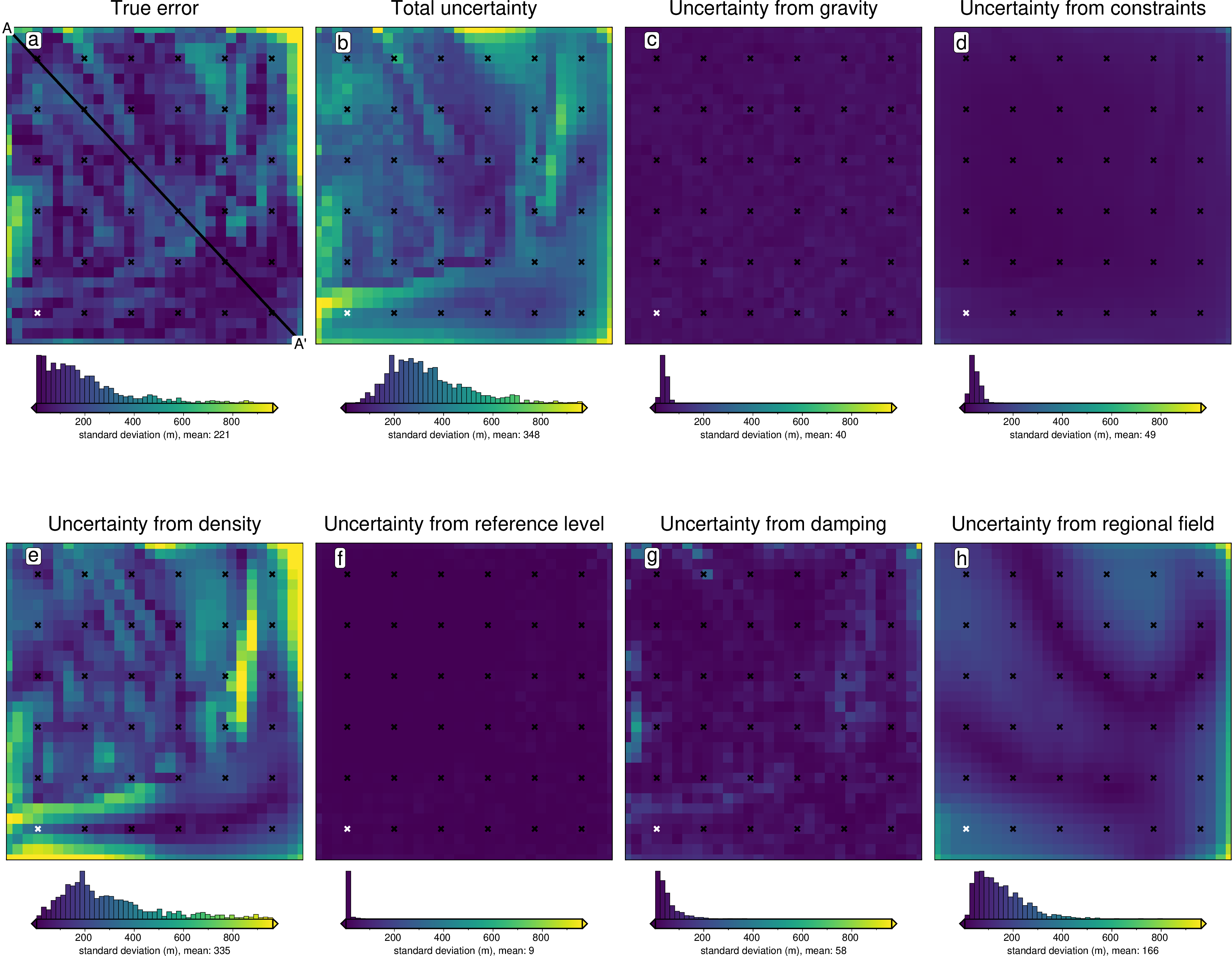
Above we perform an uncertainty assessment using all the important parameters and data. Now, we can repeat this stochastic analysis isolated the uncertainty arising from each component. This should give us a sense of which parameters/data are the most important.
[37]:
# plotting functions for uncertainty results
def uncert_plots(results):
    ds = uncertainty.merged_stats(
        results=results,
        plot=True,
        constraints_df=constraint_points,
        weight_by="constraints",
        region=inversion_region,
    )

    _ = polar_utils.grd_compare(
        grid.basement_topo,
        ds.weighted_mean,
        region=inner_region,
        plot=True,
        grid1_name="True topography",
        grid2_name="Inverted topography",
        robust=True,
        hist=True,
        inset=False,
        verbose="q",
        title="difference",
        grounding_line=False,
        reverse_cpt=True,
        cmap="rain",
        points=constraint_points,
        points_style="x.3c",
    )
    _ = polar_utils.grd_compare(
        inversion_error,
        ds.weighted_stdev,
        region=inner_region,
        plot=True,
        grid1_name="True error",
        grid2_name="Stochastic uncertainty",
        robust=True,
        hist=True,
        inset=False,
        verbose="q",
        title="difference",
        grounding_line=False,
        points=constraint_points,
        points_style="x.3c",
    )
[38]:
# best_spline_damping = starting_topography.attrs["damping"]
[39]:
# parameters used in final inversion
best_density_contrast, best_zref, best_damping  # , best_spline_damping
[39]:
(281, -6282.867295306448, 0.006122657668776113)
[40]:
# kwargs to reuse for all uncertainty analyses
uncert_kwargs = dict(
    grav_df=grav_df,
    density_contrast=best_density_contrast,
    zref=best_zref,
    starting_prisms=starting_prisms,
    starting_topography=starting_topography,
    regional_grav_kwargs=new_regional_grav_kwargs,
    **kwargs,
)
Density component#
[41]:
# load study
with pathlib.Path("../tmp/bishop_model_density_cv_study.pickle").open("rb") as f:
    study = pickle.load(f)

study_df = study.trials_dataframe()
study_df = study_df.sort_values("value")

# calculate zscores of values
study_df["value_zscore"] = sp.stats.zscore(study_df["value"])

# drop outliers (values with zscore > |2|)
study_df2 = study_df[(np.abs(study_df.value_zscore) < 2)]

stdev = study_df2.params_density_contrast.std()
print(f"calculated stdev: {stdev}")

# manually pick a stdev
# stdev = 20
print(f"using stdev: {stdev}")
calculated stdev: 159.47256817396527
using stdev: 159.47256817396527
[42]:
fig = plotting.plot_cv_scores(
    study.trials_dataframe().value.values,
    study.trials_dataframe().params_density_contrast.values,
    param_name="Density",
    logx=False,
    logy=False,
)
ax = fig.axes[0]

best = study_df2.params_density_contrast.iloc[0]
upper = best + stdev
lower = best - stdev

y_lims = ax.get_ylim()
ax.vlines(best, ymin=y_lims[0], ymax=y_lims[1], color="r")
ax.vlines(upper, ymin=y_lims[0], ymax=y_lims[1], label="+/- std")
ax.vlines(lower, ymin=y_lims[0], ymax=y_lims[1])

x_lims = ax.get_xlim()
ax.set_xlim(
    min(x_lims[0], lower),
    max(x_lims[1], upper),
)
ax.legend()
print("best:", best, "\nstd:", stdev, "\n+1std:", upper, "\n-1std:", lower)
best: 281
std: 159.47256817396527
+1std: 440.47256817396527
-1std: 121.52743182603473
[43]:
density_dict = {
    "density_contrast": {
        "distribution": "normal",
        "loc": best_density_contrast,
        "scale": stdev,
    },
}

fname = "../tmp/bishop_uncertainty_density"

# delete files if already exist
for p in pathlib.Path().glob(f"{fname}*"):
    p.unlink(missing_ok=True)

uncert_density_results = uncertainty.full_workflow_uncertainty_loop(
    fname=fname,
    runs=10,
    parameter_dict=density_dict,
    **uncert_kwargs,
)

uncert_plots(uncert_density_results)
INFO:invert4geom:Sampled 'density_contrast' parameter values; mean: 280.99999999999994, min: 18.69096783978722, max: 543.3090321602126
INFO:invert4geom:No pickle files starting with '../tmp/bishop_uncertainty_density' found, creating new files
INFO:invert4geom:starting stochastic uncertainty analysis at run 0 of 10
saving results to pickle files with prefix: '../tmp/bishop_uncertainty_density'
Zref component#
[44]:
# load study
with pathlib.Path("../tmp/bishop_model_zref_cv_study.pickle").open("rb") as f:
    study = pickle.load(f)

study_df = study.trials_dataframe()
study_df = study_df.sort_values("value")

# calculate zscores of values
study_df["value_zscore"] = sp.stats.zscore(study_df["value"])

# drop outliers (values with zscore > |2|)
study_df2 = study_df[(np.abs(study_df.value_zscore) < 2)]

stdev = study_df2.params_zref.std()
print(f"calculated stdev: {stdev}")

# manually pick a stdev
# stdev = 20
print(f"using stdev: {stdev}")
calculated stdev: 1288.104213648036
using stdev: 1288.104213648036
[45]:
fig = plotting.plot_cv_scores(
    study.trials_dataframe().value.values,
    study.trials_dataframe().params_zref.values,
    param_name="Reference level",
    logx=False,
    logy=False,
)
ax = fig.axes[0]

best = study_df2.params_zref.iloc[0]
upper = best + stdev
lower = best - stdev

y_lims = ax.get_ylim()
ax.vlines(best, ymin=y_lims[0], ymax=y_lims[1], color="r")
ax.vlines(upper, ymin=y_lims[0], ymax=y_lims[1], label="+/- std")
ax.vlines(lower, ymin=y_lims[0], ymax=y_lims[1])

x_lims = ax.get_xlim()
ax.set_xlim(
    min(x_lims[0], lower),
    max(x_lims[1], upper),
)
ax.legend()
print("best:", best, "\nstd:", stdev, "\n+1std:", upper, "\n-1std:", lower)
best: -6282.867295306448
std: 1288.104213648036
+1std: -4994.7630816584115
-1std: -7570.971508954484
[46]:
zref_dict = {
    "zref": {
        "distribution": "normal",
        "loc": best_zref,
        "scale": stdev,
    },
}

fname = "../tmp/bishop_uncertainty_zref"

# delete files if already exist
for p in pathlib.Path().glob(f"{fname}*"):
    p.unlink(missing_ok=True)

uncert_zref_results = uncertainty.full_workflow_uncertainty_loop(
    fname=fname,
    runs=10,
    parameter_dict=zref_dict,
    **uncert_kwargs,
)

uncert_plots(uncert_zref_results)
INFO:invert4geom:Sampled 'zref' parameter values; mean: -6282.867295306449, min: -8401.610183016895, max: -4164.124407596002
INFO:invert4geom:No pickle files starting with '../tmp/bishop_uncertainty_zref' found, creating new files
INFO:invert4geom:starting stochastic uncertainty analysis at run 0 of 10
saving results to pickle files with prefix: '../tmp/bishop_uncertainty_zref'
Damping component#
[47]:
# load study
with pathlib.Path("../tmp/bishop_model_damping_cv_study.pickle").open("rb") as f:
    study = pickle.load(f)

study_df = study.trials_dataframe().drop(columns=["user_attrs_results"])
study_df = study_df.sort_values("value")

# calculate zscores of values
study_df["value_zscore"] = sp.stats.zscore(study_df["value"])

# drop outliers (values with zscore > |2|)
study_df2 = study_df[(np.abs(study_df.value_zscore) < 2)]

# pick damping standard deviation based on optimization
stdev = np.log10(study_df2.params_damping).std()
print(f"calculated stdev: {stdev}")
# stdev = 0.4
print(f"using stdev: {stdev}")
calculated stdev: 0.43809134514671205
using stdev: 0.43809134514671205
[48]:
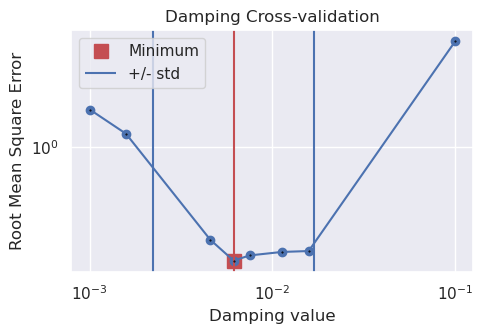
fig = plotting.plot_cv_scores(
    study_df.value,
    study_df.params_damping,
    param_name="Damping",
    logx=True,
    logy=True,
)
ax = fig.axes[0]

best = float(study_df2.params_damping.iloc[0])
upper = float(10 ** (np.log10(best) + stdev))
lower = float(10 ** (np.log10(best) - stdev))

y_lims = ax.get_ylim()
ax.vlines(best, ymin=y_lims[0], ymax=y_lims[1], color="r")
ax.vlines(upper, ymin=y_lims[0], ymax=y_lims[1], label="+/- std")
ax.vlines(lower, ymin=y_lims[0], ymax=y_lims[1])

x_lims = ax.get_xlim()
ax.set_xlim(
    min(x_lims[0], lower),
    max(x_lims[1], upper),
)
ax.legend()
print("best:", best, "\nstd:", stdev, "\n+1std:", upper, "\n-1std:", lower)
best: 0.006122657668776113
std: 0.43809134514671205
+1std: 0.01678925103965166
-1std: 0.0022327938774927454
[49]:
solver_dict = {
    "solver_damping": {
        "distribution": "normal",
        "loc": np.log10(best_damping),  # mean base 10 exponent
        "scale": stdev,  # standard deviation of base 10 exponent
        "log": True,
    },
}

fname = "../tmp/bishop_uncertainty_damping"

# delete files if already exist
for p in pathlib.Path().glob(f"{fname}*"):
    p.unlink(missing_ok=True)

uncert_damping_results = uncertainty.full_workflow_uncertainty_loop(
    fname=fname,
    runs=10,
    parameter_dict=solver_dict,
    **uncert_kwargs,
)

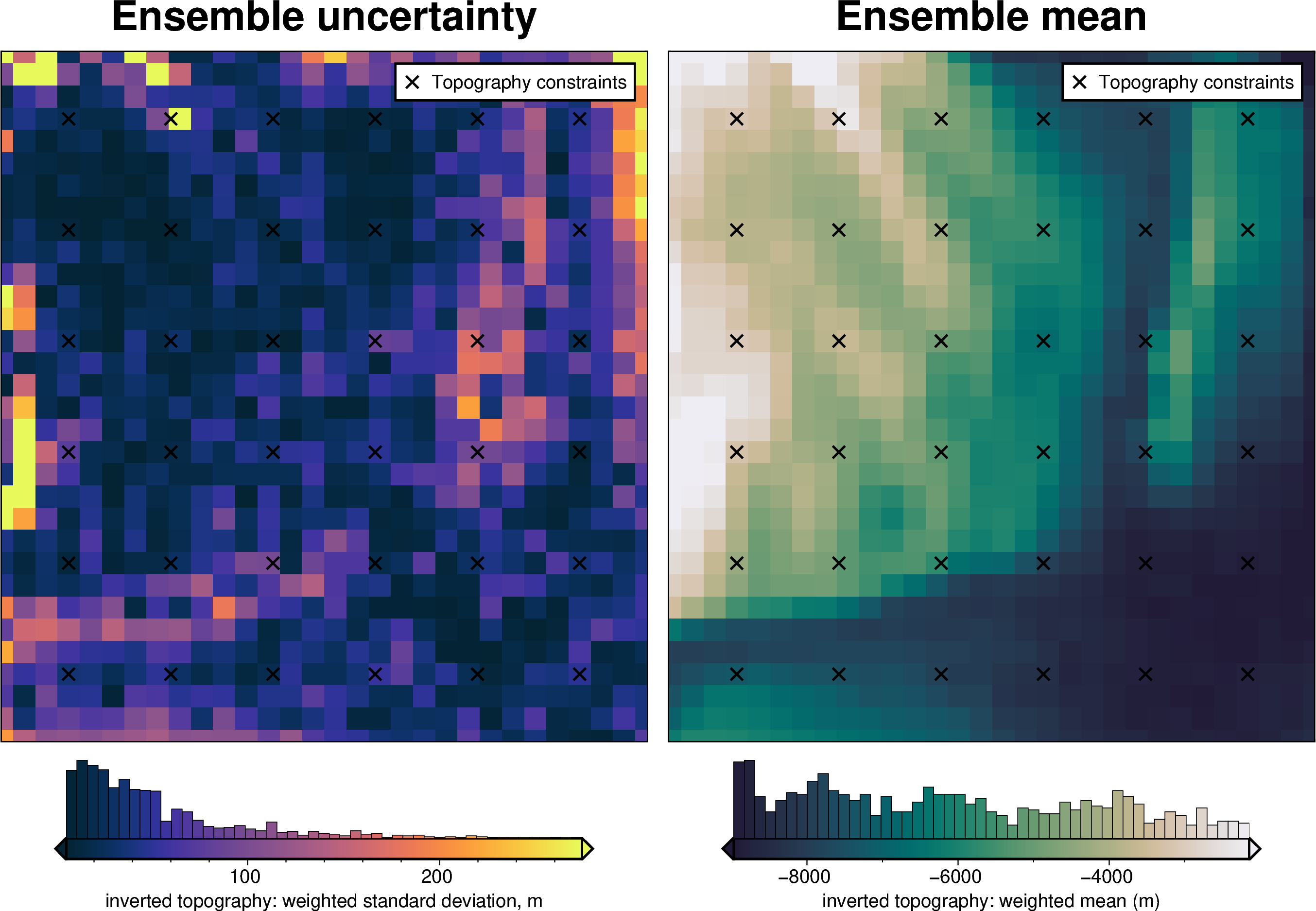
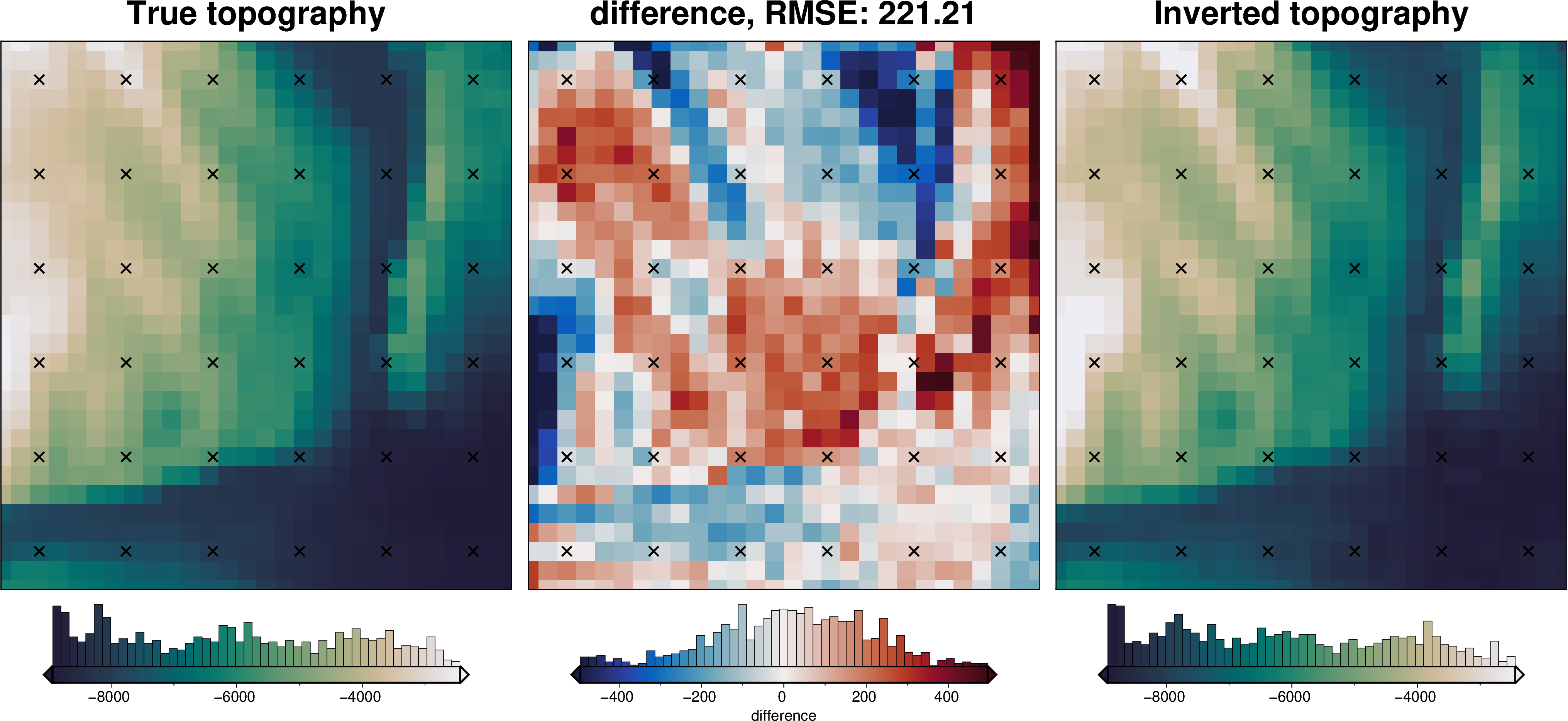
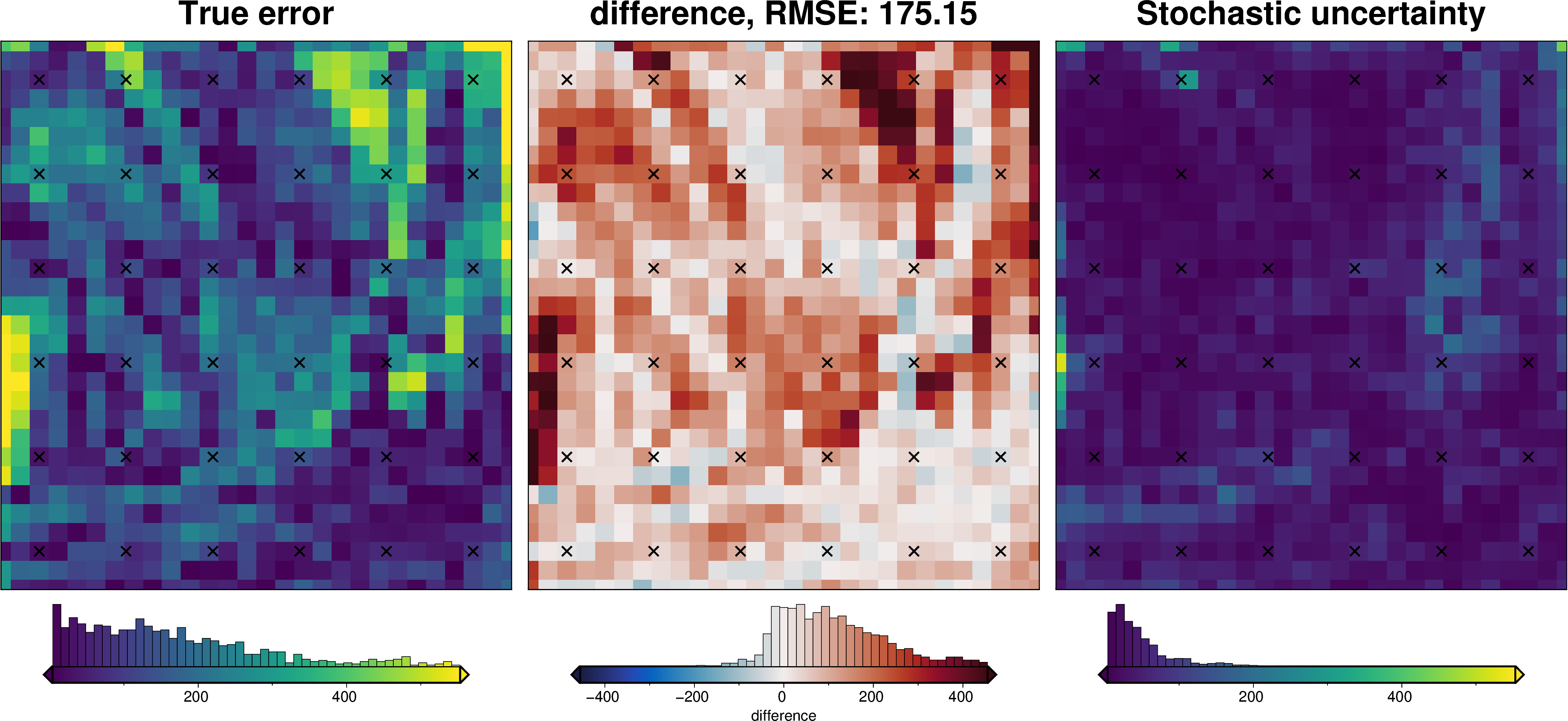
uncert_plots(uncert_damping_results)
INFO:invert4geom:Sampled 'solver_damping' parameter values; mean: 0.009362788686956806, min: 0.001165048056562874, max: 0.0321763009841988
INFO:invert4geom:No pickle files starting with '../tmp/bishop_uncertainty_damping' found, creating new files
INFO:invert4geom:starting stochastic uncertainty analysis at run 0 of 10
saving results to pickle files with prefix: '../tmp/bishop_uncertainty_damping'
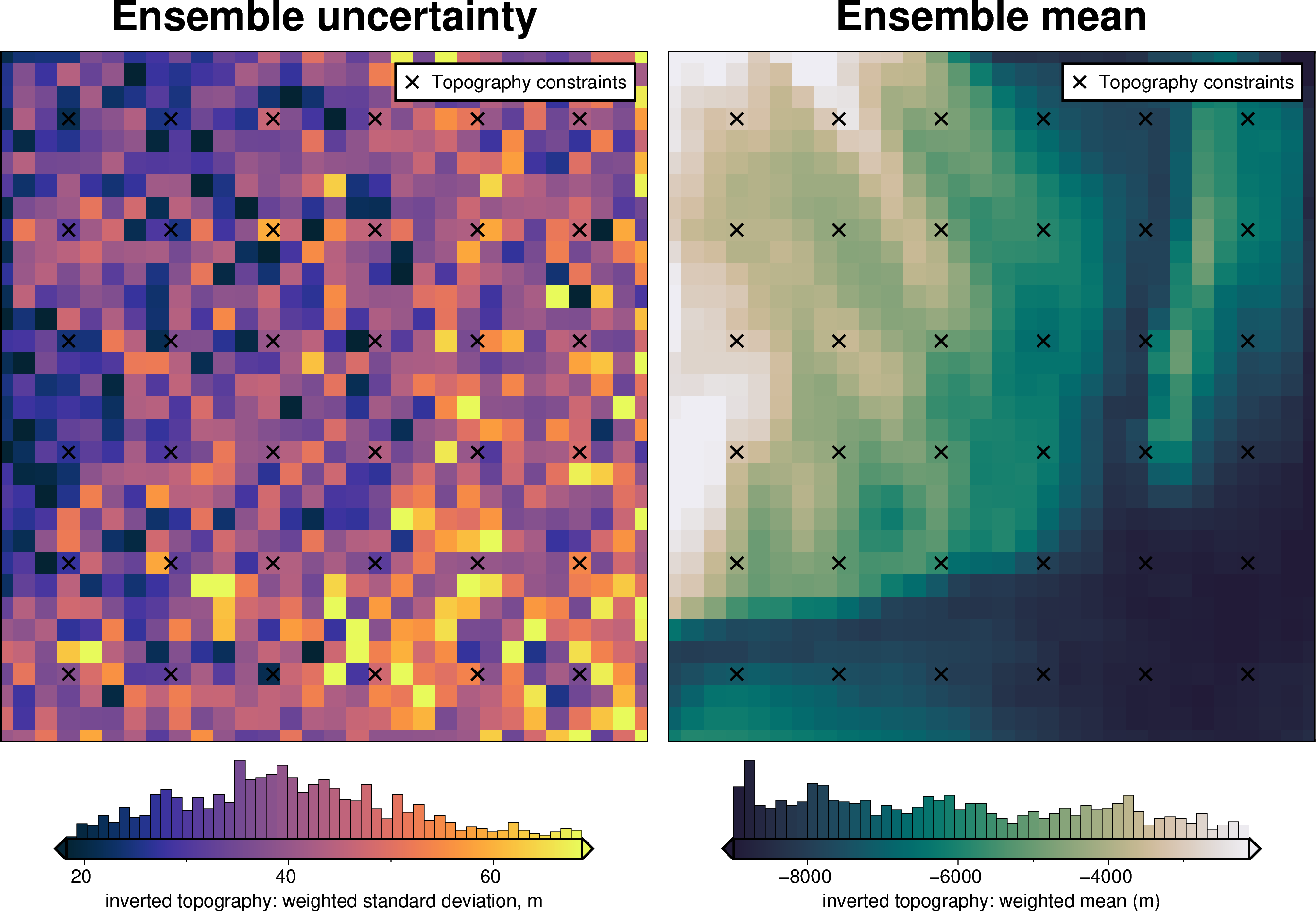
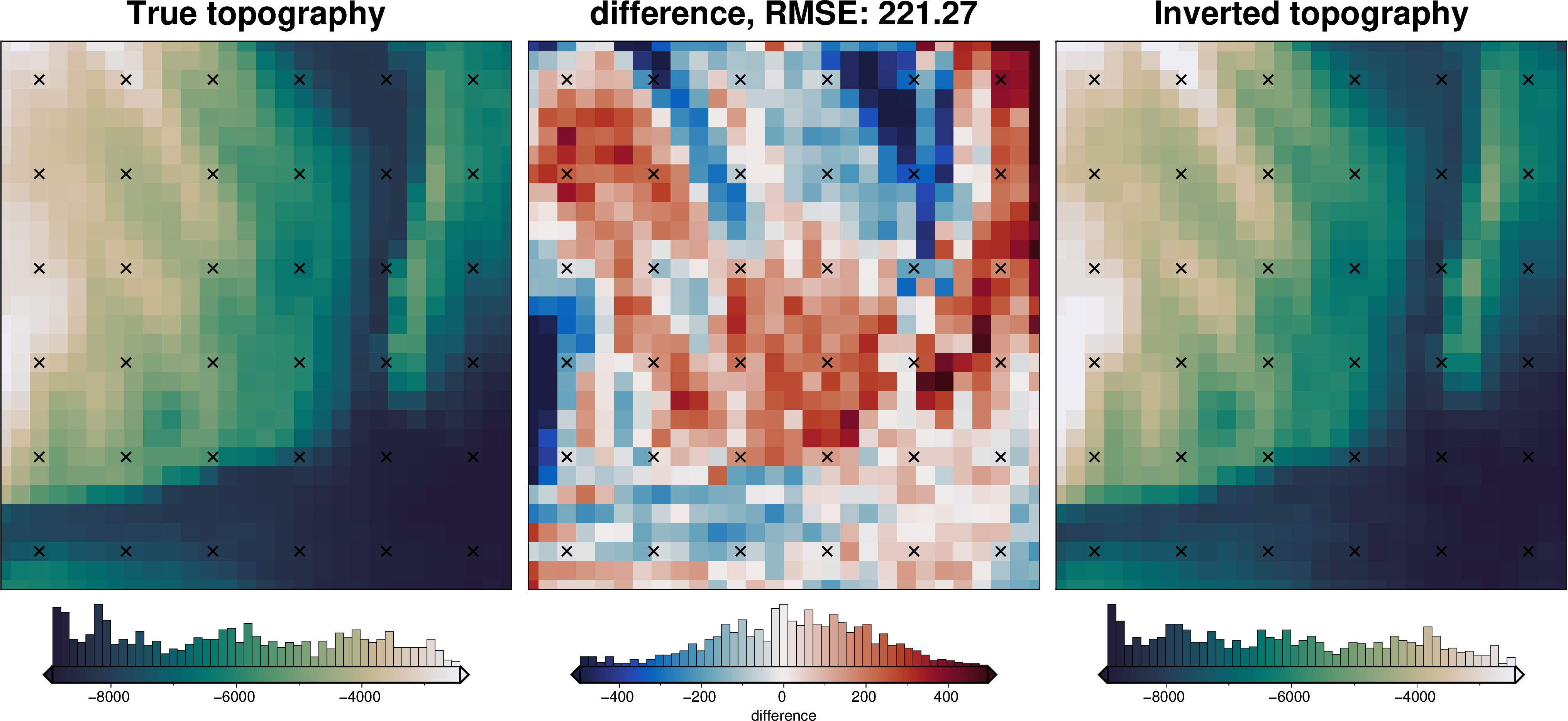
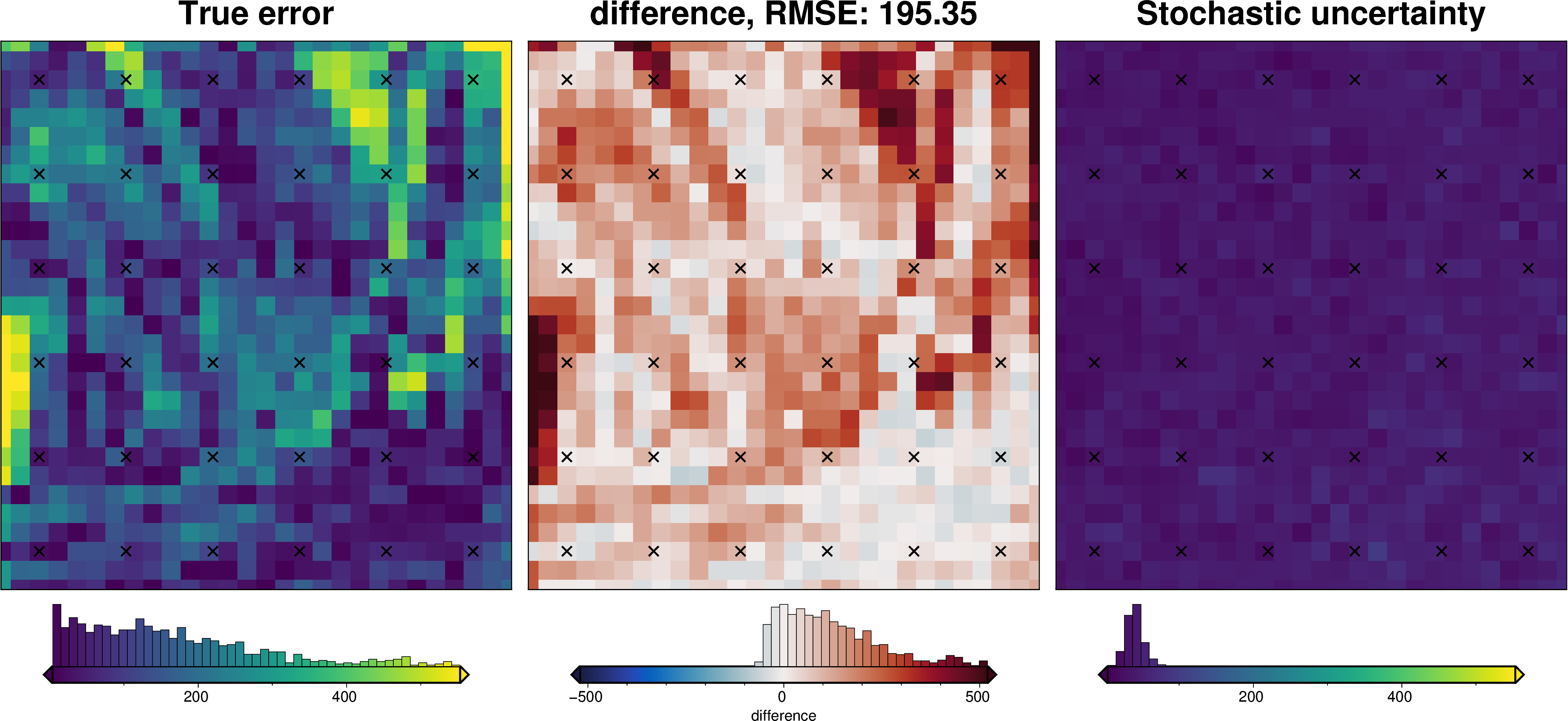
Gravity component#
[50]:
fname = "../tmp/bishop_uncertainty_grav"

# delete files if already exist
for p in pathlib.Path().glob(f"{fname}*"):
    p.unlink(missing_ok=True)

uncert_grav_results = uncertainty.full_workflow_uncertainty_loop(
    fname=fname,
    runs=10,
    sample_gravity=True,
    **uncert_kwargs,
)

uncert_plots(uncert_grav_results)
INFO:invert4geom:No pickle files starting with '../tmp/bishop_uncertainty_grav' found, creating new files
INFO:invert4geom:starting stochastic uncertainty analysis at run 0 of 10
saving results to pickle files with prefix: '../tmp/bishop_uncertainty_grav'
Constraints component#
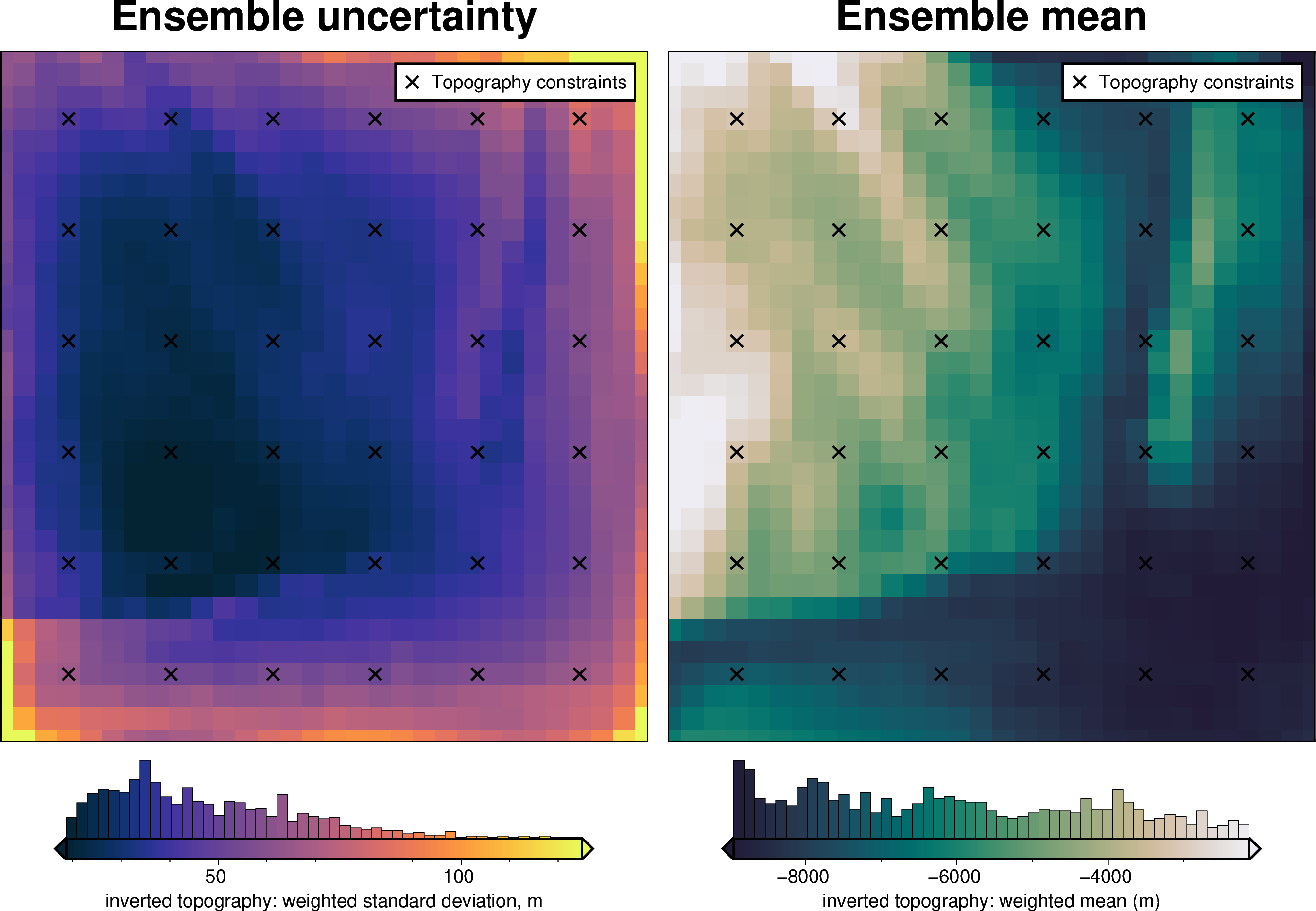
[51]:
fname = "../tmp/bishop_uncertainty_constraints"

# delete files if already exist
for p in pathlib.Path().glob(f"{fname}*"):
    p.unlink(missing_ok=True)

uncert_constraints_results = uncertainty.full_workflow_uncertainty_loop(
    fname=fname,
    runs=10,
    sample_constraints=True,
    constraints_df=constraint_points,
    starting_topography_kwargs=starting_topography_kwargs,
    **uncert_kwargs,
)

uncert_plots(uncert_constraints_results)
INFO:invert4geom:No pickle files starting with '../tmp/bishop_uncertainty_constraints' found, creating new files
INFO:invert4geom:starting stochastic uncertainty analysis at run 0 of 10
saving results to pickle files with prefix: '../tmp/bishop_uncertainty_constraints'
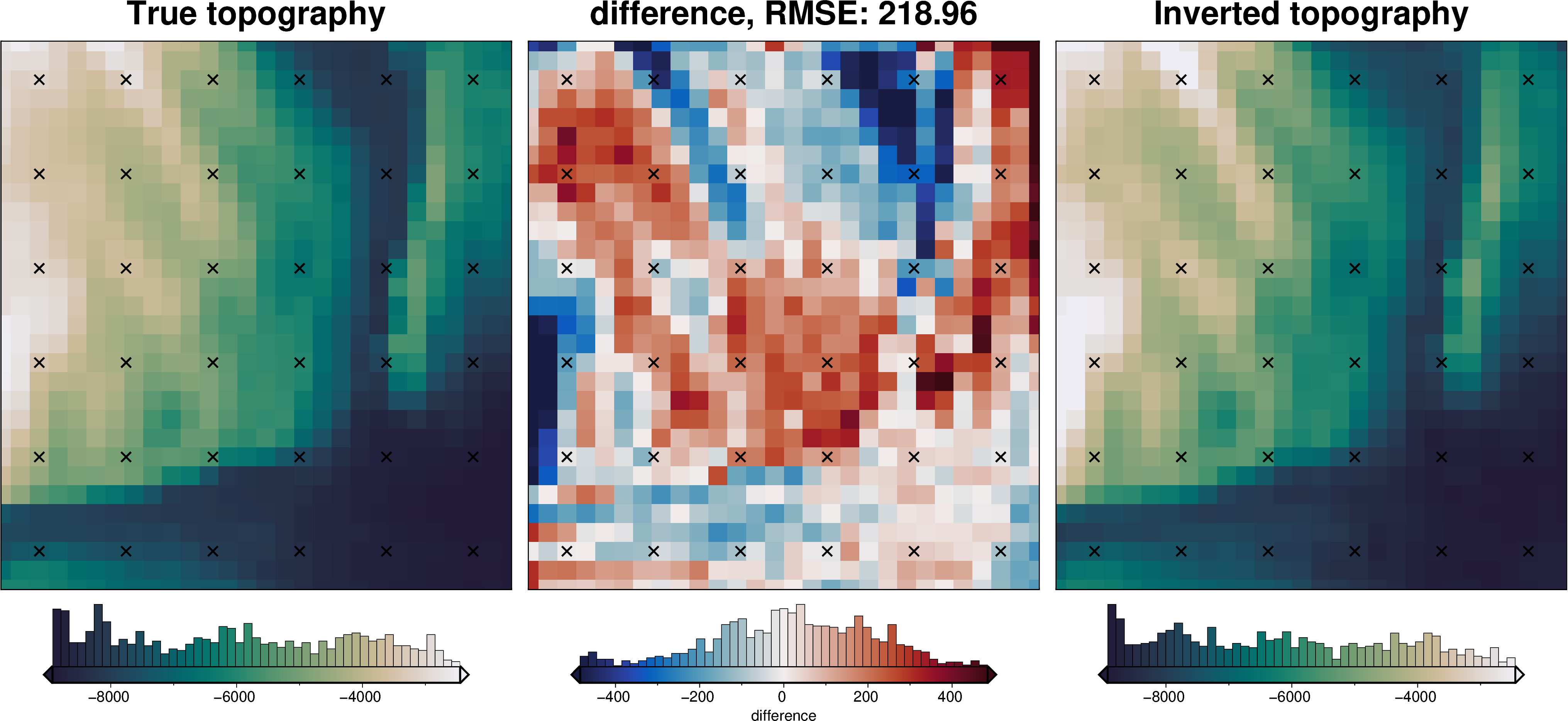
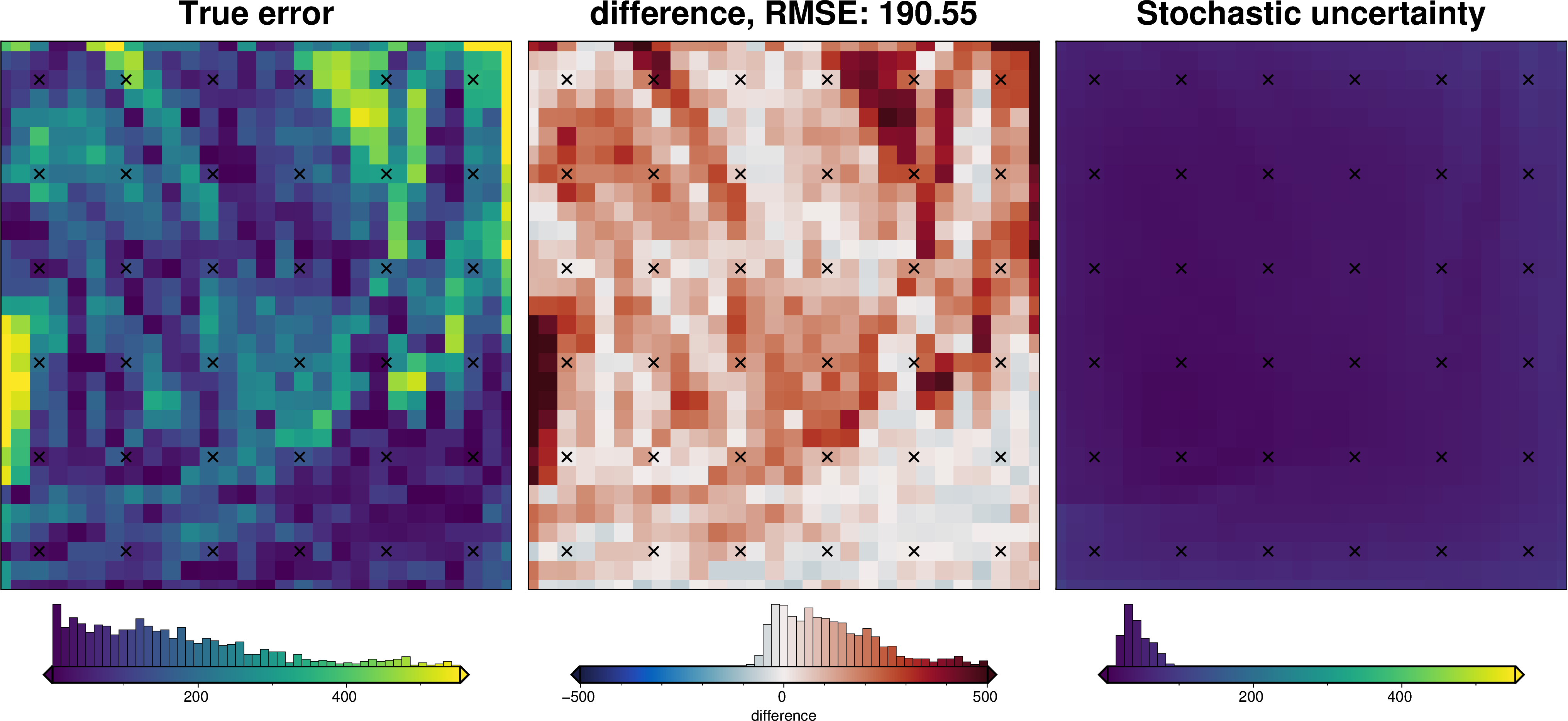
Regional gravity component#
[52]:
fname = "../tmp/bishop_uncertainty_regional"

# delete files if already exist
for p in pathlib.Path().glob(f"{fname}*"):
    p.unlink(missing_ok=True)

uncert_regional_results = uncertainty.full_workflow_uncertainty_loop(
    fname=fname,
    runs=10,
    regional_misfit_parameter_dict=regional_misfit_parameter_dict,
    **uncert_kwargs,
)

uncert_plots(uncert_regional_results)
INFO:invert4geom:Sampled 'depth' parameter values; mean: 974124.3677063866, min: -2230459.630940934, max: 4178708.3663537065
INFO:invert4geom:Sampled 'damping' parameter values; mean: 0.0691067267805829, min: 0.004082833742144754, max: 0.2576093935897783
INFO:invert4geom:No pickle files starting with '../tmp/bishop_uncertainty_regional' found, creating new files
INFO:invert4geom:starting stochastic uncertainty analysis at run 0 of 10
saving results to pickle files with prefix: '../tmp/bishop_uncertainty_regional'
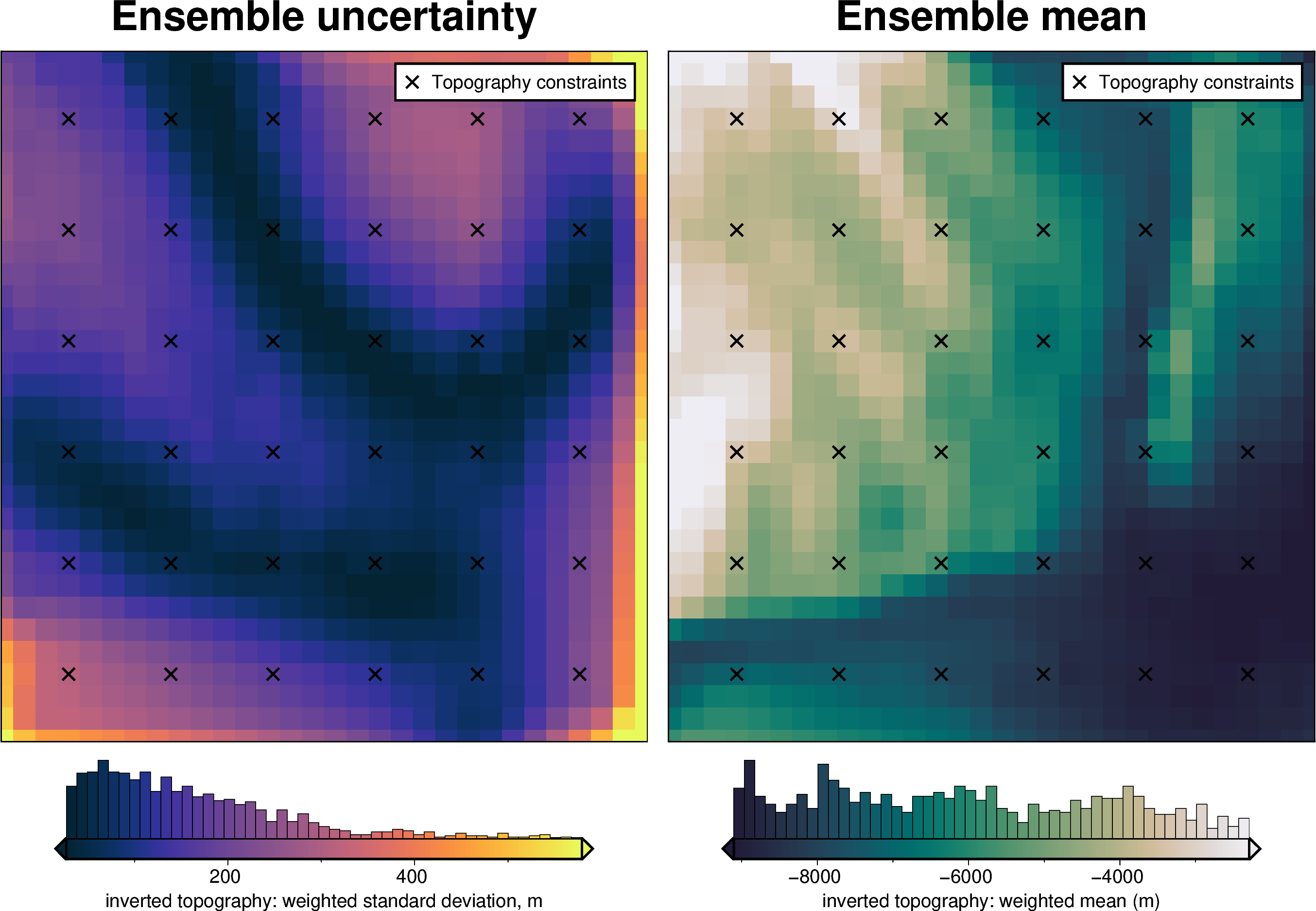
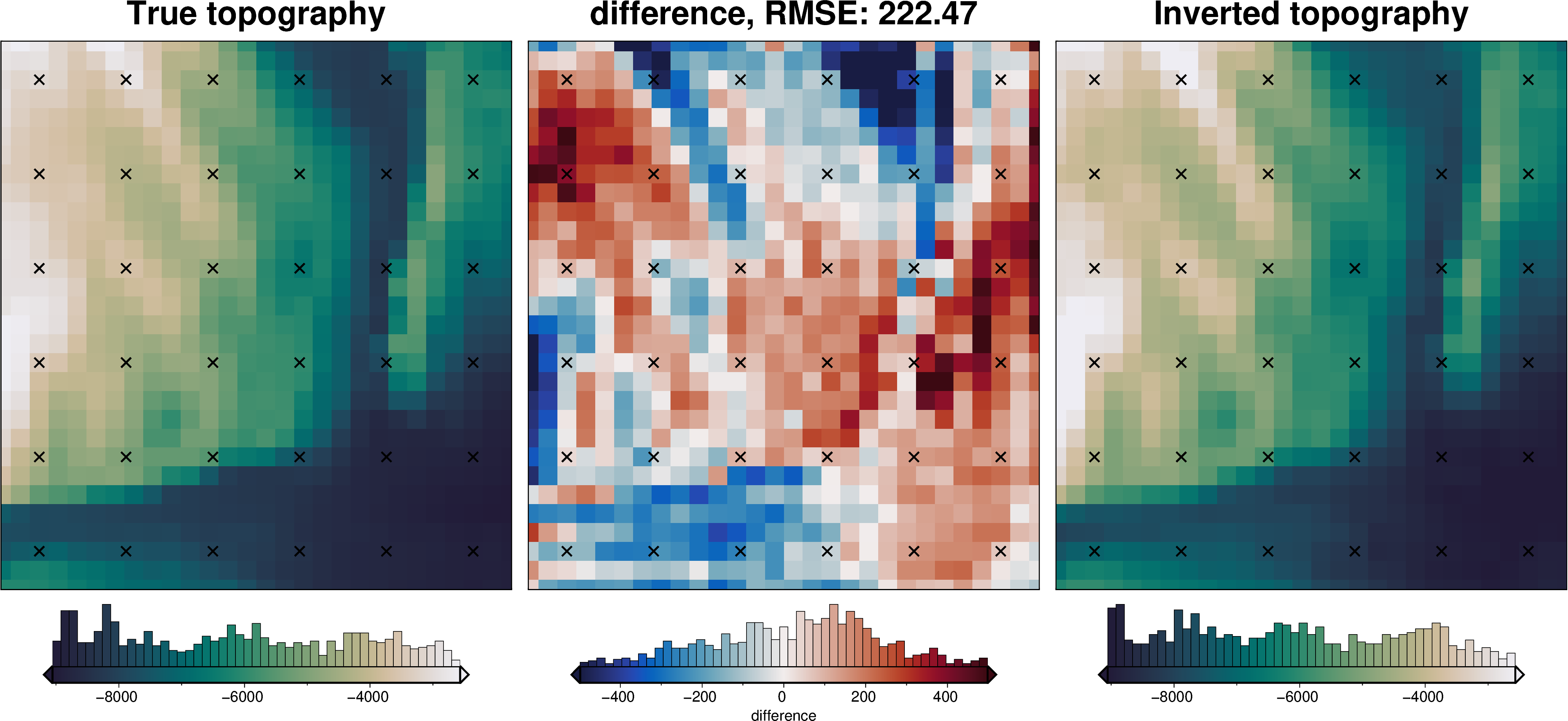
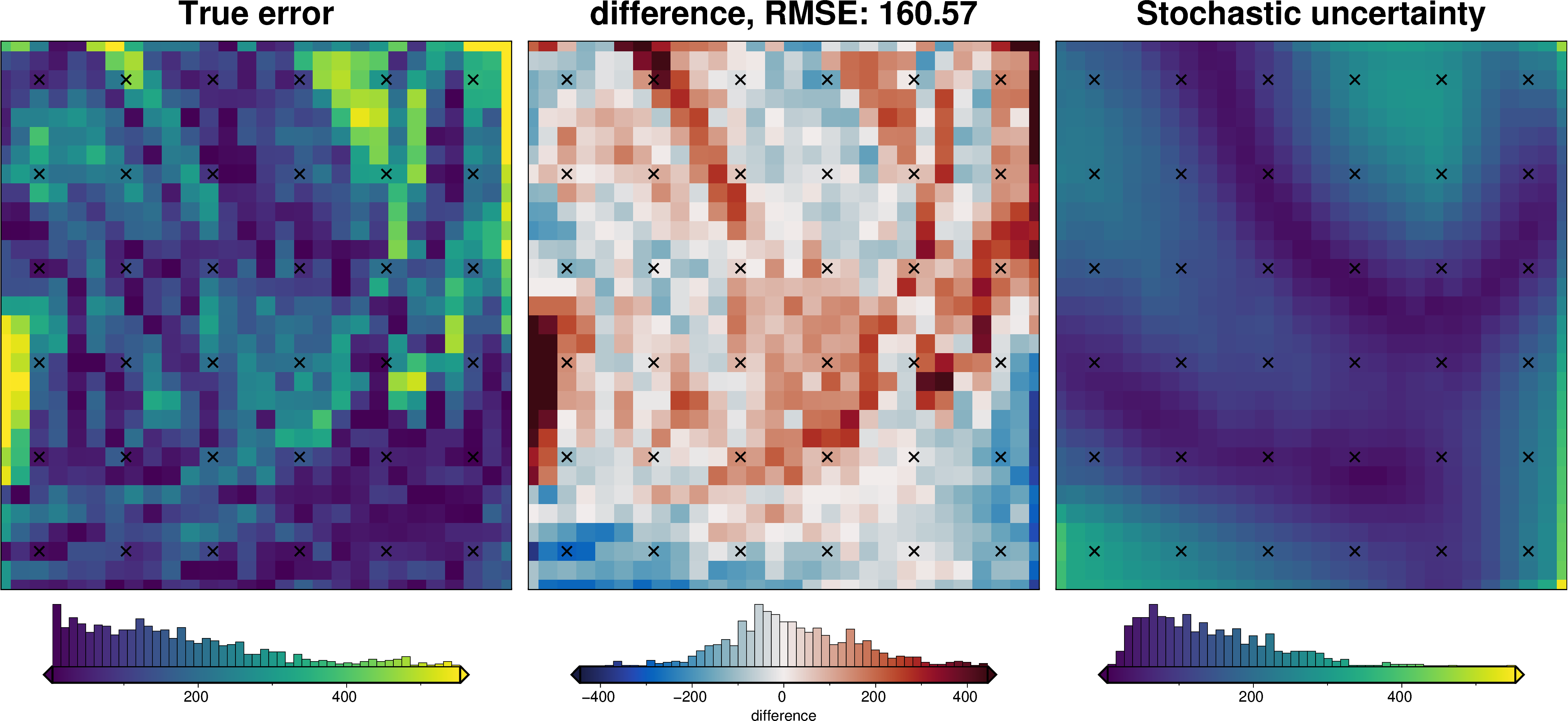
Total Uncertainty#
[53]:
fname = "../tmp/bishop_uncertainty_full"

# delete files if already exist
for p in pathlib.Path().glob(f"{fname}*"):
    p.unlink(missing_ok=True)

uncert_results = uncertainty.full_workflow_uncertainty_loop(
    fname=fname,
    runs=20,
    sample_gravity=True,
    sample_constraints=True,
    constraints_df=constraint_points,
    starting_topography_kwargs=starting_topography_kwargs,
    parameter_dict=density_dict | zref_dict | solver_dict,
    regional_misfit_parameter_dict=regional_misfit_parameter_dict,
    **uncert_kwargs,
)

uncert_plots(uncert_results)
INFO:invert4geom:Sampled 'density_contrast' parameter values; mean: 281.0, min: -31.56049014308047, max: 593.5604901430806
INFO:invert4geom:Sampled 'zref' parameter values; mean: -6282.867295306447, min: -8807.505162390886, max: -3758.2294282220078
INFO:invert4geom:Sampled 'solver_damping' parameter values; mean: 0.009695115399105083, min: 0.0008478064559166373, max: 0.0442163853169679
INFO:invert4geom:Sampled 'depth' parameter values; mean: 974124.3677063871, min: -2844372.986628355, max: 4792621.722041131
INFO:invert4geom:Sampled 'damping' parameter values; mean: 0.06956522891938234, min: 0.003638829402930621, max: 0.28904249360926937
INFO:invert4geom:No pickle files starting with '../tmp/bishop_uncertainty_full' found, creating new files
INFO:invert4geom:starting stochastic uncertainty analysis at run 0 of 20
saving results to pickle files with prefix: '../tmp/bishop_uncertainty_full'
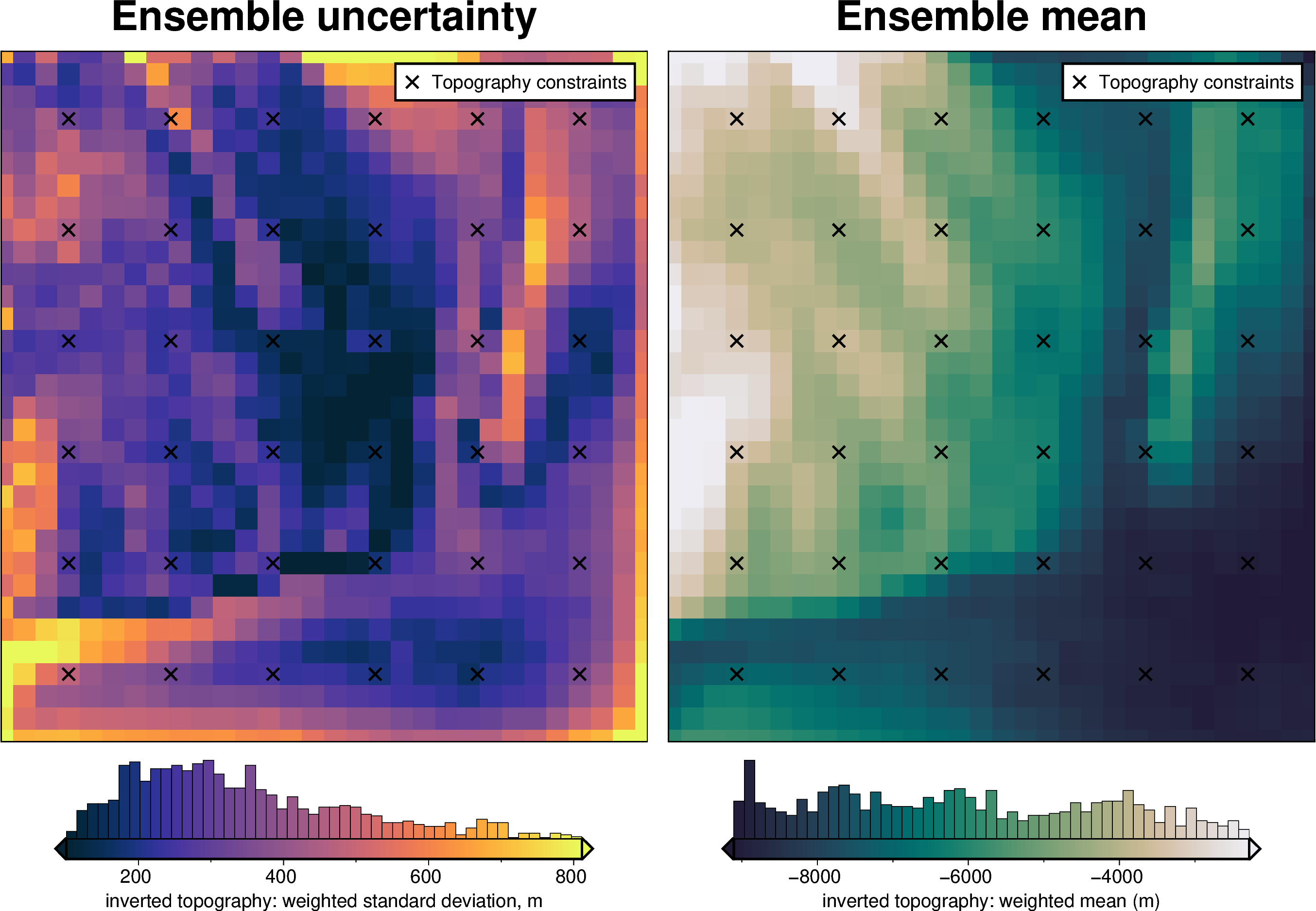
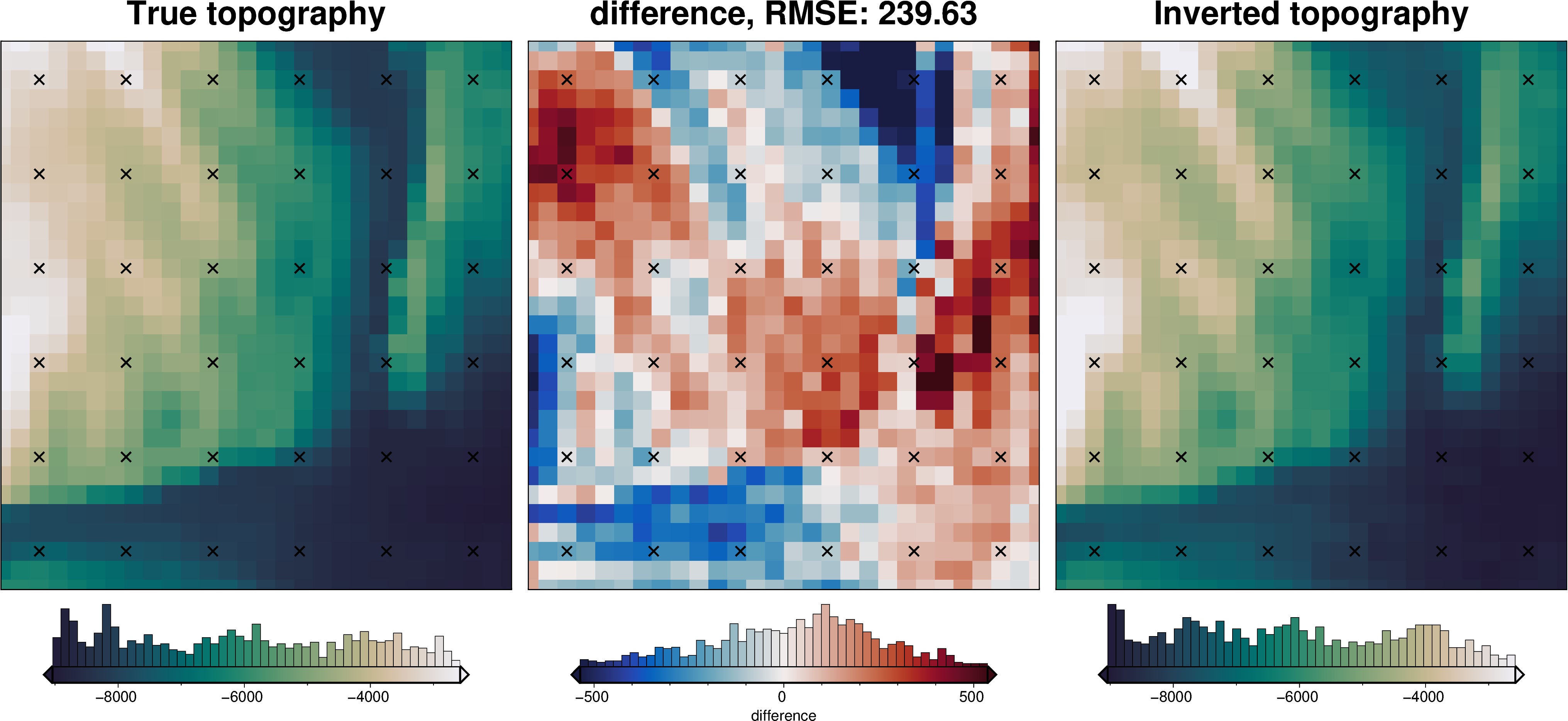
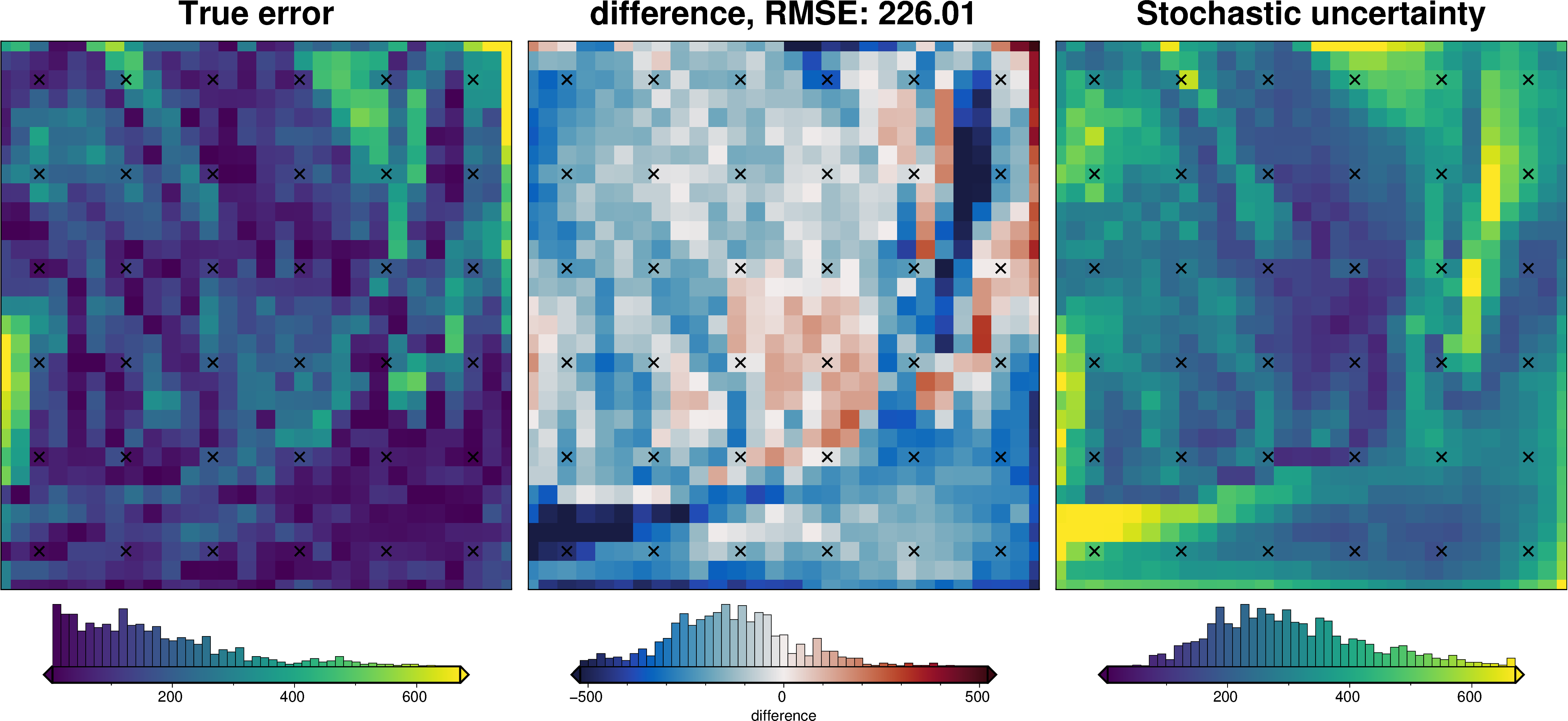
Comparing results#
[54]:
results = [
    uncert_results,
    uncert_grav_results,
    uncert_constraints_results,
    uncert_density_results,
    uncert_zref_results,
    uncert_damping_results,
    uncert_regional_results,
]

# get cell-wise stats for each ensemble
stats = []
for r in results:
    ds = uncertainty.merged_stats(
        results=r,
        plot=False,
        constraints_df=constraint_points,
        weight_by="constraints",
    )
    stats.append(ds)
[55]:
names = [
    "full",
    "grav",
    "constraints",
    "density",
    "zref",
    "damping",
    "regional",
]

# get the standard deviation of the ensemble of ensembles
stdevs = []
for i, s in enumerate(stats):
    stdevs.append(s.weighted_stdev.rename(f"{names[i]}_stdev"))

merged = xr.merge(stdevs)
merged
[55]:
<xarray.Dataset> Size: 86kB
Dimensions:            (northing: 40, easting: 38)
Coordinates:
  * northing           (northing) float64 320B 1.459e+05 1.559e+05 ... 5.359e+05
  * easting            (easting) float64 304B 6.9e+03 1.69e+04 ... 3.769e+05
Data variables:
    full_stdev         (northing, easting) float64 12kB 332.2 314.5 ... 388.4
    grav_stdev         (northing, easting) float64 12kB 0.1977 0.2633 ... 0.2144
    constraints_stdev  (northing, easting) float64 12kB 425.2 401.2 ... 373.3
    density_stdev      (northing, easting) float64 12kB 7.607 10.6 ... 9.256
    zref_stdev         (northing, easting) float64 12kB 3.295 4.644 ... 0.3084
    damping_stdev      (northing, easting) float64 12kB 0.7727 1.184 ... 1.727
regional_stdev (northing, easting) float64 12kB 5.438 7.232 ... 3.653[56]:
titles = [
    "True error",
    "Total uncertainty",
    "Uncertainty from gravity",
    "Uncertainty from constraints",
    "Uncertainty from density",
    "Uncertainty from reference level",
    "Uncertainty from damping",
    "Uncertainty from regional field",
]
grids = list(merged.data_vars.values())

# grids.insert(0, np.abs(stats[0].weighted_mean - grid.basement_topo))
grids.insert(0, inversion_error)

grids = [
    g.sel(
        {
            "easting": slice(*inversion_region[:2]),
            "northing": slice(*inversion_region[2:]),
        }
    )
    for g in grids
]

fig_height = 9
for i, g in enumerate(grids):
    xshift_amount = 1
    if i == 0:
        fig = None
        origin_shift = "initialize"
        cpt_lims = polar_utils.get_min_max(
            g,
            robust=True,
        )
    elif i == 4:
        origin_shift = "both"
        xshift_amount = -3
    else:
        origin_shift = "x"

    fig = maps.plot_grd(
        grid=g,
        fig_height=fig_height,
        title=titles[i],
        title_font="16p,Helvetica,black",
        # cmap="thermal",
        cpt_lims=cpt_lims,
        robust=True,
        cbar_label=f"standard deviation (m), mean: {int(np.nanmean(g))}",
        hist=True,
        fig=fig,
        origin_shift=origin_shift,
        xshift_amount=xshift_amount,
        yshift_amount=-1.1,
    )
    fig.plot(
        x=constraint_points.easting,
        y=constraint_points.northing,
        style="x.2c",
        pen="1.5p,white",
    )
    fig.text(
        position="TL",
        text=f"{string.ascii_lowercase[i]}",
        fill="white",
        pen=True,
        font="16p,Helvetica,black",
        offset="j.6/.2",
        clearance="+tO",
        no_clip=True,
    )
    if i == 0:
        # plot profile location, and endpoints on map
        start = [inversion_region[0], inversion_region[3]]
        stop = [inversion_region[1], inversion_region[2]]
        fig.plot(
            vd.line_coordinates(start, stop, size=100),
            pen="2p,black",
        )
        fig.text(
            x=start[0],
            y=start[1],
            text="A",
            fill="white",
            font="12p,Helvetica,black",
            justify="CM",
            clearance="+tO",
            no_clip=True,
        )
        fig.text(
            x=stop[0],
            y=stop[1],
            text="A' ",
            fill="white",
            font="12p,Helvetica,black",
            justify="CM",
            clearance="+tO",
            no_clip=True,
        )
fig.show()
[57]:
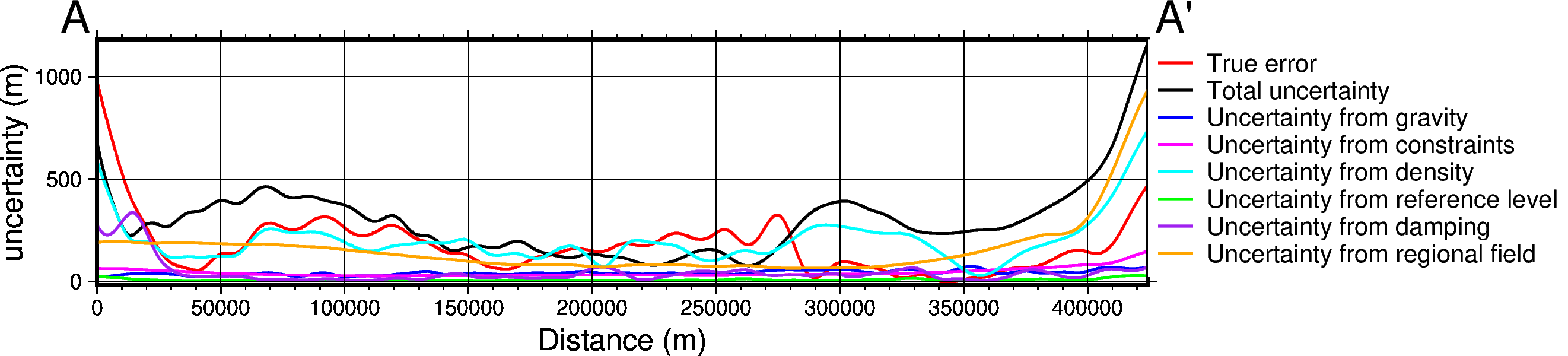
data_dict = profiles.make_data_dict(
    names=titles,
    grids=grids,
    colors=[
        "red",
        "black",
        "blue",
        "magenta",
        "cyan",
        "green",
        "purple",
        "orange",
    ],
)

fig, df_data = profiles.plot_data(
    "points",
    start=[inversion_region[0], inversion_region[3]],
    stop=[inversion_region[1], inversion_region[2]],
    num=10000,
    fig_height=4,
    fig_width=15,
    data_dict=data_dict,
    data_legend_loc="jTR+jTL",
    data_legend_box="+gwhite",
    data_buffer=0.01,
    data_frame=["neSW", "xafg+lDistance (m)", "yag+luncertainty (m)"],
    # data_pen_style=[None,None,"4_2:2p"],
    # data_pen_thickness=[1, 1.5, 1],
    share_yaxis=True,
    start_label="A",
    end_label="A' ",
)
fig.show()