
8. Combining it all#
Here we will combine the approaches of all the past inversions. Here our the main steps we will follow:
create a true topography and synthetic observed gravity
create a starting model from the points of known topography (
constraints)calculate a starting misfit
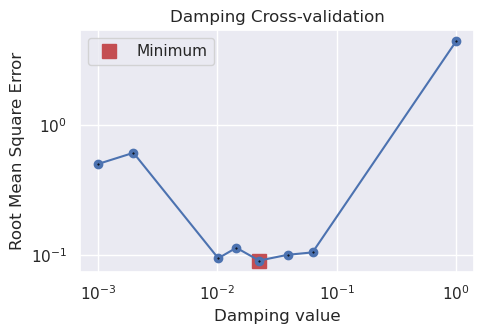
perform a damping parameter cross validation to determine the optimal damping value
use this damping value to perform a cross validation to find the optimal density and reference level values
create the weighting grid to help the inversion adhere to the constraints
perform a full final inversion constrained by the
weighting grid, using the optimal damping, density, and reference level values.
8.1. Import packages#
[1]:
%load_ext autoreload
%autoreload 2
import logging
import pathlib
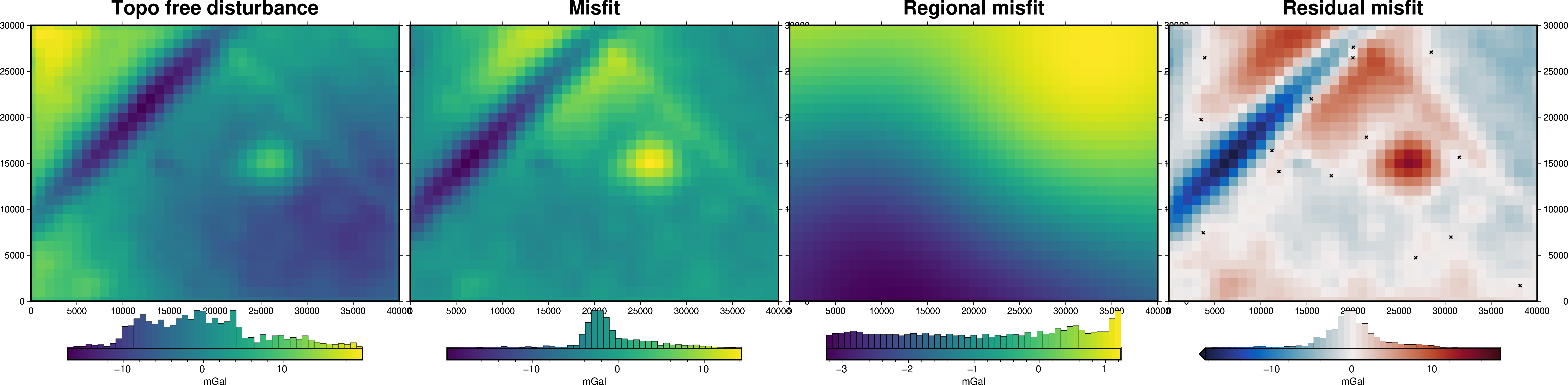
import pickle

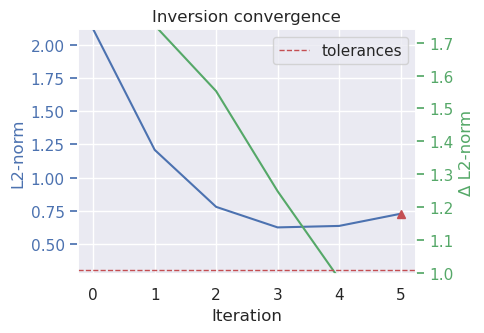
import numpy as np
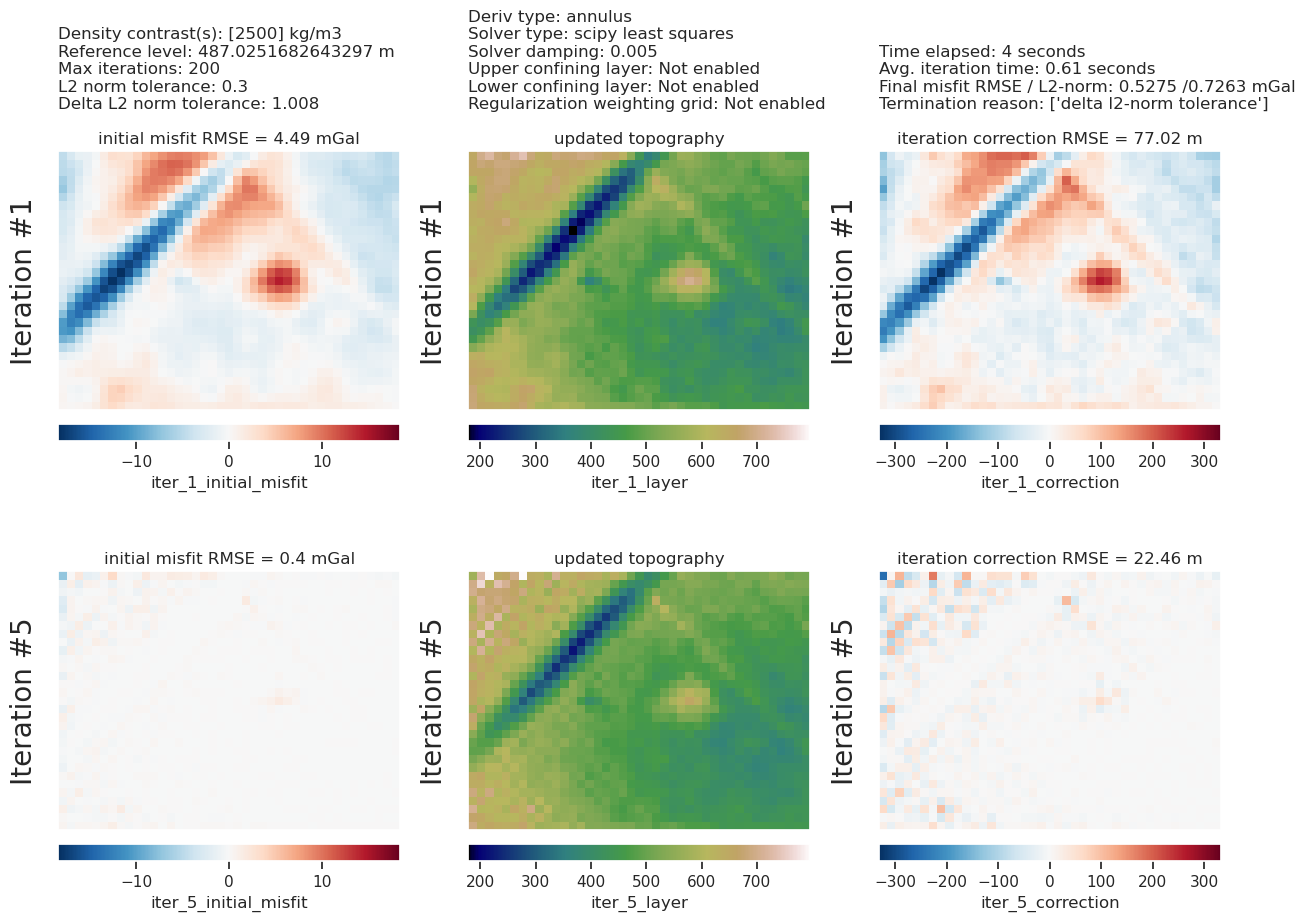
import pandas as pd
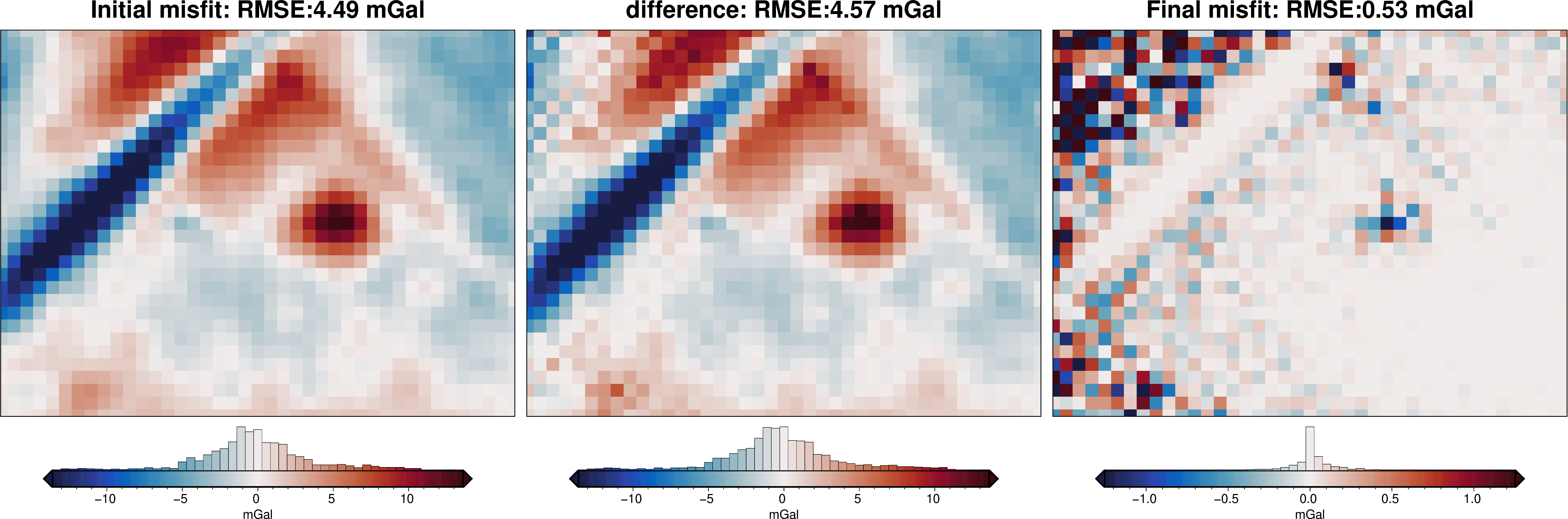
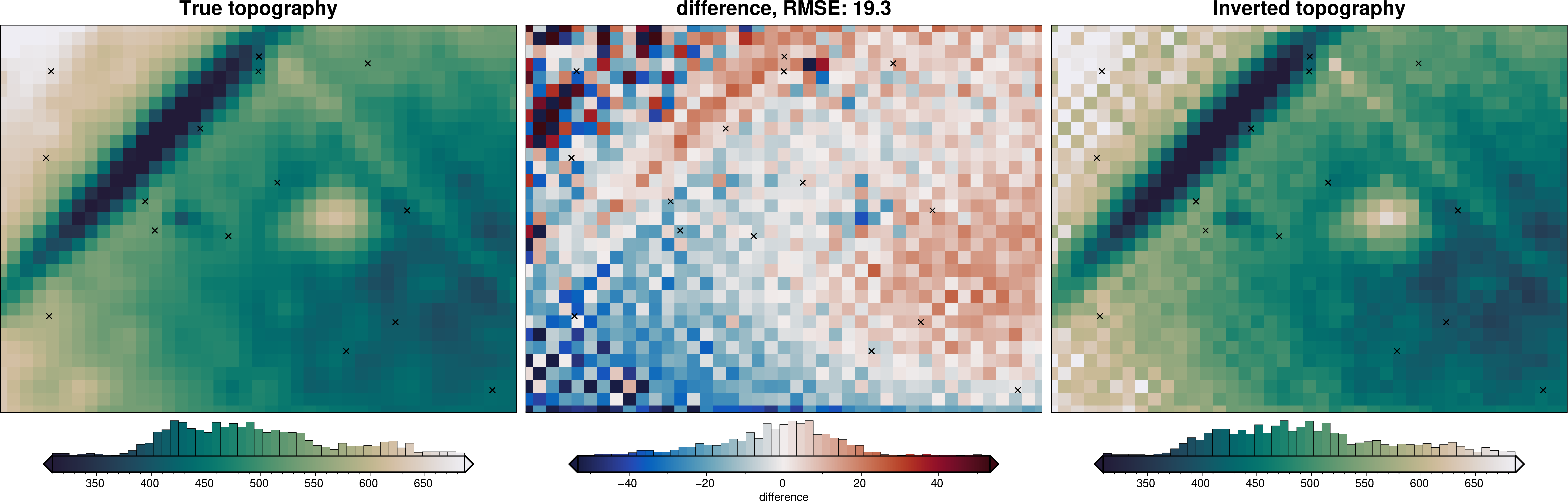
import verde as vd
import xarray as xr
from polartoolkit import maps
from polartoolkit import utils as polar_utils

from invert4geom import (
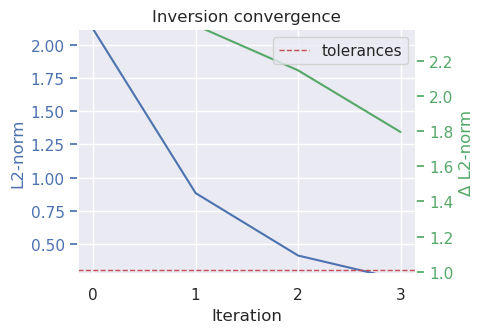
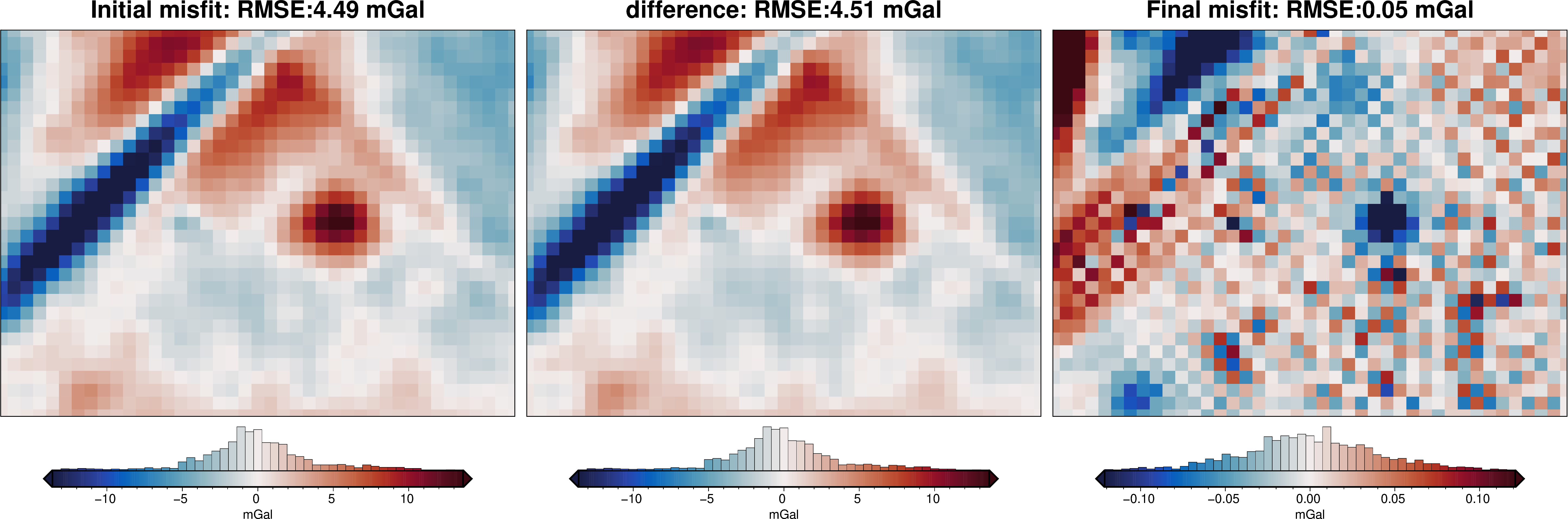
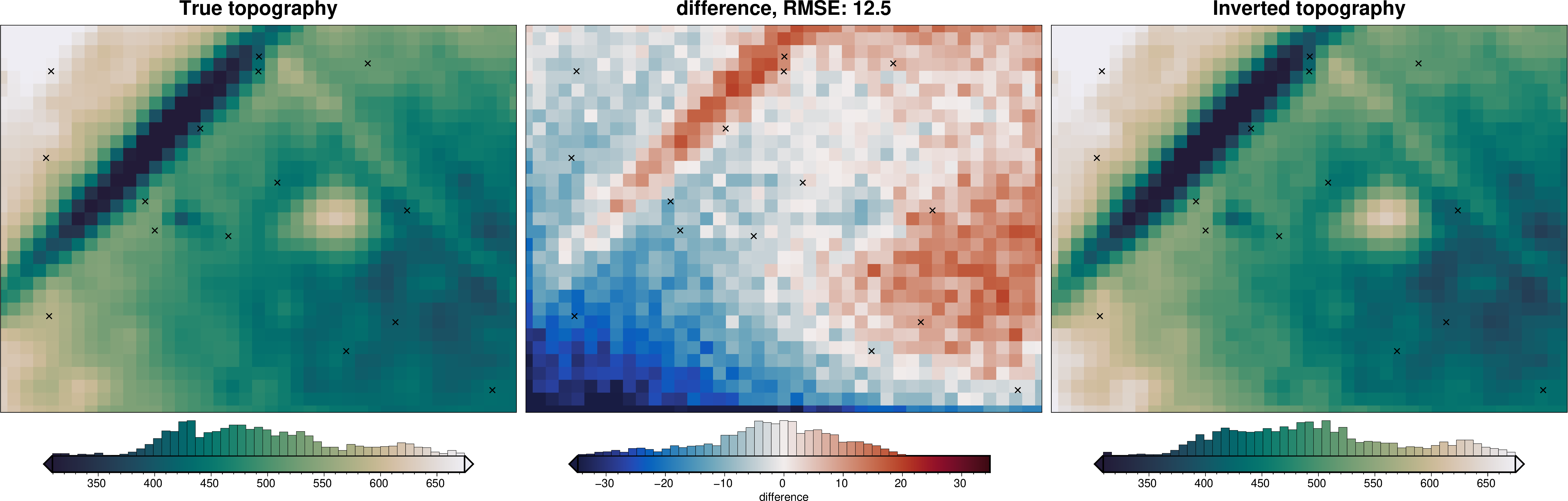
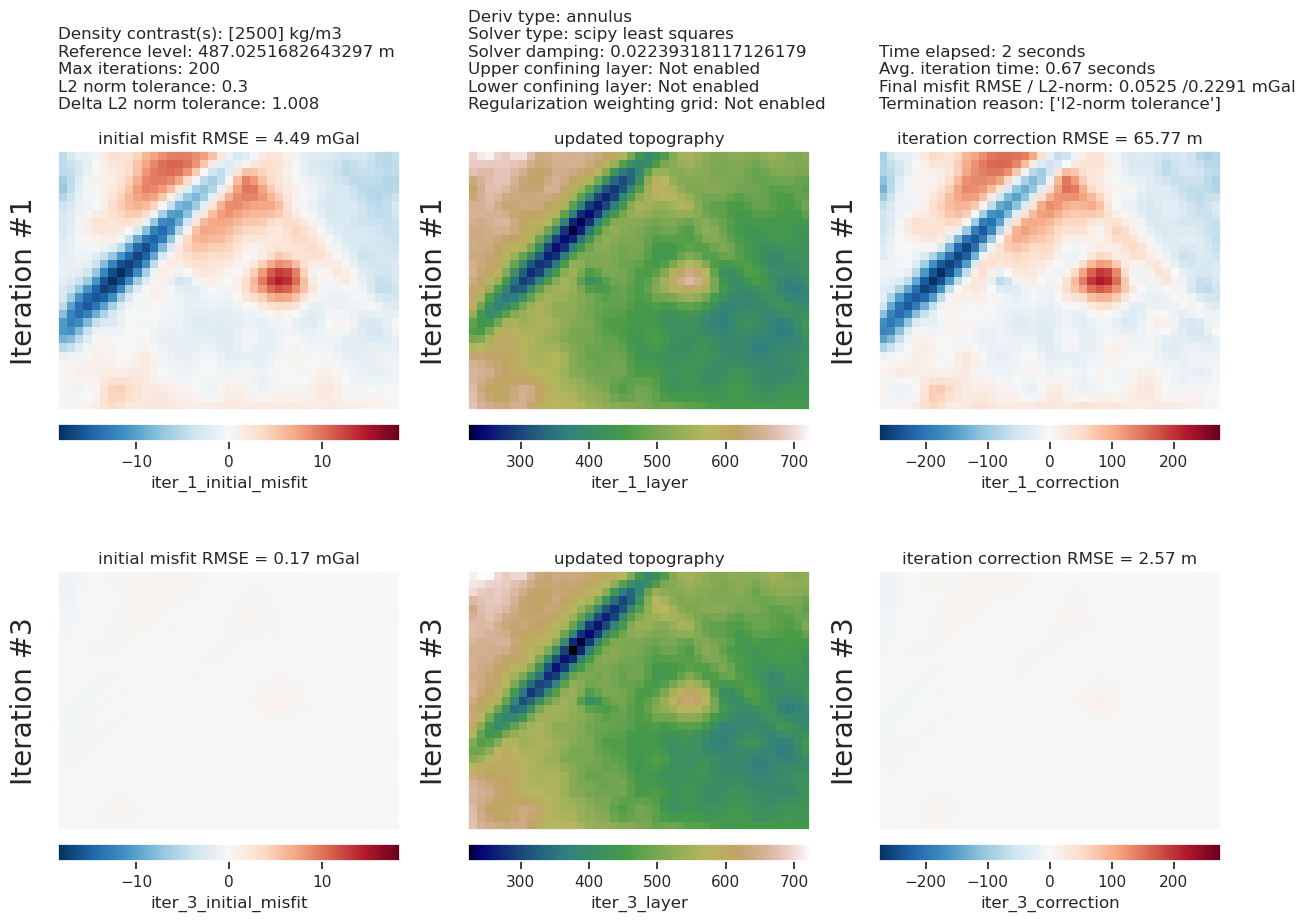
    cross_validation,
    inversion,
    optimization,
    plotting,
    regional,
    synthetic,
    uncertainty,
    utils,
)

# set up logging to see what's going on
logging.basicConfig(level=logging.INFO)
/home/mdtanker/miniforge3/envs/invert4geom/lib/python3.12/site-packages/UQpy/__init__.py:6: UserWarning:

pkg_resources is deprecated as an API. See https://setuptools.pypa.io/en/latest/pkg_resources.html. The pkg_resources package is slated for removal as early as 2025-11-30. Refrain from using this package or pin to Setuptools<81.
8.2. Get Input datasets#
[2]:
# set grid parameters
spacing = 1000
region = (0, 40000, 0, 30000)

(
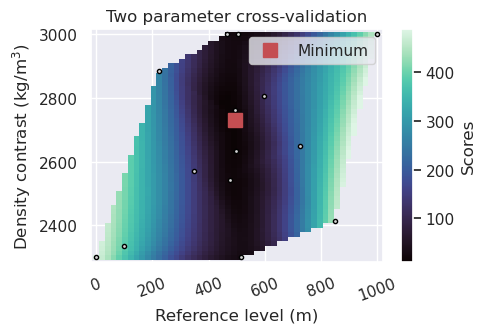
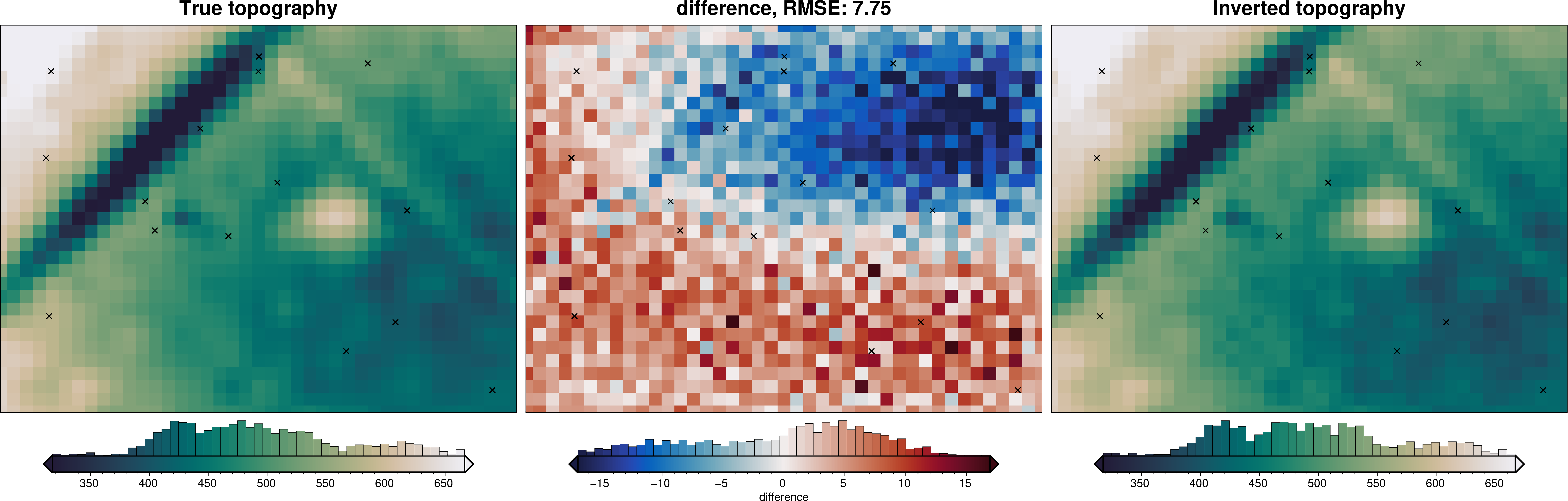
    true_topography,
    _,
    _,
    _,
) = synthetic.load_synthetic_model(
    spacing=spacing,
    region=region,
    topography_coarsen_factor=2,
    topography_percent_noise=0.02,
)

# create lower synthetic topography data
lower_topography = synthetic.synthetic_topography_regional(
    spacing,
    region,
    scale=1,
    yoffset=-1000,
)

true_zref = true_topography.to_numpy().mean()
print(f"mean of true topography: {true_zref} m ")
INFO:invert4geom:Standard deviation used for noise: [14.371030389252887]
INFO:polartoolkit:changing grid spacing
WARNING:polartoolkit:requested spacing (1000.0) is smaller than the original (2000.0).
mean of true topography: 492.2589625197673 m
[3]:
# the density contrast is between rock (~2670 kg/m3) and air (~1 kg/m3)
true_density_contrast = 2670 - 1

# prisms are created between the mean topography value and the height of the topography
true_zref = true_topography.to_numpy().mean()

# prisms above zref have positive density contrast and prisms below zref have negative
# density contrast
density_grid = xr.where(
    true_topography >= true_zref,
    true_density_contrast,
    -true_density_contrast,
)

# create layer of prisms
prisms = utils.grids_to_prisms(
    true_topography,
    true_zref,
    density=density_grid,
)

# the density contrast is between lower crust (~3100 kg/m3) and rock (~2670 kg/m3)
density_contrast = 3100 - 2670
zref = lower_topography.to_numpy().mean()

density_grid = xr.where(lower_topography >= zref, density_contrast, -density_contrast)
lower_prisms = utils.grids_to_prisms(
    lower_topography,
    zref,
    density=density_grid,
)

plotting.show_prism_layers(
    [prisms, lower_prisms],
    color_by="thickness",
    log_scale=False,
    zscale=20,
    backend="static",
)

print(f"mean topography is {prisms.attrs.get('zref')} m")
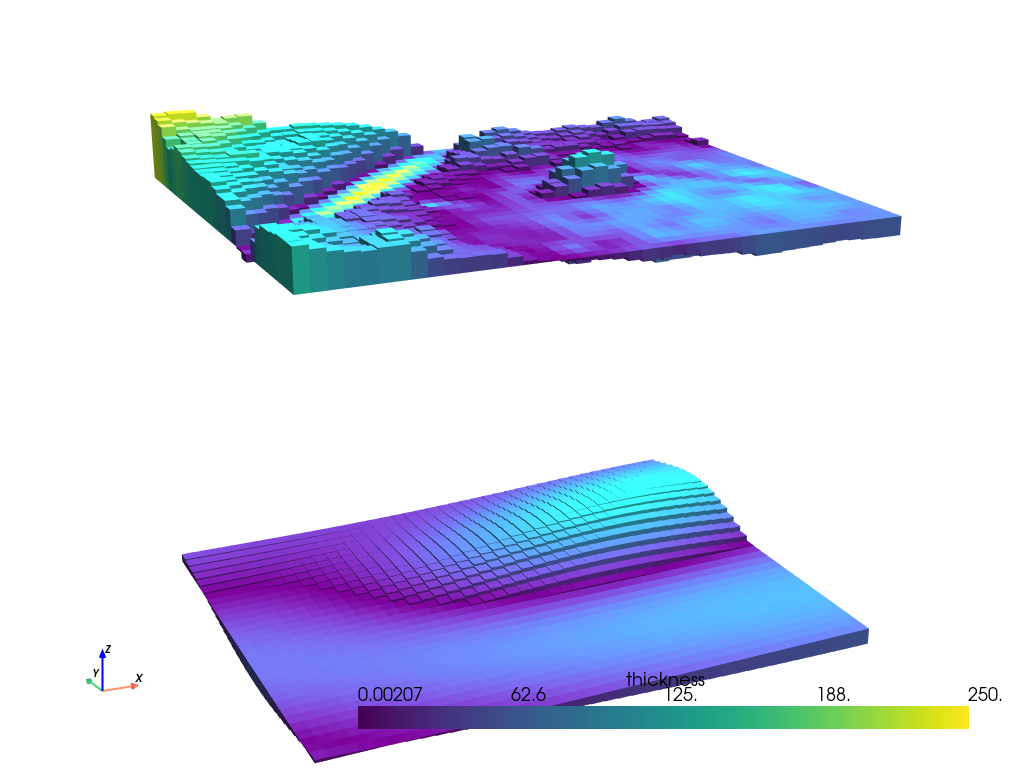
mean topography is 492.2589625197673 m
[4]:
# make pandas dataframe of locations to calculate gravity
# this represents the station locations of a gravity survey
# create lists of coordinates
coords = vd.grid_coordinates(
    region=region,
    spacing=spacing,
    pixel_register=False,
    extra_coords=1001,  # survey elevation
)

# grid the coordinates
observations = vd.make_xarray_grid(
    (coords[0], coords[1]),
    data=coords[2],
    data_names="upward",
    dims=("northing", "easting"),
).upward

grav_df = vd.grid_to_table(observations)

grav_df["upper_surface_grav"] = prisms.prism_layer.gravity(
    coordinates=(
        grav_df.easting,
        grav_df.northing,
        grav_df.upward,
    ),
    field="g_z",
    progressbar=True,
)

# forward gravity of lower surface prisms
grav_df["lower_surface_grav"] = lower_prisms.prism_layer.gravity(
    coordinates=(
        grav_df.easting,
        grav_df.northing,
        grav_df.upward,
    ),
    field="g_z",
    progressbar=True,
)

grav_df["observed_grav"] = grav_df.upper_surface_grav + grav_df.lower_surface_grav
grav_df
[4]:
| northing | easting | upward | upper_surface_grav | lower_surface_grav | observed_grav | |
|---|---|---|---|---|---|---|
| 0 | 0.0 | 0.0 | 1001.0 | 9.042402 | -0.041223 | 9.001179 |
| 1 | 0.0 | 1000.0 | 1001.0 | 9.568091 | -0.052122 | 9.515969 |
| 2 | 0.0 | 2000.0 | 1001.0 | 8.893385 | -0.068787 | 8.824597 |
| 3 | 0.0 | 3000.0 | 1001.0 | 8.340538 | -0.088267 | 8.252271 |
| 4 | 0.0 | 4000.0 | 1001.0 | 8.106203 | -0.108803 | 7.997400 |
| ... | ... | ... | ... | ... | ... | ... |
| 1266 | 30000.0 | 36000.0 | 1001.0 | 4.192357 | 0.658225 | 4.850582 |
| 1267 | 30000.0 | 37000.0 | 1001.0 | 3.673730 | 0.641455 | 4.315185 |
| 1268 | 30000.0 | 38000.0 | 1001.0 | 2.982330 | 0.607664 | 3.589994 |
| 1269 | 30000.0 | 39000.0 | 1001.0 | 2.946999 | 0.545480 | 3.492479 |
| 1270 | 30000.0 | 40000.0 | 1001.0 | 2.784613 | 0.441061 | 3.225674 |
1271 rows × 6 columns
[5]:
# contaminate gravity with 0.1 mGal of random noise
grav_df["gravity_anomaly"], stddev = synthetic.contaminate(
    grav_df.observed_grav,
    stddev=0.1,
    percent=False,
    seed=0,
)
grav_df["uncert"] = stddev
INFO:invert4geom:Standard deviation used for noise: [0.1]
[6]:
grav_grid = grav_df.set_index(["northing", "easting"]).to_xarray()

fig = maps.plot_grd(
    grav_grid.lower_surface_grav,
    fig_height=10,
    title="lower prisms gravity",
    cmap="viridis",
    hist=True,
    cbar_label="mGal",
    frame=["nSWe", "xaf10000", "yaf10000"],
)

fig = maps.plot_grd(
    grav_grid.upper_surface_grav,
    fig=fig,
    origin_shift="x",
    fig_height=10,
    title="upper prisms gravity",
    cmap="viridis",
    hist=True,
    cbar_label="mGal",
    frame=["nSwE", "xaf10000", "yaf10000"],
)

fig = maps.plot_grd(
    grav_grid.gravity_anomaly,
    fig=fig,
    origin_shift="x",
    fig_height=10,
    title="Observed gravity",
    cmap="viridis",
    hist=True,
    cbar_label="mGal",
    frame=["nSwE", "xaf10000", "yaf10000"],
)

fig.show()
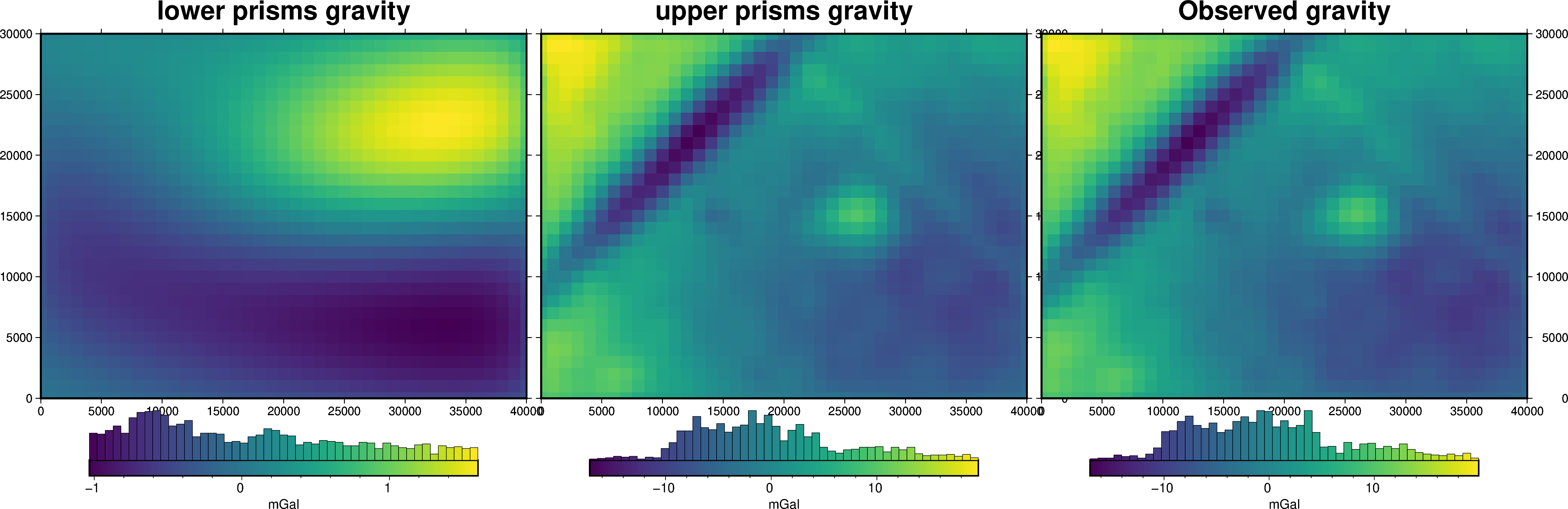
8.3. Create “a-priori” topography measurements#
[7]:
# create 15 random point within the outcropping basement region
num_constraints = 15
coords = vd.scatter_points(
    region=vd.pad_region(region, -spacing),
    size=num_constraints,
    random_state=7,
)
constraint_points = pd.DataFrame(data={"easting": coords[0], "northing": coords[1]})

# sample true topography at these points
constraint_points = utils.sample_grids(
    constraint_points,
    true_topography,
    "true_upward",
)

constraint_points["upward"] = constraint_points.true_upward
constraint_points.head()
[7]:
| easting | northing | true_upward | upward | |
|---|---|---|---|---|
| 0 | 3899.714996 | 26468.618776 | 666.725645 | 666.725645 |
| 1 | 30636.914105 | 6974.789900 | 406.379413 | 406.379413 |
| 2 | 17659.550795 | 13659.470931 | 480.393921 | 480.393921 |
| 3 | 28491.676758 | 27073.768551 | 517.183455 | 517.183455 |
| 4 | 38163.601456 | 1697.178371 | 435.459979 | 435.459979 |
[8]:
# re-sample depths with uncertainty to emulate measurement errors
# set each points uncertainty equal to 2% of depth
uncert = np.abs(0.02 * constraint_points.upward)
constraint_points.loc[constraint_points.index, "uncert"] = uncert

constraint_points = uncertainty.randomly_sample_data(
    seed=0,
    data_df=constraint_points,
    data_col="upward",
    uncert_col="uncert",
)

# create weights column
constraint_points["weight"] = 1 / (constraint_points.uncert**2)

constraint_points.head()
[8]:
| easting | northing | true_upward | upward | uncert | weight | |
|---|---|---|---|---|---|---|
| 0 | 3899.714996 | 26468.618776 | 666.725645 | 668.402196 | 13.334513 | 0.005624 |
| 1 | 30636.914105 | 6974.789900 | 406.379413 | 405.305719 | 8.127588 | 0.015138 |
| 2 | 17659.550795 | 13659.470931 | 480.393921 | 486.547024 | 9.607878 | 0.010833 |
| 3 | 28491.676758 | 27073.768551 | 517.183455 | 518.268507 | 10.343669 | 0.009347 |
| 4 | 38163.601456 | 1697.178371 | 435.459979 | 430.794727 | 8.709200 | 0.013184 |
8.4. Create starting model#
[9]:
# grid the sampled values using verde
starting_topography_kwargs = dict(
    method="splines",
    region=region,
    spacing=spacing,
    constraints_df=constraint_points,
    dampings=np.logspace(-40, 0, 100),
    weights_col="weight",
)

starting_topography = utils.create_topography(**starting_topography_kwargs)

_ = polar_utils.grd_compare(
    true_topography,
    starting_topography,
    region=region,
    grid1_name="True topography",
    grid2_name="Starting topography",
    robust=True,
    hist=True,
    inset=False,
    title="difference",
    grounding_line=False,
    reverse_cpt=True,
    cmap="rain",
    points=constraint_points,
    points_style="x.3c",
)
INFO:invert4geom:Best SplineCV score: 0.6403721398666893
INFO:invert4geom:Best damping: 1.3530477745797964e-07
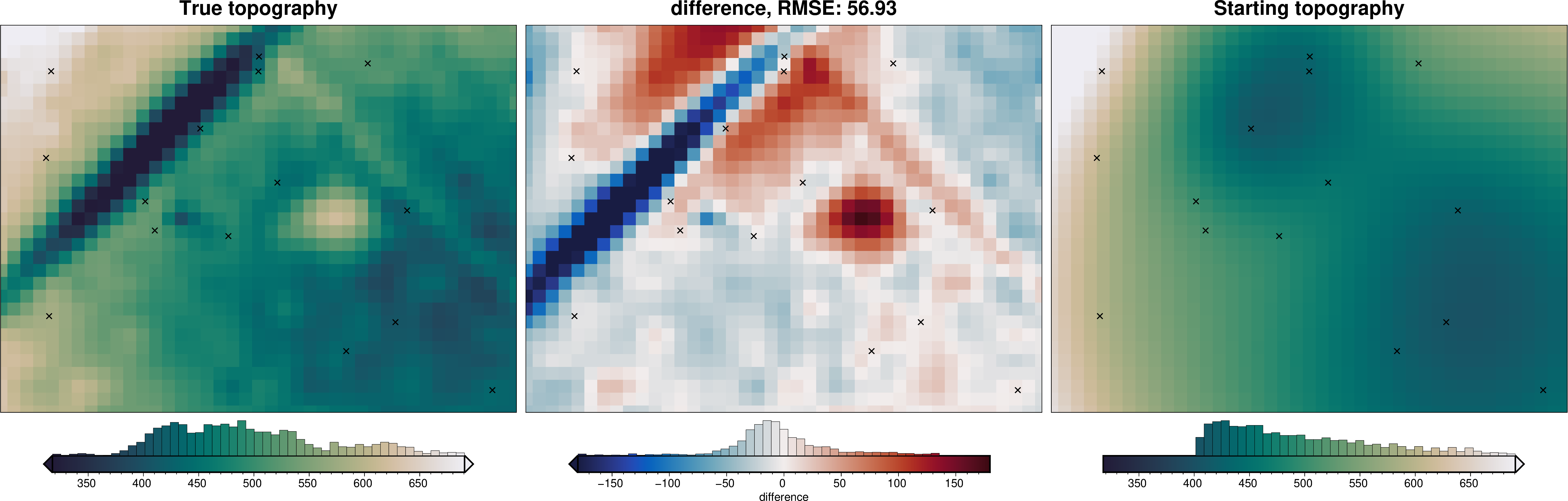
[10]:
# the true zref value is 492 m
zref = constraint_points.upward.mean()

# the true density contrast is 2669 kg/m3
density_contrast = 2500

# prisms above zref have positive density contrast and prisms below zref have negative
# density contrast
density_grid = xr.where(
    starting_topography >= zref, density_contrast, -density_contrast
)

# create layer of prisms
starting_prisms = utils.grids_to_prisms(
    starting_topography,
    zref,
    density=density_grid,
)
plotting.show_prism_layers(
    starting_prisms,
    color_by="density",
    log_scale=False,
    zscale=20,
    backend="static",
)
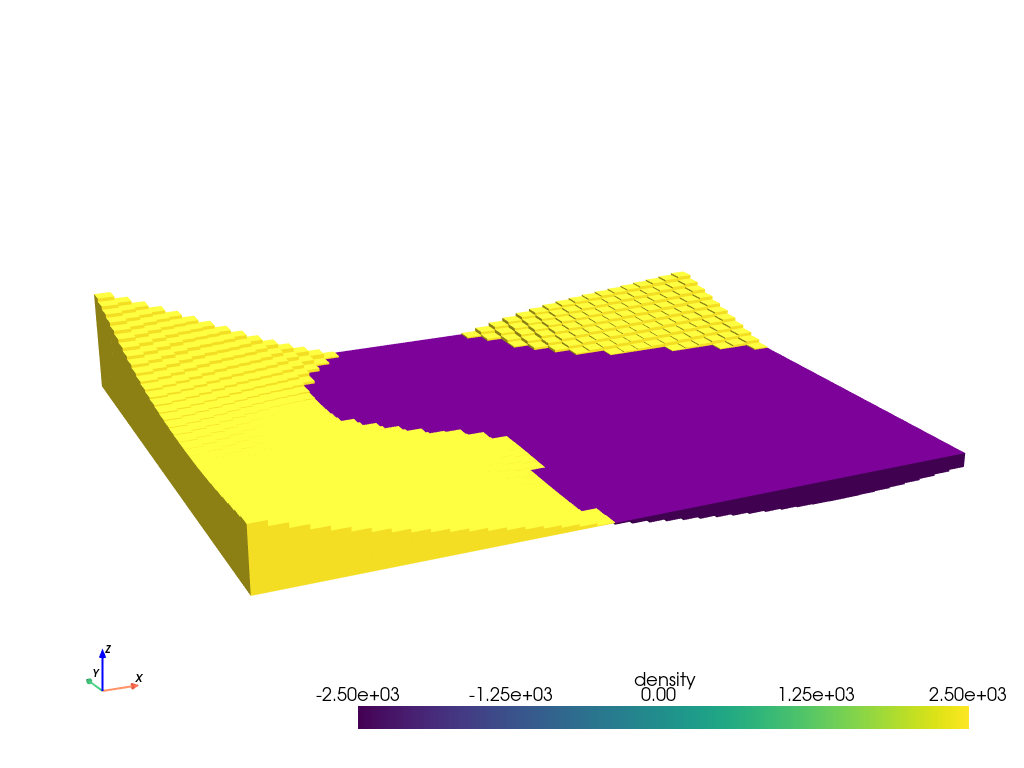
8.5. Calculate starting gravity misfit#
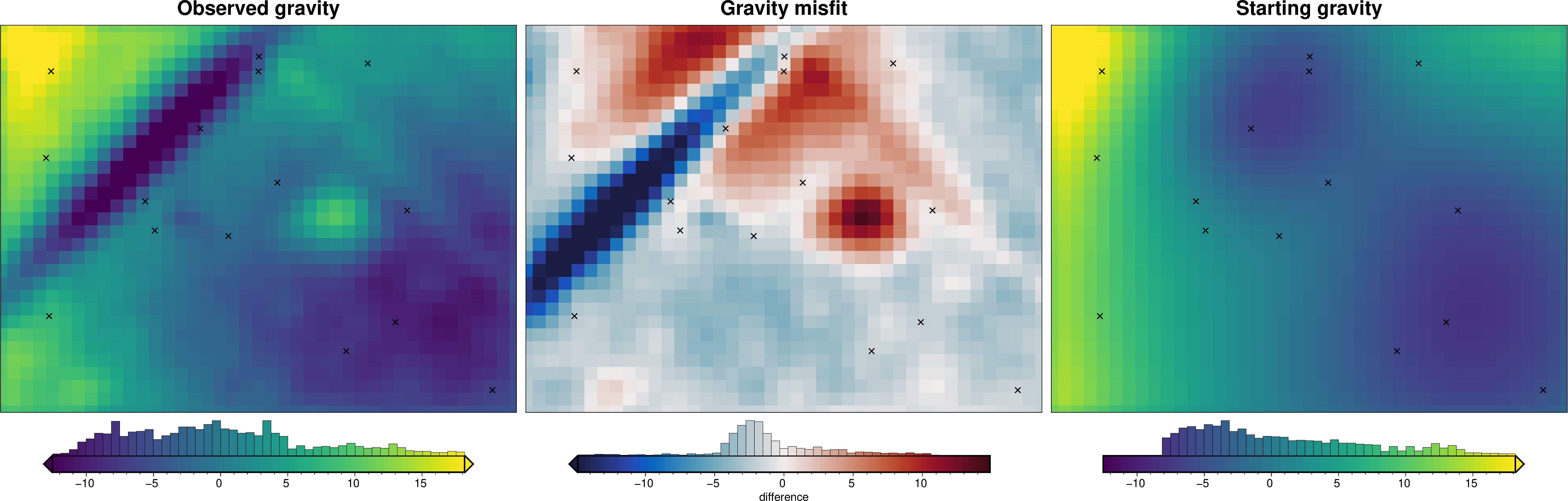
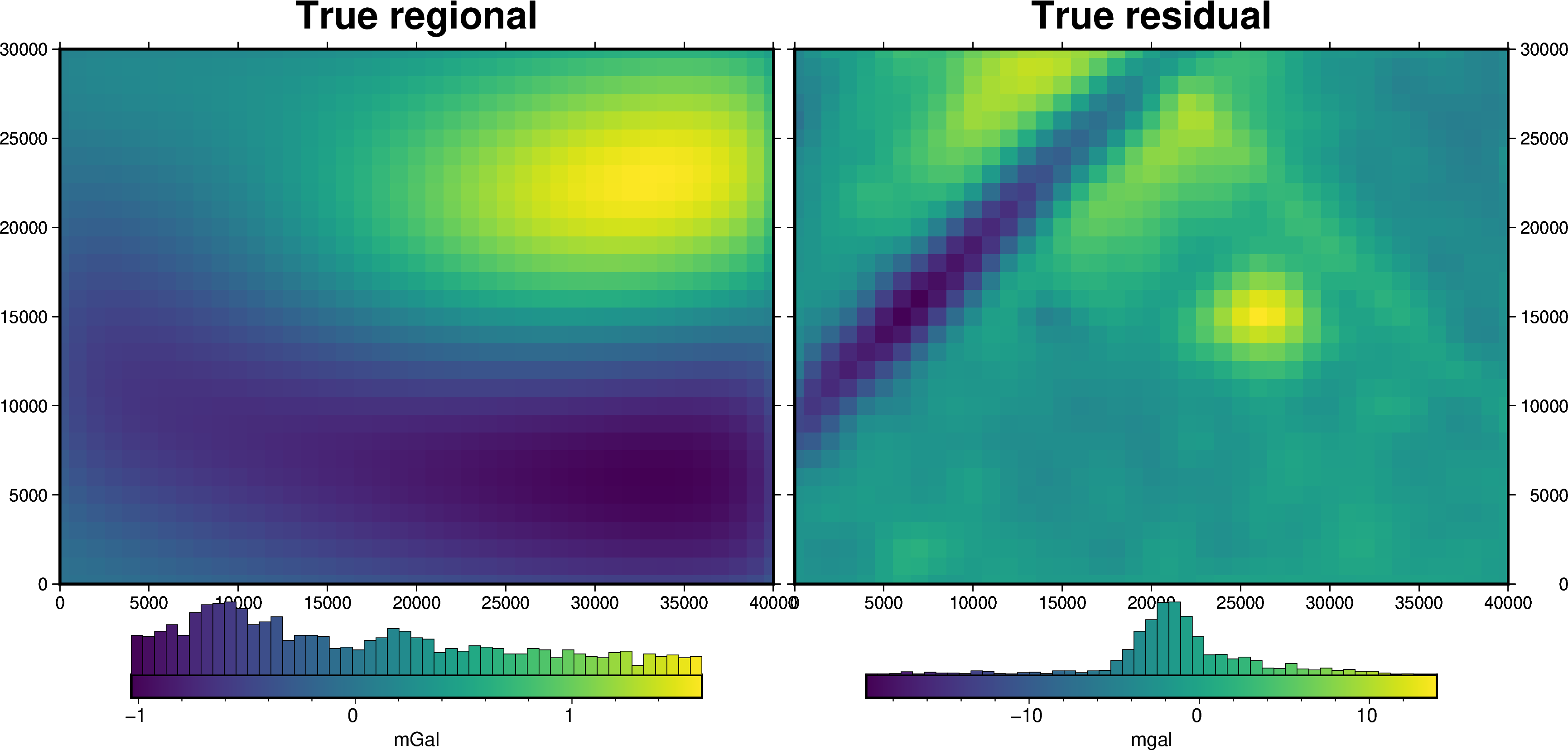
Now we need to calculate the forward gravity of the starting topography. We then can subtract it from our observed gravity to get a starting gravity misfit.
We don’t know the optimal values for the density contrast or the reference level, so we will make a guess at appropriate values for the starting model.
[11]:
# calculate forward gravity of starting prism layer
grav_df["starting_gravity"] = starting_prisms.prism_layer.gravity(
    coordinates=(
        grav_df.easting,
        grav_df.northing,
        grav_df.upward,
    ),
    field="g_z",
    progressbar=True,
)

# calculate the true residual misfit
grav_df["true_res"] = (
    grav_df.gravity_anomaly - grav_df.starting_gravity - grav_df.lower_surface_grav
)

grav_df.describe()
[11]:
| northing | easting | upward | upper_surface_grav | lower_surface_grav | observed_grav | gravity_anomaly | uncert | starting_gravity | true_res | |
|---|---|---|---|---|---|---|---|---|---|---|
| count | 1271.000000 | 1271.00000 | 1271.0 | 1271.000000 | 1271.000000 | 1271.000000 | 1271.000000 | 1.271000e+03 | 1271.000000 | 1271.000000 |
| mean | 15000.000000 | 20000.00000 | 1001.0 | -0.128924 | 0.004007 | -0.124917 | -0.124917 | 1.000000e-01 | 1.130048 | -1.258972 |
| std | 8947.792584 | 11836.81698 | 0.0 | 7.128555 | 0.714063 | 7.271000 | 7.269461 | 2.776650e-17 | 6.906876 | 4.602393 |
| min | 0.000000 | 0.00000 | 1001.0 | -17.179165 | -1.033526 | -16.887668 | -17.040892 | 1.000000e-01 | -8.029374 | -19.592048 |
| 25% | 7000.000000 | 10000.00000 | 1001.0 | -5.448852 | -0.601914 | -5.750137 | -5.739415 | 1.000000e-01 | -4.384273 | -3.001265 |
| 50% | 15000.000000 | 20000.00000 | 1001.0 | -1.160222 | -0.153040 | -0.758131 | -0.713654 | 1.000000e-01 | -0.620986 | -1.444045 |
| 75% | 23000.000000 | 30000.00000 | 1001.0 | 3.675021 | 0.541706 | 3.825804 | 3.815224 | 1.000000e-01 | 5.463603 | 0.461464 |
| max | 30000.000000 | 40000.00000 | 1001.0 | 19.599674 | 1.599823 | 19.781652 | 19.936108 | 1.000000e-01 | 23.315668 | 13.969990 |
[12]:
# grid the results
grav_grid = grav_df.set_index(["northing", "easting"]).to_xarray()

_ = polar_utils.grd_compare(
    grav_grid.gravity_anomaly,
    grav_grid.starting_gravity,
    grid1_name="Observed gravity",
    grid2_name="Starting gravity",
    robust=True,
    hist=True,
    inset=False,
    title="Gravity misfit",
    rmse_in_title=False,
    grounding_line=False,
    points=constraint_points,
    points_style="x.3c",
)
[13]:
fig = maps.plot_grd(
    grav_grid.lower_surface_grav,
    fig_height=10,
    title="True regional",
    hist=True,
    cbar_label="mGal",
    frame=["nSWe", "xaf10000", "yaf10000"],
)

fig = maps.plot_grd(
    grav_grid.true_res,
    fig=fig,
    origin_shift="x",
    fig_height=10,
    title="True residual",
    hist=True,
    cbar_label="mgal",
    frame=["nSwE", "xaf10000", "yaf10000"],
)

fig.show()
8.6. Regional separation#
[14]:
def regional_comparison(df):
    # grid the results
    grav_grid = df.set_index(["northing", "easting"]).to_xarray()

    # compare with true regional
    _ = polar_utils.grd_compare(
        grav_grid.lower_surface_grav,
        grav_grid.reg,
        robust=True,
        grid1_name="True regional field",
        grid2_name="Estimated regional field",
        hist=True,
        inset=False,
        title="difference",
        grounding_line=False,
        points=constraint_points,
        points_style="x.3c",
    )
    # compare with true residual
    _ = polar_utils.grd_compare(
        grav_grid.true_res,
        grav_grid.res,
        robust=True,
        grid1_name="True residual field",
        grid2_name="Estimated residual field",
        hist=True,
        inset=False,
        title="difference",
        grounding_line=False,
        points=constraint_points,
        points_style="x.3c",
    )
[15]:
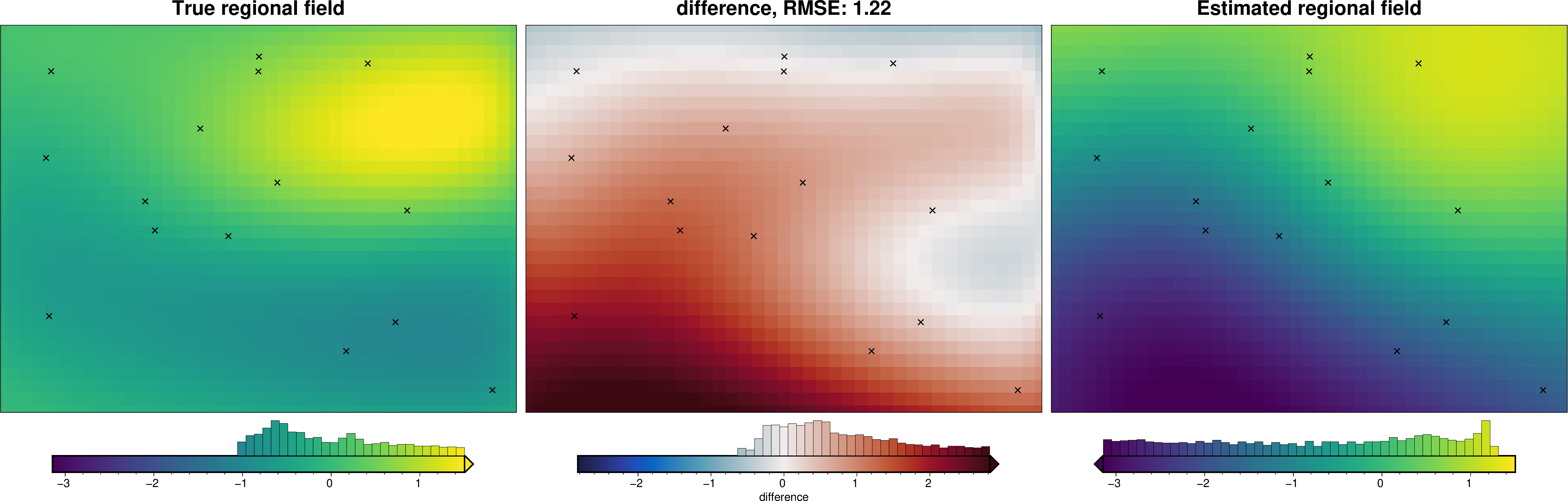
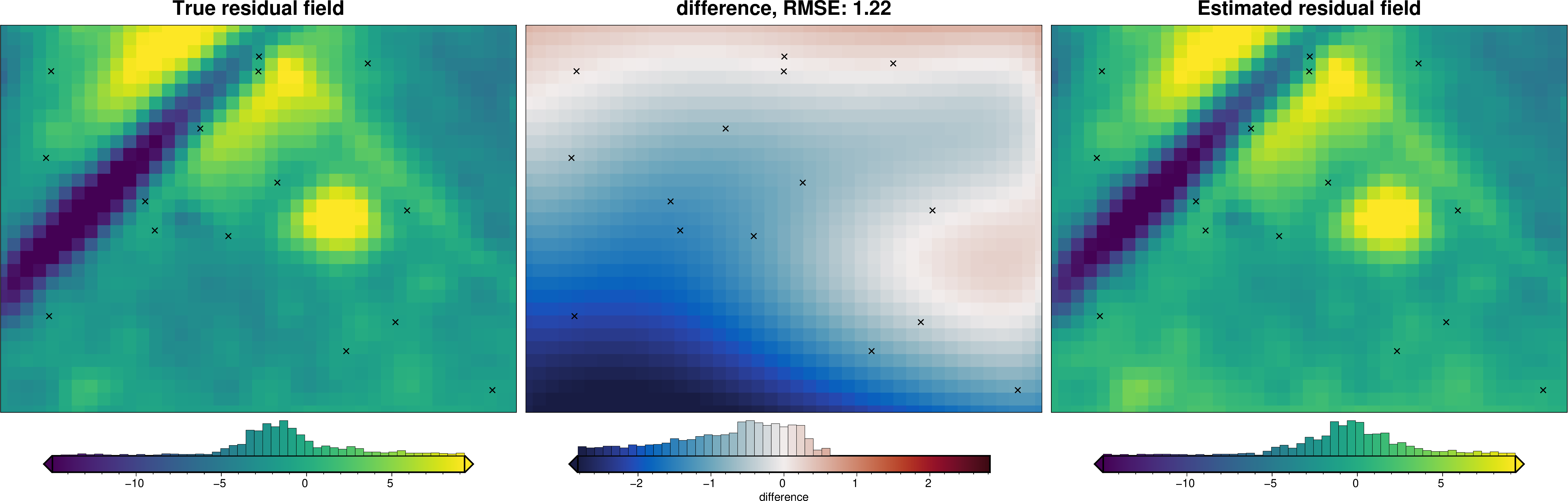
# estimate regional with the mean misfit at constraints
regional_grav_kwargs = dict(
    method="constraints",
    grid_method="eq_sources",
    constraints_df=constraint_points,
    constraints_weights_column="weight",
    cv=True,
    cv_kwargs=dict(
        n_trials=50,
        damping_limits=(1e-10, 1),
        # depth_limits=(1e3,100e3),
        progressbar=False,
        fname="../tmp/regional_sep",
        # plot=True,
    ),
    depth="default",
    block_size=None,
)

grav_df = regional.regional_separation(
    grav_df=grav_df,
    **regional_grav_kwargs,
)

regional_comparison(grav_df)
grav_df.describe()
INFO:invert4geom:using 12 startup trials
INFO:invert4geom:Trial with best score:
INFO:invert4geom:       trial number: 29
INFO:invert4geom:       parameter: {'damping': 0.0007645086132828042}
INFO:invert4geom:       scores: [-0.261367068796698]
[15]:
| northing | easting | upward | upper_surface_grav | lower_surface_grav | observed_grav | gravity_anomaly | uncert | starting_gravity | true_res | misfit | reg | res | |
|---|---|---|---|---|---|---|---|---|---|---|---|---|---|
| count | 1271.000000 | 1271.00000 | 1271.0 | 1271.000000 | 1271.000000 | 1271.000000 | 1271.000000 | 1.271000e+03 | 1271.000000 | 1271.000000 | 1271.000000 | 1271.000000 | 1271.000000 |
| mean | 15000.000000 | 20000.00000 | 1001.0 | -0.128924 | 0.004007 | -0.124917 | -0.124917 | 1.000000e-01 | 1.130048 | -1.258972 | -1.254965 | -0.826201 | -0.428763 |
| std | 8947.792584 | 11836.81698 | 0.0 | 7.128555 | 0.714063 | 7.271000 | 7.269461 | 2.776650e-17 | 6.906876 | 4.602393 | 4.828938 | 1.381250 | 4.468387 |
| min | 0.000000 | 0.00000 | 1001.0 | -17.179165 | -1.033526 | -16.887668 | -17.040892 | 1.000000e-01 | -8.029374 | -19.592048 | -19.972714 | -3.252807 | -18.401653 |
| 25% | 7000.000000 | 10000.00000 | 1001.0 | -5.448852 | -0.601914 | -5.750137 | -5.739415 | 1.000000e-01 | -4.384273 | -3.001265 | -3.103593 | -2.061124 | -2.179234 |
| 50% | 15000.000000 | 20000.00000 | 1001.0 | -1.160222 | -0.153040 | -0.758131 | -0.713654 | 1.000000e-01 | -0.620986 | -1.444045 | -1.845960 | -0.728762 | -0.376594 |
| 75% | 23000.000000 | 30000.00000 | 1001.0 | 3.675021 | 0.541706 | 3.825804 | 3.815224 | 1.000000e-01 | 5.463603 | 0.461464 | 0.793943 | 0.449259 | 1.566836 |
| max | 30000.000000 | 40000.00000 | 1001.0 | 19.599674 | 1.599823 | 19.781652 | 19.936108 | 1.000000e-01 | 23.315668 | 13.969990 | 14.301613 | 1.237170 | 14.384863 |
[16]:
grav_grid = grav_df.set_index(["northing", "easting"]).to_xarray()

fig = maps.plot_grd(
    grav_grid.gravity_anomaly,
    fig_height=10,
    title="Topo free disturbance",
    cmap="viridis",
    hist=True,
    cbar_label="mGal",
    frame=["nSWe", "xaf10000", "yaf10000"],
)

fig = maps.plot_grd(
    grav_grid.misfit,
    fig=fig,
    origin_shift="x",
    fig_height=10,
    title="Misfit",
    cmap="viridis",
    hist=True,
    cbar_label="mGal",
    frame=["nSwE", "xaf10000", "yaf10000"],
)

fig = maps.plot_grd(
    grav_grid.reg,
    fig=fig,
    origin_shift="x",
    fig_height=10,
    title="Regional misfit",
    cmap="viridis",
    hist=True,
    cbar_label="mGal",
    frame=["nSwE", "xaf10000", "yaf10000"],
)

fig = maps.plot_grd(
    grav_grid.res,
    fig=fig,
    origin_shift="x",
    fig_height=10,
    title="Residual misfit",
    cmap="balance+h0",
    cpt_lims=[-vd.maxabs(grav_grid.res), vd.maxabs(grav_grid.res)],
    hist=True,
    cbar_label="mGal",
    frame=["nSwE", "xaf10000", "yaf10000"],
    points=constraint_points,
    points_style="x.15c",
)
fig.show()
8.7. Single inversion#
Perform a single inversion to experiment with values of stopping criteria.
[17]:
# set kwargs to pass to the inversion
kwargs = {
    # set stopping criteria
    "max_iterations": 200,
    "l2_norm_tolerance": 0.3,  # grav error of .1mGal -> sqrt(.1) = 0.3
    "delta_l2_norm_tolerance": 1.008,
}
[18]:
# run the inversion workflow, including a cross validation for the damping parameter
inversion_results = inversion.run_inversion_workflow(
    grav_df=grav_df,
    solver_damping=0.005,
    fname="../tmp/combining_it_all",
    starting_prisms=starting_prisms,
    plot_dynamic_convergence=True,
    **kwargs,
)
[19]:
# collect the results
topo_results, grav_results, parameters, elapsed_time = inversion_results

plotting.plot_inversion_results(
    grav_results,
    topo_results,
    parameters,
    region,
    iters_to_plot=2,
    plot_iter_results=True,
    plot_topo_results=False,
    plot_grav_results=True,
)

final_topography = topo_results.set_index(["northing", "easting"]).to_xarray().topo

_ = polar_utils.grd_compare(
    true_topography,
    final_topography,
    grid1_name="True topography",
    grid2_name="Inverted topography",
    robust=True,
    hist=True,
    inset=False,
    title="difference",
    grounding_line=False,
    reverse_cpt=True,
    cmap="rain",
    points=constraint_points,
    points_style="x.3c",
)
8.8. Damping parameter cross validation#
8.8.1. Resample to create testing / training data sets#
[20]:
# resample to half spacing
grav_df = cross_validation.resample_with_test_points(spacing, grav_df, region)
grav_df
[20]:
| northing | easting | test | upward | upper_surface_grav | lower_surface_grav | observed_grav | gravity_anomaly | uncert | starting_gravity | true_res | misfit | reg | res | |
|---|---|---|---|---|---|---|---|---|---|---|---|---|---|---|
| 0 | 0.0 | 0.0 | False | 1001.0 | 9.042402 | -0.041223 | 9.001179 | 9.017793 | 0.1 | 11.408351 | -2.349335 | -2.390558 | -2.794467 | 0.403909 |
| 1 | 0.0 | 500.0 | True | 1001.0 | 9.380272 | -0.046312 | 9.333959 | 9.331242 | 0.1 | 11.909467 | -2.531914 | -2.578226 | -2.830408 | 0.252182 |
| 2 | 0.0 | 1000.0 | False | 1001.0 | 9.568091 | -0.052122 | 9.515969 | 9.506800 | 0.1 | 12.216886 | -2.657964 | -2.710087 | -2.865829 | 0.155743 |
| 3 | 0.0 | 1500.0 | True | 1001.0 | 9.298147 | -0.059918 | 9.238228 | 9.269420 | 0.1 | 11.954939 | -2.625601 | -2.685519 | -2.899994 | 0.214475 |
| 4 | 0.0 | 2000.0 | False | 1001.0 | 8.893385 | -0.068787 | 8.824597 | 8.892680 | 0.1 | 11.475842 | -2.514374 | -2.583162 | -2.933029 | 0.349868 |
| ... | ... | ... | ... | ... | ... | ... | ... | ... | ... | ... | ... | ... | ... | ... |
| 4936 | 30000.0 | 38000.0 | False | 1001.0 | 2.982330 | 0.607664 | 3.589994 | 3.623280 | 0.1 | 7.275366 | -4.259751 | -3.652086 | 1.155424 | -4.807511 |
| 4937 | 30000.0 | 38500.0 | True | 1001.0 | 2.931601 | 0.580987 | 3.512587 | 3.472411 | 0.1 | 7.420455 | -4.529030 | -3.948043 | 1.142835 | -5.090878 |
| 4938 | 30000.0 | 39000.0 | False | 1001.0 | 2.946999 | 0.545480 | 3.492479 | 3.401948 | 0.1 | 7.429615 | -4.573146 | -4.027666 | 1.129283 | -5.156950 |
| 4939 | 30000.0 | 39500.0 | True | 1001.0 | 2.873747 | 0.495910 | 3.369657 | 3.335928 | 0.1 | 7.089355 | -4.249337 | -3.753427 | 1.114635 | -4.868062 |
| 4940 | 30000.0 | 40000.0 | False | 1001.0 | 2.784613 | 0.441061 | 3.225674 | 3.282663 | 0.1 | 6.629842 | -3.788240 | -3.347180 | 1.099535 | -4.446714 |
4941 rows × 14 columns
[21]:
damping_study, inversion_results = optimization.optimize_inversion_damping(
    training_df=grav_df[grav_df.test == False],
    testing_df=grav_df[grav_df.test == True],
    prism_layer=starting_prisms,
    damping_limits=(0.001, 1),
    n_trials=8,
    fname="../tmp/combining_it_all_damping_CV",
    **kwargs,
)
INFO:invert4geom:using 4 startup trials
INFO:invert4geom:Trial with best score:
INFO:invert4geom:       trial number: 4
INFO:invert4geom:       parameter: {'damping': 0.02239318117126179}
INFO:invert4geom:       scores: [0.09018843076888852]
[22]:
# re-load the study from the saved pickle file
with pathlib.Path("../tmp/combining_it_all_damping_CV_study.pickle").open("rb") as f:
    damping_study = pickle.load(f)

# re-load the inversion results from the saved pickle file
with pathlib.Path("../tmp/combining_it_all_damping_CV_results.pickle").open("rb") as f:
    inversion_results = pickle.load(f)
[23]:
best_damping = damping_study.best_params.get("damping")
best_damping
[23]:
0.02239318117126179
[24]:
# collect the results
topo_results, grav_results, parameters, elapsed_time = inversion_results

plotting.plot_convergence(
    grav_results,
    params=parameters,
)

plotting.plot_inversion_results(
    grav_results,
    topo_results,
    parameters,
    region,
    iters_to_plot=2,
    plot_iter_results=True,
    plot_topo_results=False,
    plot_grav_results=True,
)

final_topography = topo_results.set_index(["northing", "easting"]).to_xarray().topo

_ = polar_utils.grd_compare(
    true_topography,
    final_topography,
    grid1_name="True topography",
    grid2_name="Inverted topography",
    robust=True,
    hist=True,
    inset=False,
    title="difference",
    grounding_line=False,
    reverse_cpt=True,
    cmap="rain",
    points=constraint_points,
    points_style="x.3c",
)
[25]:
# sample the inverted topography at the constraint points
constraint_points = utils.sample_grids(
    constraint_points,
    final_topography,
    "inverted_topography",
)

rmse = utils.rmse(constraint_points.upward - constraint_points.inverted_topography)
print(f"RMSE: {rmse:.2f} m")
RMSE: 12.15 m
8.9. Density contrast cross validation#
Since this cross validation uses the inversion error at constraint points, we can’t use the constraint point minimization technique to estimate the regional field since that inherently sets the inversion error at constraints to zero, invalidating the cross validation scores.
There are two options for how to get around this issue:
use a different regional estimation technique while finding the optimal density contrast value, then use the found optimal values with the constraint point minimization regional estimation technique afterwards.
separate the constraints into testing and training sets, so that only the training set is used during the regional separation, and only the testing set is used for scoring the density contrast cross validation.
Since we have constraint points, we will just use their mean value as the zref and omit the zref CV.
Well perform both methods below:
[26]:
# # we don't need the testing points anymore
# grav_df = grav_df[grav_df.test == False].copy()
# grav_df = grav_df.drop(columns=["test"])
# grav_df
8.9.1. 1) Use alternative regional estimation method#
We will use the equivalent sources technique to estimate the regional field, and then perform a cross-validation for the density contrast. During this CV, we will use the optimal damping parameter value found above. Once we have found the optimal density contrast value, we will need to use then in a separate inversion which had the regional field estimated with the better constraint point minimization technique.
[27]:
# grav_df = regional.regional_separation(
#     grav_df=grav_df,
#     method="constant",
#     constraints_df=constraint_points,
# )
# regional_comparison(grav_df)
[28]:
# true_density_contrast, true_zref
8.9.1.1. Density CV#
[29]:
# constraint_points.upward.mean()
[30]:
# # run the cross validation for the zref
# study, inversion_results = optimization.optimize_inversion_zref_density_contrast(
#     grav_df=grav_df,
#     solver_damping=best_damping,
#     constraints_df=constraint_points,
#     zref=constraint_points.upward.mean(),
#     density_contrast_limits=(2300, 3000),
#     n_trials=8,
#     starting_topography=starting_topography,
#     regional_grav_kwargs=dict(
#         method="constant",
#         constant=0,
#     ),
#     fname="../tmp/combining_it_all_density_cv",
#     **kwargs,
# )
[31]:
# # to re-load the study from the saved pickle file
# with pathlib.Path("../tmp/combining_it_all_density_cv_study.pickle").open("rb") as f:
#     study = pickle.load(f)

# optimized_density = study.best_params.get("density_contrast", None)

# print(f"Best found density contrast: {optimized_density}")
# print(f"True density contrast: {true_density_contrast}")
# print(f"Error: {np.abs(optimized_density - true_density_contrast)}")
8.9.1.2. with optimal parameters#
[32]:
# # run the inversion workflow, including a cross validation for the damping parameter
# inversion_results = inversion.run_inversion_workflow(
#     grav_df=grav_df,
#     solver_damping=best_damping,
#     # zref=best_zref,
#     zref=constraint_points.upward.mean(),
#     density_contrast=best_density_contrast,
#     fname="../tmp/combining_it_all",
#     create_starting_prisms=True,
#     starting_topography=starting_topography,
#     calculate_regional_misfit=True,
#     plot_dynamic_convergence=True,
#     regional_grav_kwargs=regional_grav_kwargs,  # constraint point minimization
#     **kwargs,
# )
[33]:
# # collect the results
# topo_results, grav_results, parameters, elapsed_time = inversion_results

# plotting.plot_inversion_results(
#     grav_results,
#     topo_results,
#     parameters,
#     region,
#     iters_to_plot=2,
#     plot_iter_results=True,
#     plot_topo_results=False,
#     plot_grav_results=True,
# )

# final_topography = topo_results.set_index(["northing", "easting"]).to_xarray().topo

# _ = polar_utils.grd_compare(
#     true_topography,
#     final_topography,
#     plot=True,
#     region=region,
#     grid1_name="True topography",
#     grid2_name="Inverted topography",
#     robust=True,
#     hist=True,
#     inset=False,
#     verbose="q",
#     title="difference",
#     grounding_line=False,
#     reverse_cpt=True,
#     cmap="rain",
#     points=constraint_points,
#     points_style="x.3c",
# )
8.9.2. 2) K-Folds CV with constraint point minimization#
This option is less efficient, but in some cases may be more accurate.
Perform a cross validation for the optimal zref and density contrast values same as function optimize_inversion_zref_density_contrast, but pass a dataframe of constraint points which contains folds of testing and training data (generated with cross_validation.split_test_train). For each set of zref/density values, recreate the starting topography with the supplied starting_topography_kwargs, recreate the starting prism model, and perform a regional separation and inversion for each
of the K folds in the constraints dataframe.
After all K folds are inverted, the mean of the K folds scores will be the score for that set of parameters. Repeat this for all parameters. Within each fold, the training constraints are used for the regional separation and the testing constraints are used for scoring. This is only useful if the regional separation technique you supply via regional_grav_kwargs uses constraints points for the estimations, such as constraint point minimization. If using 20 sets of density and zref values, and
use 5 folds, this will run 100 inversions. It is more efficient, but less accurate, to simple use a different regional estimation technique, which doesn’t require constraint points, to find the optimal zref and density values. Then use these again in another inversion with the desired regional separation technique.
8.9.2.1. Density CV#
[34]:
# run a 5-fold cross validation for 8 parameter sets of density
# this performs 40 inversions and for each one create the starting topography from the
# training constraints, calculated the gravity misfit, performs the regional separation,
# then then performs the inversion.
# study, inversion_results = optimization.optimize_inversion_zref_density_contrast_kfolds(
#     constraints_df=constraint_points,
#     grav_df=grav_df,
#     solver_damping=best_damping,
#     density_contrast_limits=(2300, 3000),
#     zref=constraint_points.upward.mean(),
#     n_trials=8,
#     starting_topography_kwargs=starting_topography_kwargs,
#     split_kwargs=dict(
#         n_splits=5,
#         method="KFold",
#     ),
#     regional_grav_kwargs=regional_grav_kwargs,
#     fname="../tmp/combining_it_all_density_cv_with_cpm_kfolds",
#     fold_progressbar=True,
#     **kwargs,
# )
[35]:
# # to re-load the study from the saved pickle file
# with pathlib.Path(
#     "../tmp/combining_it_all_density_cv_with_cpm_kfolds_study.pickle"
# ).open("rb") as f:
#     study = pickle.load(f)

# # to re-load the inversion results from the saved pickle file
# with pathlib.Path(
#     "../tmp/combining_it_all_density_cv_with_cpm_kfolds_results.pickle"
# ).open("rb") as f:
#     inversion_results = pickle.load(f)
[36]:
# kfold_optimized_density = study.best_params.get("density_contrast")

# print(f"Best found density contrast: {kfold_optimized_density}")
# print(f"True density contrast: {true_density_contrast}")
# print(f"Error: {np.abs(kfold_optimized_density - true_density_contrast)}")
[37]:
# # collect the results
# topo_results, grav_results, parameters, elapsed_time = inversion_results

# plotting.plot_inversion_results(
#     grav_results,
#     topo_results,
#     parameters,
#     region,
#     iters_to_plot=2,
#     plot_iter_results=True,
#     plot_topo_results=False,
#     plot_grav_results=False,
# )

# final_topography = topo_results.set_index(["northing", "easting"]).to_xarray().topo

# _ = polar_utils.grd_compare(
#     true_topography,
#     final_topography,
#     plot=True,
#     grid1_name="True topography",
#     grid2_name="Inverted topography",
#     robust=True,
#     hist=True,
#     inset=False,
#     verbose="q",
#     title="difference",
#     grounding_line=False,
#     reverse_cpt=True,
#     cmap="rain",
#     points=constraint_points,
#     points_style="x.3c",
# )
[38]:
# # sample the inverted topography at the constraint points
# constraint_points = utils.sample_grids(
#     constraint_points,
#     final_topography,
#     "inverted_topography",
# )

# rmse = utils.rmse(constraint_points.upward - constraint_points.inverted_topography)
# print(f"RMSE: {rmse:.2f} m")
[39]:
# print("optimal density contrast from normal optimization: ", optimized_density)
# print("optimal density contrast from K-folds optimization: ", kfold_optimized_density)
# print("real density contrast", true_density_contrast)

# best_density_contrast = min(
#     [optimized_density, kfold_optimized_density],
#     key=lambda x: abs(x - true_density_contrast),
# )
# print("Best density contrast: ", best_density_contrast)
8.10. Z-ref cross validation#
[40]:
# # run the cross validation for the zref
# study, inversion_results = optimization.optimize_inversion_zref_density_contrast(
#     grav_df=grav_df,
#     solver_damping=best_damping,
#     constraints_df=constraint_points,
#     zref_limits=(0, 1000),
#     density_contrast=best_density_contrast,
#     n_trials=8,
#     starting_topography=starting_topography,
#     regional_grav_kwargs=dict(
#         method="constant",
#         constant=0,
#     ),
#     fname="../tmp/combining_it_all_zref_cv",
#     **kwargs,
# )
[41]:
# print(
#     f"True zref value: {true_zref}, "
#     f"best zref from CV: {study.best_params.get("zref")}"
# )
8.11. Z-ref and density contrast optimizations#
[42]:
# run the cross validation for the zref and density
study, inversion_results = optimization.optimize_inversion_zref_density_contrast(
    grav_df=grav_df,
    constraints_df=constraint_points,
    solver_damping=best_damping,
    density_contrast_limits=(2300, 3000),
    zref_limits=(0, 1e3),
    n_trials=15,
    plot_cv=False,
    starting_topography=starting_topography,
    regional_grav_kwargs={
        "method": "constant",
        "constant": 0,
    },
    fname="../tmp/combining_it_all_density_and_zref_cv",
    **kwargs,
)
INFO:invert4geom:using 8 startup trials
WARNING:invert4geom:Inversion terminated due to max_iterations limit. Consider increasing this limit.
INFO:invert4geom:Trial with best score:
INFO:invert4geom:       trial number: 12
INFO:invert4geom:       parameter: {'zref': 492.7997381853817, 'density_contrast': 2731}
INFO:invert4geom:       scores: [10.901299754052186]
WARNING:invert4geom:'starting_gravity' already a column of `grav_df`, but is being overwritten since calculate_starting_gravity is True
WARNING:invert4geom:'reg' already a column of `grav_df`, but is being overwritten since calculate_regional_misfit is True
[43]:
# to re-load the study from the saved pickle file
with pathlib.Path("../tmp/combining_it_all_density_and_zref_cv_study.pickle").open(
    "rb"
) as f:
    study = pickle.load(f)

# to re-load the inversion results from the saved pickle file
with pathlib.Path("../tmp/combining_it_all_density_and_zref_cv_results.pickle").open(
    "rb"
) as f:
    inversion_results = pickle.load(f)

# collect the results
topo_results, grav_results, parameters, elapsed_time = inversion_results

best_zref = study.best_params.get("zref")
best_density_contrast = study.best_params.get("density_contrast")

print(f"True zref value: {true_zref}, best zref from CV: {best_zref}")
print(
    f"True density contrast: {true_density_contrast}, "
    f"best density contrast from CV: {best_density_contrast}"
)
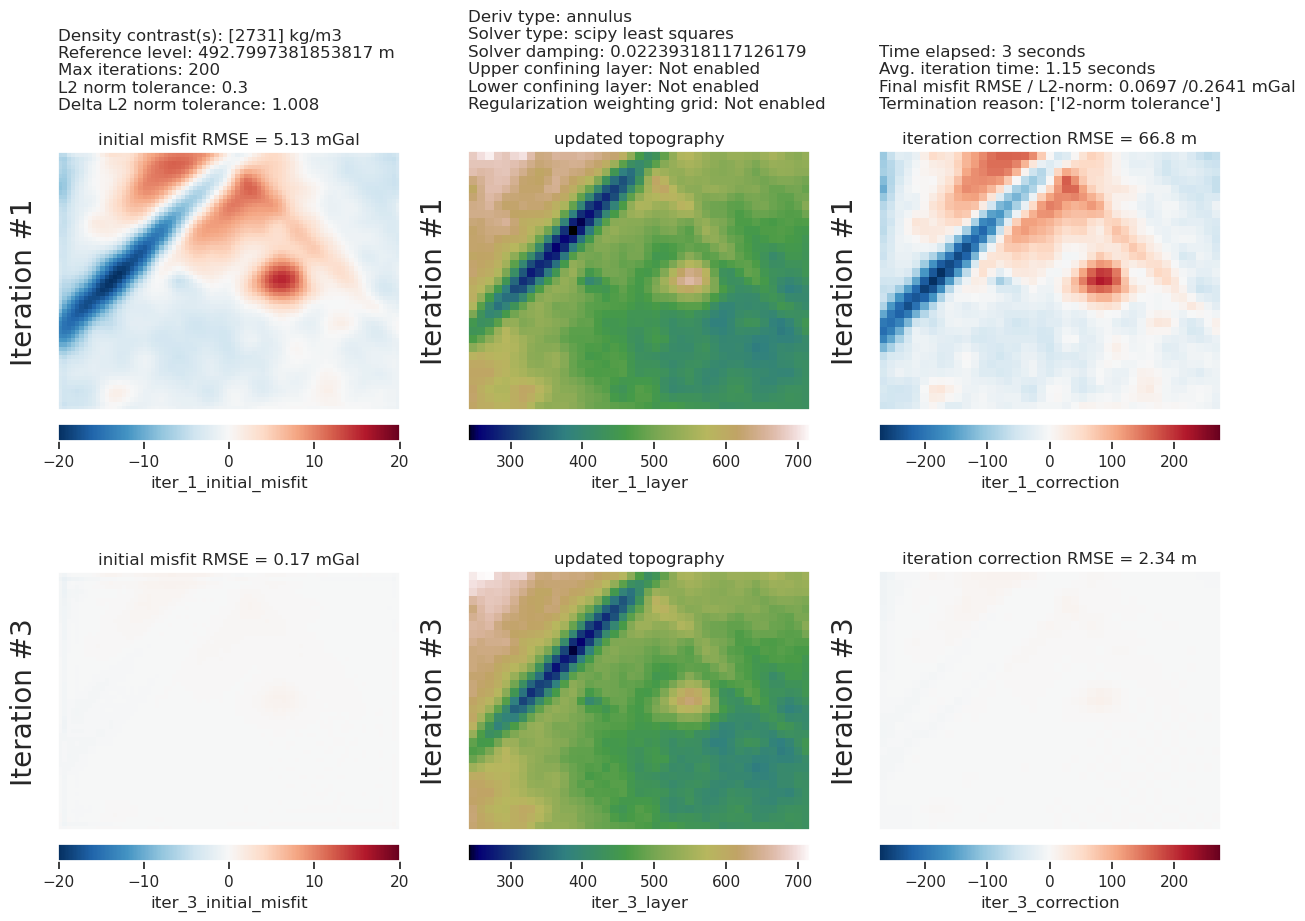
True zref value: 492.2589625197673, best zref from CV: 492.7997381853817
True density contrast: 2669, best density contrast from CV: 2731
[44]:
fig = plotting.plot_2_parameter_cv_scores_uneven(
    study,
    param_names=(
        "params_zref",
        "params_density_contrast",
    ),
    plot_param_names=(
        "Reference level (m)",
        "Density contrast (kg/m$^3$)",
    ),
)
[45]:
plotting.plot_inversion_results(
    grav_results,
    topo_results,
    parameters,
    region,
    iters_to_plot=2,
    plot_iter_results=True,
    plot_topo_results=False,
    plot_grav_results=False,
)

final_topography = topo_results.set_index(["northing", "easting"]).to_xarray().topo

_ = polar_utils.grd_compare(
    true_topography,
    final_topography,
    grid1_name="True topography",
    grid2_name="Inverted topography",
    robust=True,
    hist=True,
    inset=False,
    title="difference",
    grounding_line=False,
    reverse_cpt=True,
    cmap="rain",
    points=constraint_points,
    points_style="x.3c",
)
8.12. Save all data#
We’ll use the results from the first method of density constrast estimation since it performed better.
The notebook Uncertainty analysis will use all of the results from this notebook.
[46]:
# # to re-load the inversion results from the saved pickle file
# with pathlib.Path("../tmp/combining_it_all_results.pickle").open("rb") as f:
#     inversion_results = pickle.load(f)

# # collect the results
# topo_results, grav_results, parameters, elapsed_time = inversion_results

# plotting.plot_inversion_results(
#     grav_results,
#     topo_results,
#     parameters,
#     region,
#     iters_to_plot=2,
#     plot_iter_results=True,
#     plot_topo_results=False,
#     plot_grav_results=True,
# )

# final_topography = topo_results.set_index(["northing", "easting"]).to_xarray().topo

# _ = polar_utils.grd_compare(
#     true_topography,
#     final_topography,
#     plot=True,
#     region=region,
#     grid1_name="True topography",
#     grid2_name="Inverted topography",
#     robust=True,
#     hist=True,
#     inset=False,
#     verbose="q",
#     title="difference",
#     grounding_line=False,
#     reverse_cpt=True,
#     cmap="rain",
#     points=constraint_points,
#     points_style="x.3c",
# )
[47]:
# merge and save grids
ds = xr.merge(
    [
        true_topography.rename("true"),
        lower_topography.rename("lower"),
        starting_topography.rename("starting"),
        final_topography.rename("inverted"),
    ]
)

fname = "../tmp/combining_it_all_results.pickle"
pathlib.Path(fname).unlink(missing_ok=True)

regional_grav_kwargs.pop("constraints_df", None)

with pathlib.Path(fname).open("ab") as file:
    pickle.dump(grav_df, file, protocol=pickle.HIGHEST_PROTOCOL)
    pickle.dump(constraint_points, file, protocol=pickle.HIGHEST_PROTOCOL)
    pickle.dump(starting_topography_kwargs, file, protocol=pickle.HIGHEST_PROTOCOL)
    pickle.dump(ds, file, protocol=pickle.HIGHEST_PROTOCOL)
    pickle.dump(inversion_results, file, protocol=pickle.HIGHEST_PROTOCOL)
    pickle.dump(kwargs, file, protocol=pickle.HIGHEST_PROTOCOL)
    pickle.dump(regional_grav_kwargs, file, protocol=pickle.HIGHEST_PROTOCOL)
    pickle.dump(starting_prisms, file, protocol=pickle.HIGHEST_PROTOCOL)
[ ]: