10. Uncertainty analysis#
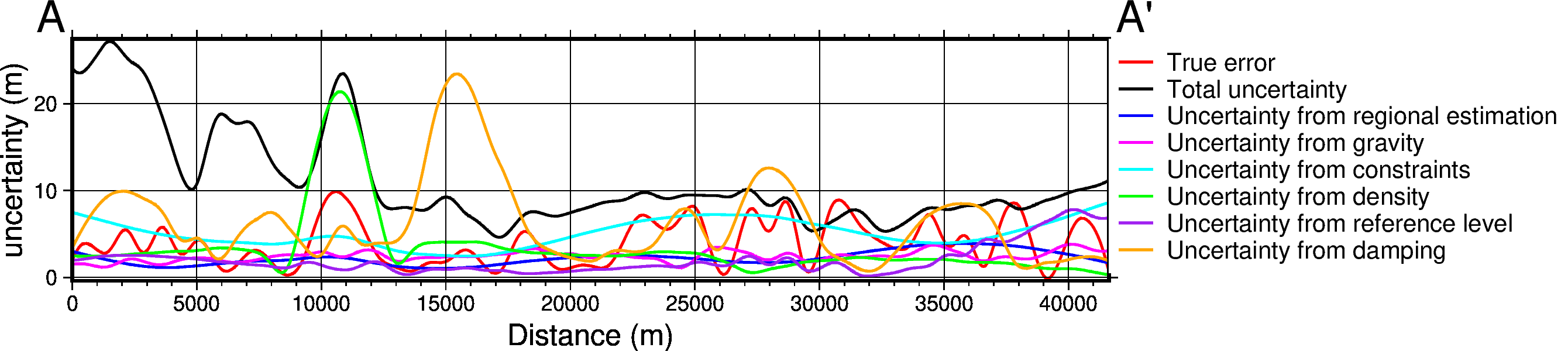
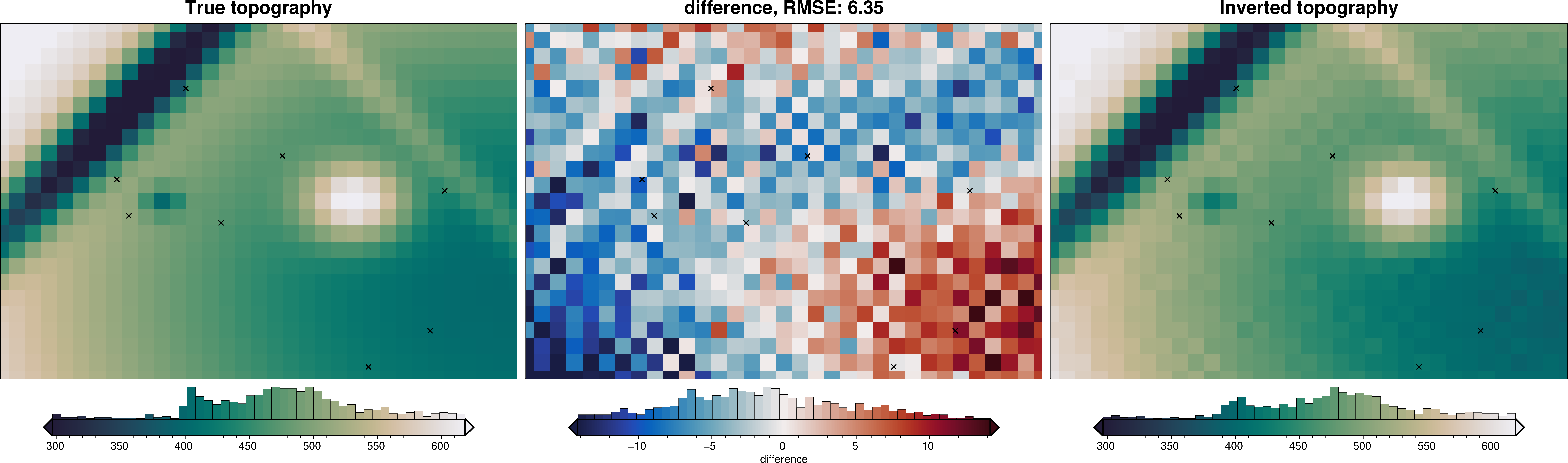
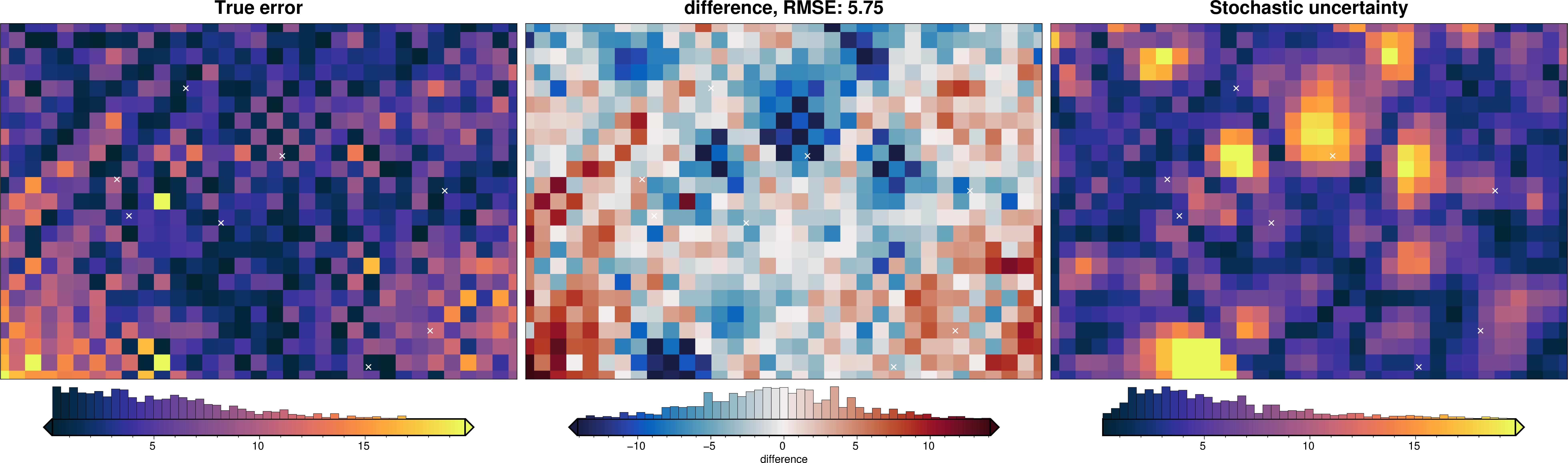
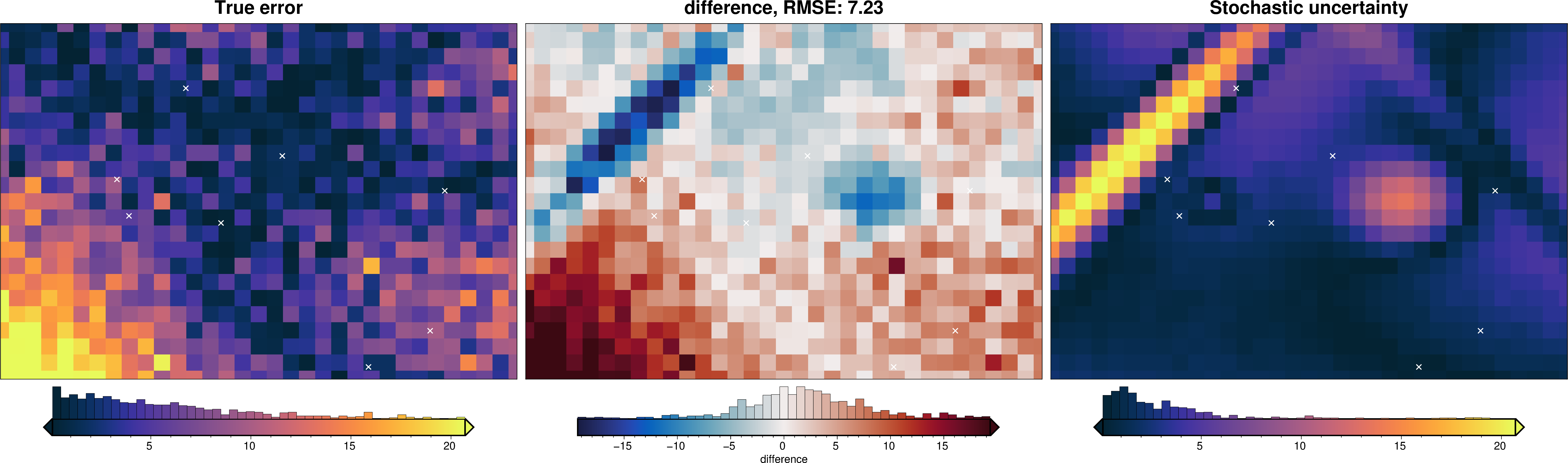
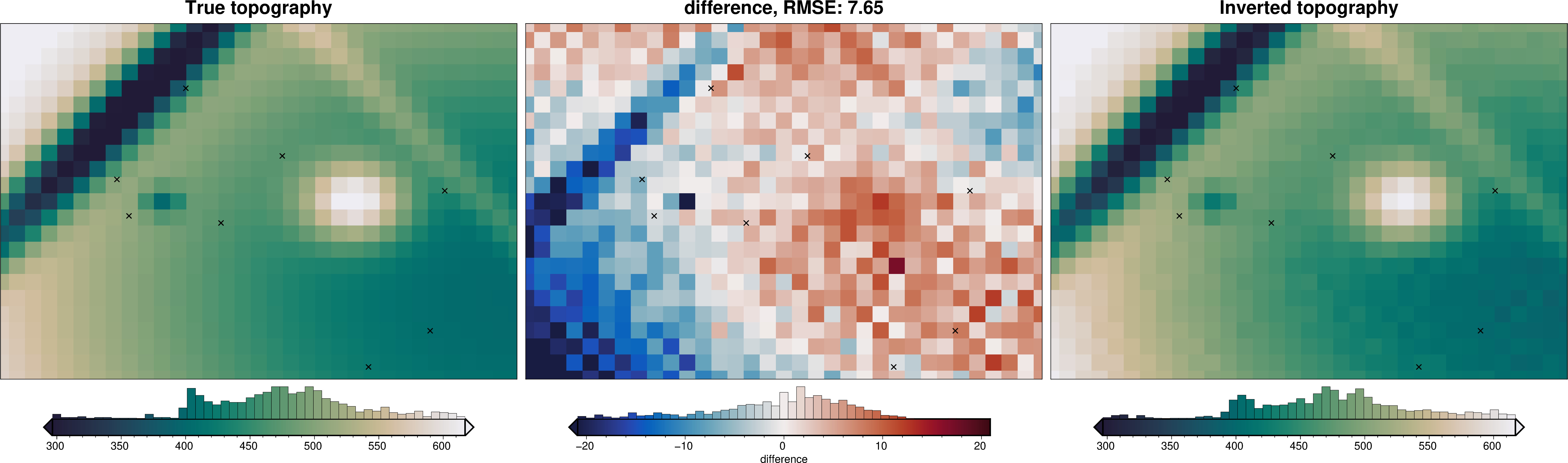
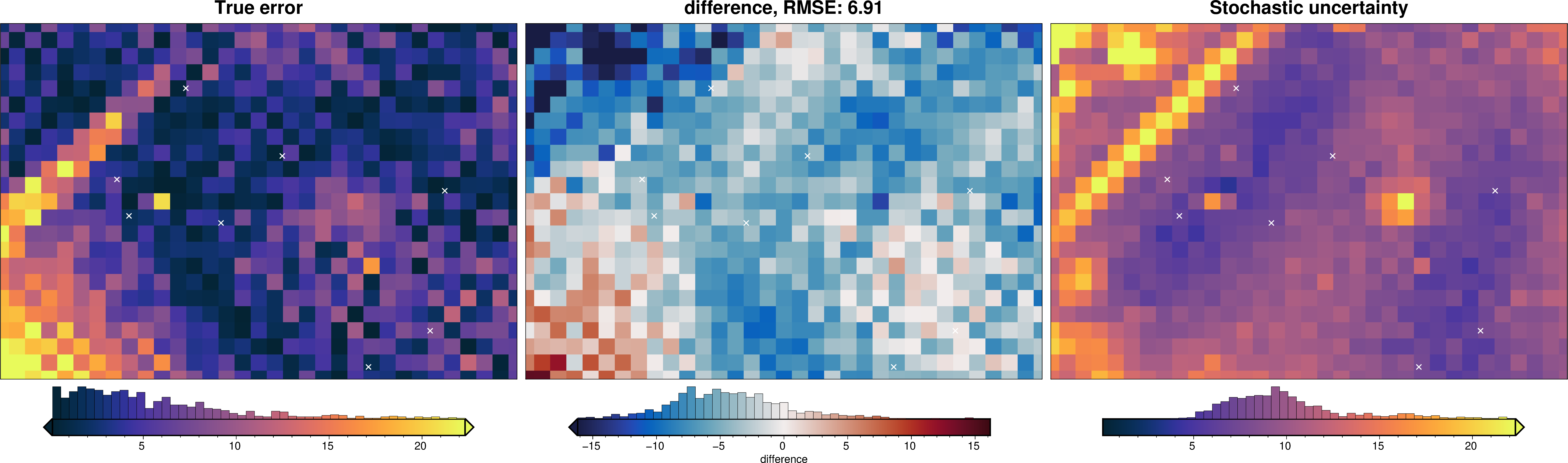
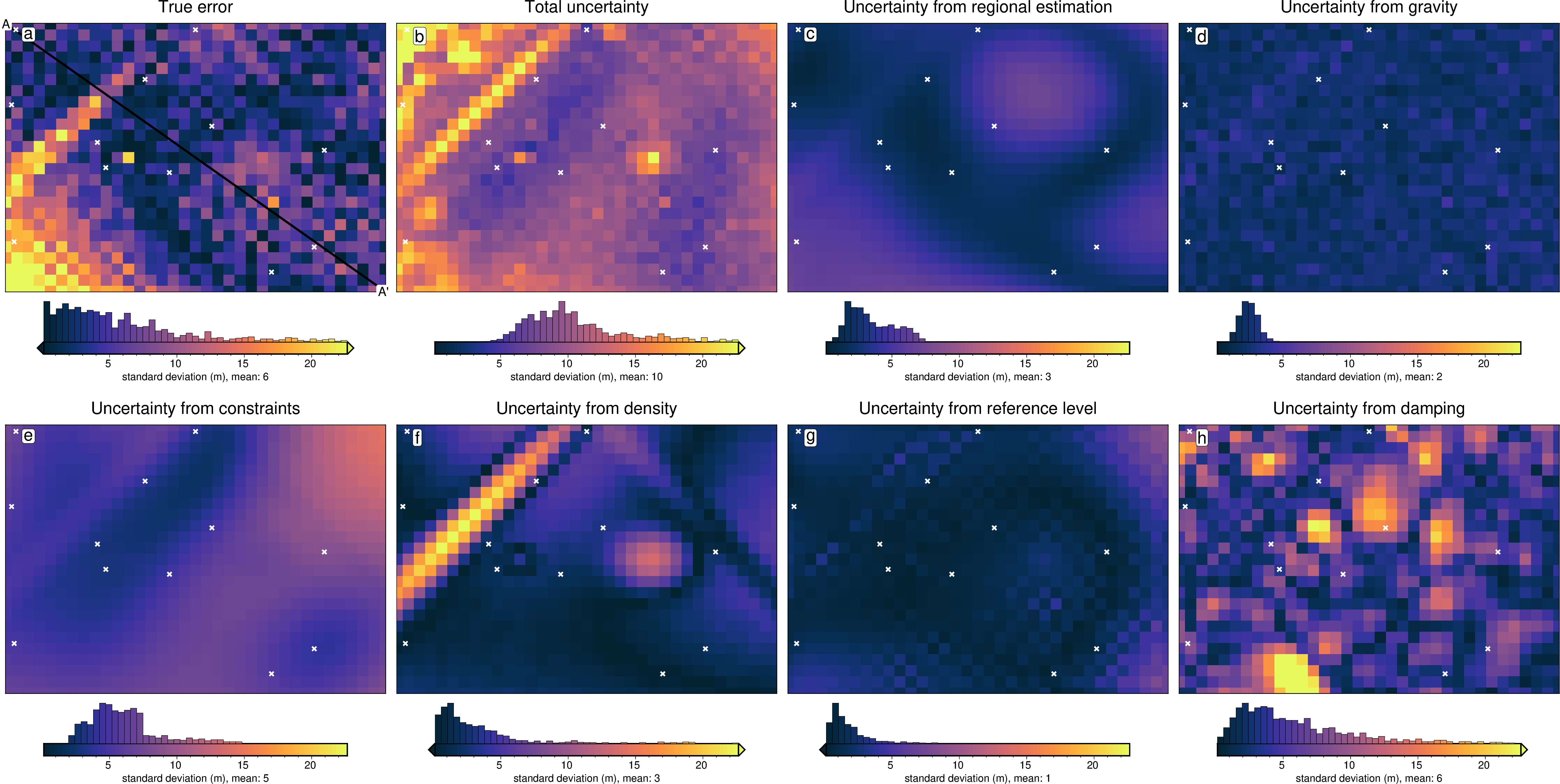
Here we will demonstrate a full uncertainty analysis of the inversion. We use a stochastic approach, where we 1) choose the important input parameters to the inversion, 2) define each of there uncertainty distributions, 3) run a series of inversions which sample these inputs from their uncertainty distributions, and 4) use the ensemble of inverted topography models to define the mean result and the uncertainty.
10.1. Import packages#
[2]:
import copy

# set EPSG for plotting functions
import os
import pathlib
import pickle
import string

import matplotlib.pyplot as plt
import numpy as np
import polartoolkit as ptk
import scipy as sp
import verde as vd
import xarray as xr

import invert4geom

os.environ["POLARTOOLKIT_EPSG"] = "3031"
10.2. Load previous inversion results#
From the notebook combining it all.
[3]:
# load pickle files
params = []
with pathlib.Path("../tmp/08_combining_it_all_results.pickle").open("rb") as file:
    while True:
        try:
            params.append(pickle.load(file))
        except EOFError:
            break
(
    inv,
    regional_grav_kwargs,
    starting_topography_kwargs,
    true_topography,
    constraints_df,
) = params
[4]:
print(f"Density contrast: {inv.model.density_contrast} kg/m3")
print(f"Reference level: {inv.model.zref} m")
print(f"Spacing: {inv.model.spacing} m")
print(f"Region: {inv.model.region}")
print(f"Solver damping: {inv.solver_damping}")
Density contrast: 2671 kg/m3
Reference level: 487.596439951174 m
Spacing: 1000.0 m
Region: (0.0, 40000.0, 0.0, 30000.0)
Solver damping: 0.022462764194497914
[6]:
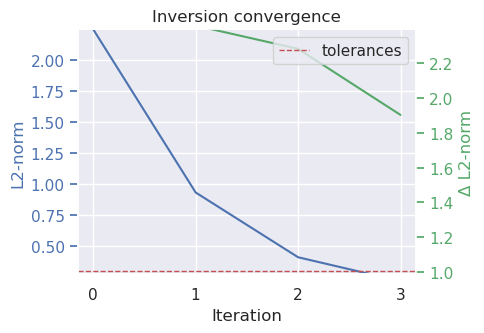
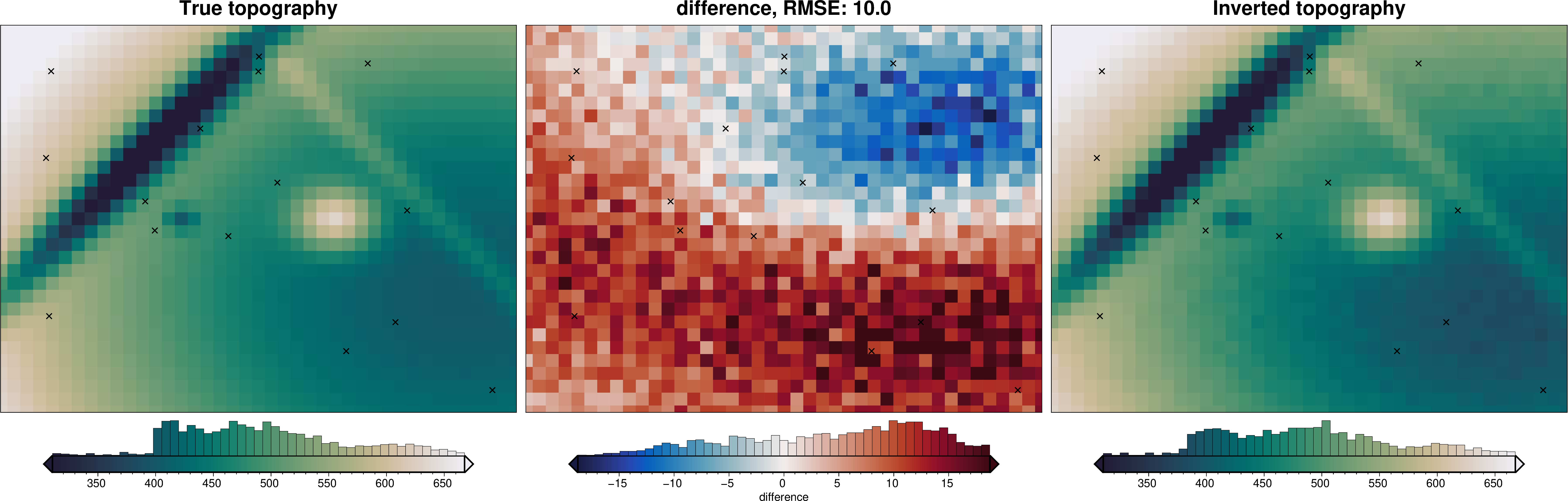
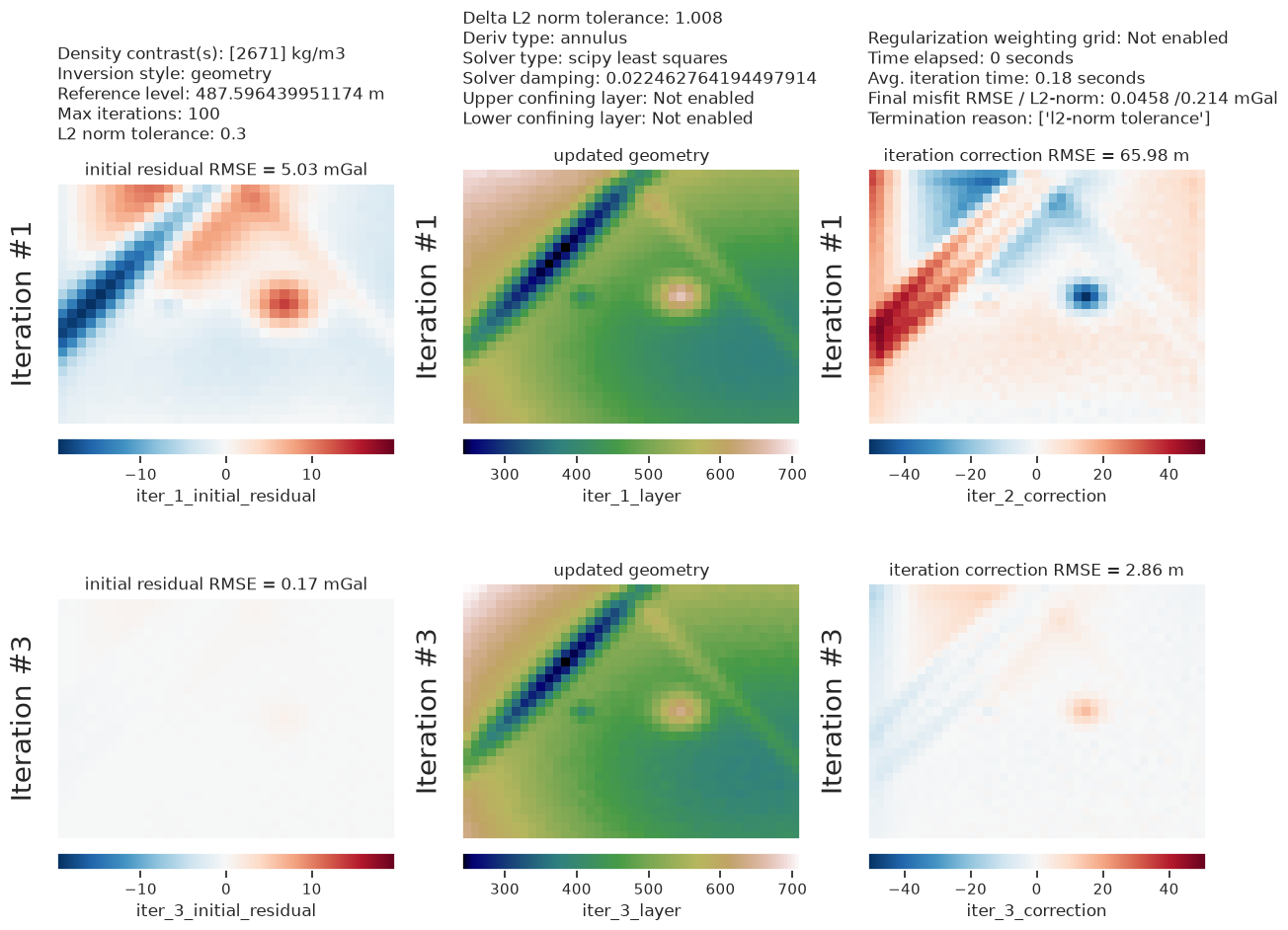
inv.plot_convergence()

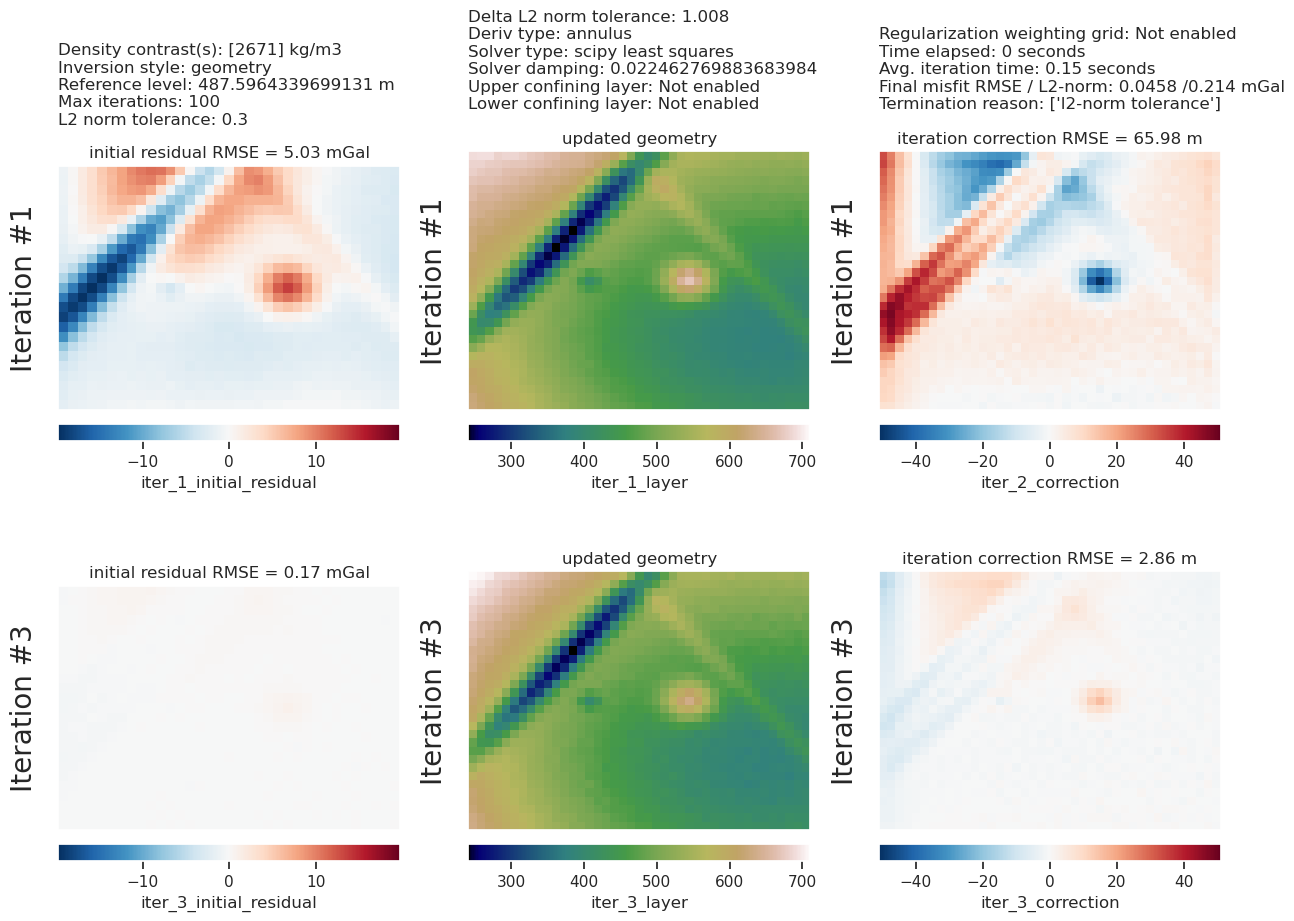
inv.plot_inversion_results(iters_to_plot=2)

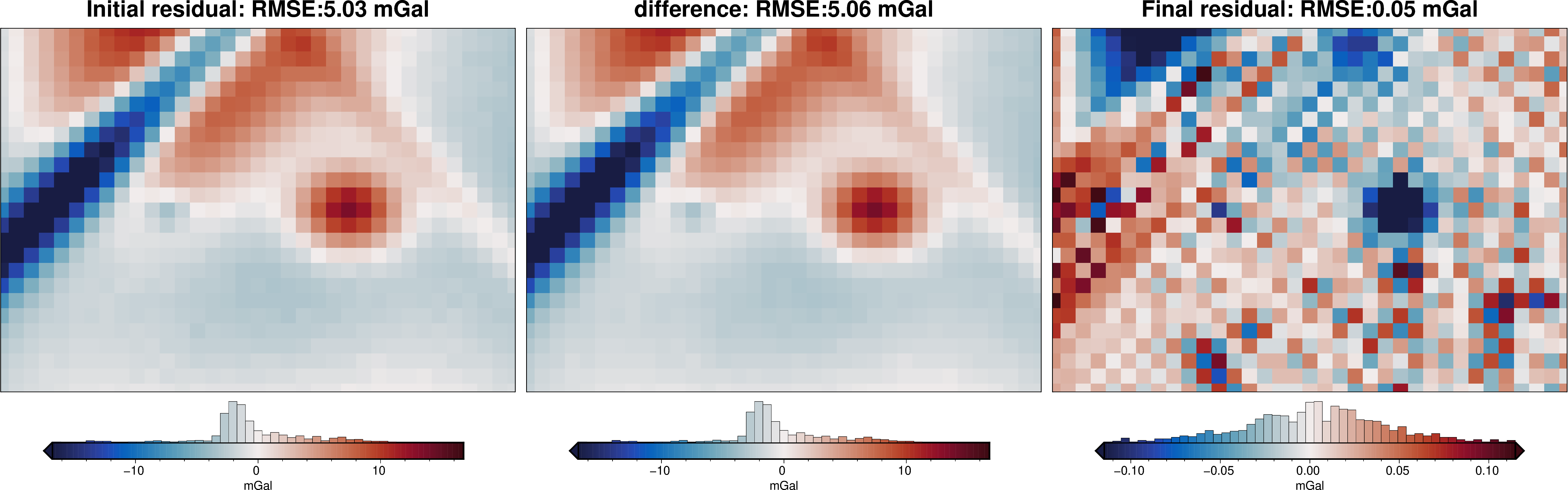
_ = ptk.grid_compare(
    true_topography,
    inv.model.topography,
    grid1_name="True topography",
    grid2_name="Inverted topography",
    robust=True,
    hist=True,
    inset=False,
    title="difference",
    reverse_cpt=True,
    cmap="rain",
    points=constraints_df,
    points_style="x.3c",
)
/home/mdtanker/invert4geom/.pixi/envs/default/lib/python3.13/site-packages/polartoolkit/maps.py:1820: FutureWarning: The 'barwidth' parameter has been deprecated since v0.18.0 and will be removed in v0.20.0. Please use 'bar_width' instead.
  self.histogram(
/home/mdtanker/invert4geom/.pixi/envs/default/lib/python3.13/site-packages/polartoolkit/maps.py:1820: FutureWarning: The 'barwidth' parameter has been deprecated since v0.18.0 and will be removed in v0.20.0. Please use 'bar_width' instead.
  self.histogram(
/home/mdtanker/invert4geom/.pixi/envs/default/lib/python3.13/site-packages/polartoolkit/maps.py:1820: FutureWarning: The 'barwidth' parameter has been deprecated since v0.18.0 and will be removed in v0.20.0. Please use 'bar_width' instead.
  self.histogram(
/home/mdtanker/invert4geom/.pixi/envs/default/lib/python3.13/site-packages/polartoolkit/maps.py:1820: FutureWarning: The 'barwidth' parameter has been deprecated since v0.18.0 and will be removed in v0.20.0. Please use 'bar_width' instead.
  self.histogram(
/home/mdtanker/invert4geom/.pixi/envs/default/lib/python3.13/site-packages/polartoolkit/maps.py:1820: FutureWarning: The 'barwidth' parameter has been deprecated since v0.18.0 and will be removed in v0.20.0. Please use 'bar_width' instead.
  self.histogram(
/home/mdtanker/invert4geom/.pixi/envs/default/lib/python3.13/site-packages/polartoolkit/maps.py:1820: FutureWarning: The 'barwidth' parameter has been deprecated since v0.18.0 and will be removed in v0.20.0. Please use 'bar_width' instead.
  self.histogram(
/home/mdtanker/invert4geom/.pixi/envs/default/lib/python3.13/site-packages/polartoolkit/maps.py:1820: FutureWarning: The 'barwidth' parameter has been deprecated since v0.18.0 and will be removed in v0.20.0. Please use 'bar_width' instead.
  self.histogram(
/home/mdtanker/invert4geom/.pixi/envs/default/lib/python3.13/site-packages/polartoolkit/maps.py:1820: FutureWarning: The 'barwidth' parameter has been deprecated since v0.18.0 and will be removed in v0.20.0. Please use 'bar_width' instead.
  self.histogram(
/home/mdtanker/invert4geom/.pixi/envs/default/lib/python3.13/site-packages/polartoolkit/maps.py:1820: FutureWarning: The 'barwidth' parameter has been deprecated since v0.18.0 and will be removed in v0.20.0. Please use 'bar_width' instead.
  self.histogram(
10.3. Absolute value of inversion error#
[7]:
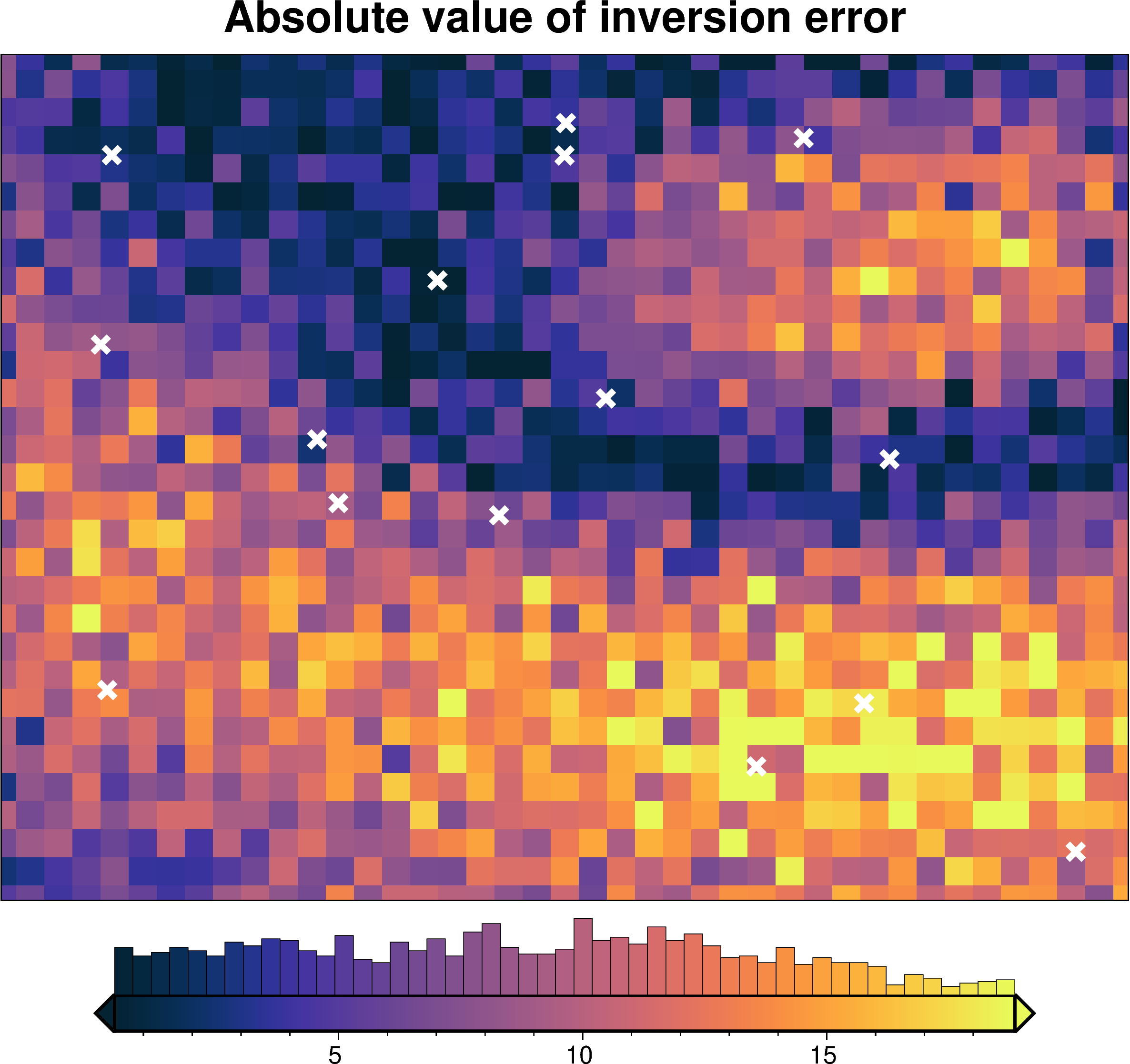
inversion_error = np.abs(true_topography - inv.model.topography)
fig = ptk.plot_grid(
    inversion_error,
    hist=True,
    cmap="thermal",
    title="Absolute value of inversion error",
    robust=True,
    points=constraints_df,
    points_style="x.4c",
    points_pen="3p",
    points_fill="white",
)
fig.show()
/home/mdtanker/invert4geom/.pixi/envs/default/lib/python3.13/site-packages/polartoolkit/maps.py:1820: FutureWarning: The 'barwidth' parameter has been deprecated since v0.18.0 and will be removed in v0.20.0. Please use 'bar_width' instead.
  self.histogram(
10.4. Redo starting gravity and regional separation#
use the optimal determined density contrast and zref values
[8]:
inv.reinitialize_inversion()
[9]:
inv.data = invert4geom.create_data(inv.data)

inv.model = invert4geom.create_model(
    zref=inv.model.zref,
    density_contrast=inv.model.density_contrast,
    topography=inv.model.starting_topography.to_dataset(name="upward"),
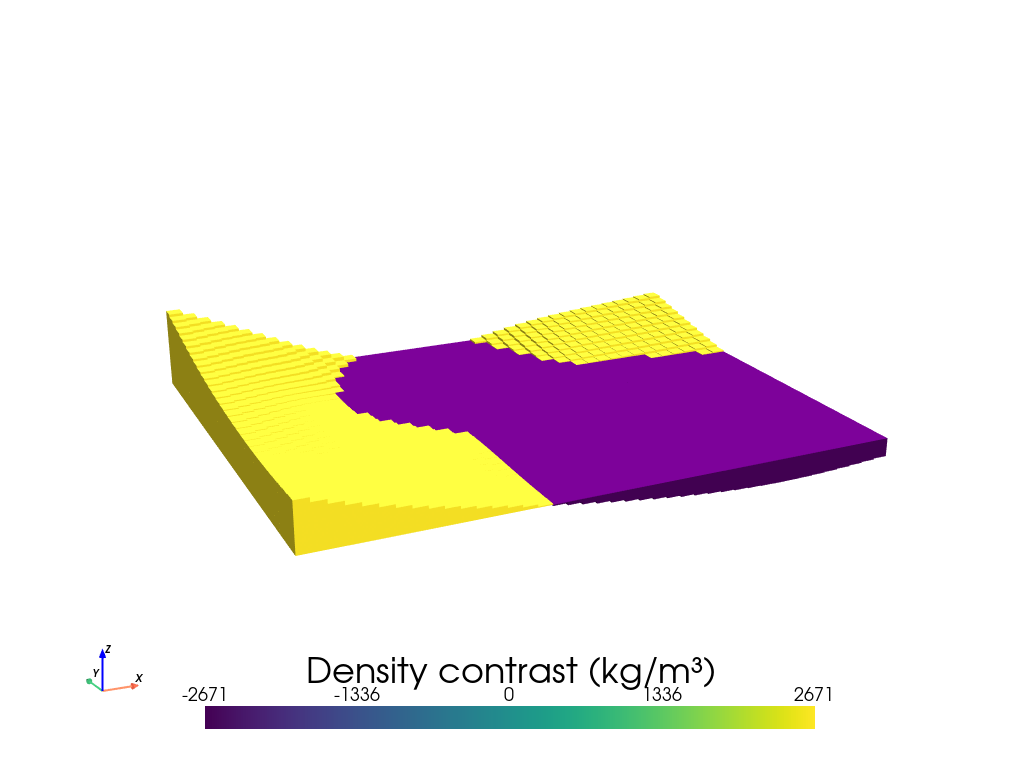
)
inv.model.inv.plot_model(
    color_by="density",
    zscale=20,
)
[10]:
inv.data.inv.forward_gravity(inv.model)

# regional separation
temp_reg_kwargs = copy.deepcopy(regional_grav_kwargs)

# temporarily set some kwargs
# temp_reg_kwargs["cv_kwargs"]["plot"]=True
temp_reg_kwargs["cv_kwargs"]["progressbar"] = True

inv.data.inv.regional_separation(
    **temp_reg_kwargs,
)

inv.data.inv.df.describe()
[10]:
| northing | easting | upward | upper_surface_grav | lower_surface_grav | gravity_anomaly_no_noise | gravity_anomaly | uncert | forward_gravity | true_res | misfit | reg | res | starting_forward_gravity | starting_misfit | starting_reg | starting_res | |
|---|---|---|---|---|---|---|---|---|---|---|---|---|---|---|---|---|---|
| count | 1271.000000 | 1271.00000 | 1271.0 | 1271.000000 | 1271.000000 | 1271.000000 | 1271.000000 | 1271.0 | 1271.000000 | 1271.000000 | 1271.000000 | 1271.000000 | 1271.000000 | 1271.000000 | 1271.000000 | 1271.000000 | 1271.000000 |
| mean | 15000.000000 | 20000.00000 | 1001.0 | -0.129619 | 0.004659 | -0.124959 | -0.124959 | 0.1 | 0.840947 | -1.209548 | -0.965906 | -0.684833 | -0.281073 | 0.840947 | -0.965906 | -0.684833 | -0.281073 |
| std | 8947.792584 | 11836.81698 | 0.0 | 7.147140 | 0.830306 | 7.314752 | 7.313577 | 0.0 | 7.057931 | 4.456801 | 4.751909 | 1.103354 | 4.454188 | 7.057931 | 4.751909 | 1.103354 | 4.454188 |
| min | 0.000000 | 0.00000 | 1001.0 | -17.180401 | -1.201774 | -16.908339 | -17.061563 | 0.1 | -8.747007 | -19.046854 | -19.737380 | -2.553734 | -18.166099 | -8.747007 | -19.737380 | -2.553734 | -18.166099 |
| 25% | 7000.000000 | 10000.00000 | 1001.0 | -5.537833 | -0.699901 | -5.826630 | -5.827131 | 0.1 | -4.537787 | -2.622186 | -2.566995 | -1.572707 | -2.051413 | -4.537787 | -2.566995 | -1.572707 | -2.051413 |
| 50% | 15000.000000 | 20000.00000 | 1001.0 | -1.136301 | -0.177953 | -0.557795 | -0.572175 | 0.1 | -1.141619 | -1.088926 | -1.355349 | -0.734276 | -0.118056 | -1.141619 | -1.355349 | -0.734276 | -0.118056 |
| 75% | 23000.000000 | 30000.00000 | 1001.0 | 3.743994 | 0.629891 | 4.171648 | 4.139840 | 0.1 | 4.857942 | 0.332004 | 0.684006 | 0.231197 | 1.680729 | 4.857942 | 0.684006 | 0.231197 | 1.680729 |
| max | 30000.000000 | 40000.00000 | 1001.0 | 19.581120 | 1.860259 | 19.774399 | 19.944613 | 0.1 | 23.397696 | 12.693226 | 13.597926 | 1.319281 | 13.772263 | 23.397696 | 13.597926 | 1.319281 | 13.772263 |
[11]:
# plotting functions for uncertainty results
def uncert_plots(
    results,
    inversion_region,
    spacing,
    true_topography,
    constraints_df=None,
    weight_by=None,
):
    if (weight_by == "constraints") & (constraints_df is None):
        msg = "must provide constraints_df if weighting by constraints"
        raise ValueError(msg)

    stats_ds = invert4geom.merged_stats(
        results=results,
        plot=True,
        constraints_df=constraints_df,
        weight_by=weight_by,
        region=inversion_region,
    )

    try:
        mean = stats_ds.weighted_mean
        stdev = stats_ds.weighted_stdev
    except AttributeError:
        mean = stats_ds.z_mean
        stdev = stats_ds.z_stdev

    _ = ptk.grid_compare(
        true_topography,
        mean,
        region=vd.pad_region(inversion_region, -spacing),
        grid1_name="True topography",
        grid2_name="Inverted topography",
        robust=True,
        hist=True,
        inset=False,
        title="difference",
        reverse_cpt=True,
        cmap="rain",
        points=constraints_df,
        points_style="x.3c",
    )
    _ = ptk.grid_compare(
        np.abs(true_topography - mean),
        stdev,
        region=vd.pad_region(inversion_region, -spacing),
        grid1_name="True error",
        grid2_name="Stochastic uncertainty",
        cmap="thermal",
        robust=True,
        hist=True,
        inset=False,
        title="difference",
        points=constraints_df,
        points_style="x.3c",
        points_fill="white",
    )
    return stats_ds
10.5. Uncertainty analysis#
[12]:
# get mean spacing between nearest constraints
mean_spacing = np.mean(
    vd.median_distance(
        (constraints_df.easting, constraints_df.northing),
        k_nearest=1,
    )
)
mean_spacing
[12]:
np.float64(5599.156508868462)
[13]:
# use optimal eq source parameters for regional separation in uncertainty analysis
# re-load the study from the saved pickle file
with pathlib.Path(f"{regional_grav_kwargs.get('cv_kwargs').get('fname')}.pickle").open(
    "rb"
) as f:
    study = pickle.load(f)
reg_eq_damping = min(study.best_trials, key=lambda t: t.values[0]).params["damping"]

reg_eq_depth = 4.5 * mean_spacing

new_regional_grav_kwargs = dict(
    method="constraints",
    grid_method="eq_sources",
    constraints_df=constraints_df,
    damping=reg_eq_damping,
    depth=reg_eq_depth,
    block_size=None,
)
reg_eq_damping, reg_eq_depth
[13]:
(0.04852697025087582, np.float64(25196.204289908077))
10.5.1. Solver damping component#
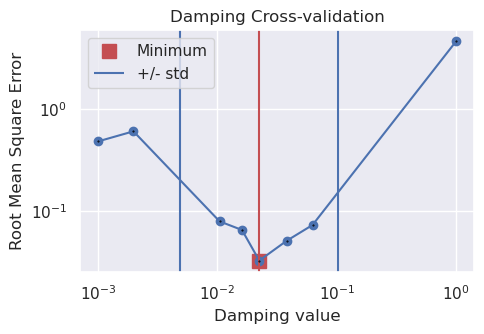
To estimate the uncertainty of the choice of solver damping value, we will load the damping cross validation and calculate the standard deviation of the trials (excluding outliers)
[37]:
# load study
with pathlib.Path("../tmp/08_combining_it_all_damping_CV_study.pickle").open("rb") as f:
    study = pickle.load(f)

study_df = study.trials_dataframe()
study_df = study_df.sort_values("value")

# calculate zscores of values
study_df["value_zscore"] = sp.stats.zscore(study_df["value"])

# drop outliers (values with zscore > |2|)
study_df2 = study_df[(np.abs(study_df.value_zscore) < 2)]

# pick damping standard deviation based on optimization
stdev = np.log10(study_df2.params_damping).std()
print(f"calculated stdev: {stdev}")
# stdev = .1
print(f"using stdev: {stdev}")
calculated stdev: 0.6611845098229931
using stdev: 0.6611845098229931
[38]:
fig = invert4geom.plot_scores(
    study_df.value,
    study_df.params_damping,
    param_name="Damping",
    logx=True,
    logy=True,
)
ax = fig.axes[0]

best = float(study_df2.params_damping.iloc[0])
upper = float(10 ** (np.log10(best) + stdev))
lower = float(10 ** (np.log10(best) - stdev))

y_lims = ax.get_ylim()
ax.vlines(best, ymin=y_lims[0], ymax=y_lims[1], color="r")
ax.vlines(upper, ymin=y_lims[0], ymax=y_lims[1], label="+/- std")
ax.vlines(lower, ymin=y_lims[0], ymax=y_lims[1])

x_lims = ax.get_xlim()
ax.set_xlim(
    min(x_lims[0], lower),
    max(x_lims[1], upper),
)
ax.legend()
print("best:", best, "\nstd:", stdev, "\n+1std:", upper, "\n-1std:", lower)
best: 0.022462764194497914
std: 0.6611845098229931
+1std: 0.10295506281262981
-1std: 0.004900932129738063
[16]:
solver_dict = {
    "solver_damping": {
        "distribution": "normal",
        "loc": np.log10(inv.solver_damping),  # mean of base 10 exponent
        "scale": stdev,  # standard deviation of base 10 exponent
        "log": True,
        # "distribution": "uniform",
        # "loc": -3,  # lower limit of exponent range
        # "scale": 2,  # value added to loc to get upper range of exponent
        # "log": True,
    },
}
fname = "../tmp/10_uncertainty_damping"

# delete files if already exist
for p in pathlib.Path().glob(f"{fname}*"):
    p.unlink(missing_ok=True)

uncert_damping_results = invert4geom.full_workflow_uncertainty_loop(
    inv,
    fname=fname,
    runs=10,
    parameter_dict=solver_dict,
    regional_grav_kwargs=new_regional_grav_kwargs,
    starting_topography_kwargs=starting_topography_kwargs,
)

stats_ds = uncert_plots(
    uncert_damping_results,
    inv.data.inner_region,
    inv.data.spacing,
    true_topography,
    constraints_df=constraints_df,
    weight_by="constraints",
)
/home/mdtanker/invert4geom/.pixi/envs/default/lib/python3.13/site-packages/polartoolkit/maps.py:1820: FutureWarning: The 'barwidth' parameter has been deprecated since v0.18.0 and will be removed in v0.20.0. Please use 'bar_width' instead.
  self.histogram(
/home/mdtanker/invert4geom/.pixi/envs/default/lib/python3.13/site-packages/polartoolkit/maps.py:1820: FutureWarning: The 'barwidth' parameter has been deprecated since v0.18.0 and will be removed in v0.20.0. Please use 'bar_width' instead.
  self.histogram(
/home/mdtanker/invert4geom/.pixi/envs/default/lib/python3.13/site-packages/polartoolkit/maps.py:1820: FutureWarning: The 'barwidth' parameter has been deprecated since v0.18.0 and will be removed in v0.20.0. Please use 'bar_width' instead.
  self.histogram(
/home/mdtanker/invert4geom/.pixi/envs/default/lib/python3.13/site-packages/polartoolkit/maps.py:1820: FutureWarning: The 'barwidth' parameter has been deprecated since v0.18.0 and will be removed in v0.20.0. Please use 'bar_width' instead.
  self.histogram(
/home/mdtanker/invert4geom/.pixi/envs/default/lib/python3.13/site-packages/polartoolkit/maps.py:1820: FutureWarning: The 'barwidth' parameter has been deprecated since v0.18.0 and will be removed in v0.20.0. Please use 'bar_width' instead.
  self.histogram(
/home/mdtanker/invert4geom/.pixi/envs/default/lib/python3.13/site-packages/polartoolkit/maps.py:1820: FutureWarning: The 'barwidth' parameter has been deprecated since v0.18.0 and will be removed in v0.20.0. Please use 'bar_width' instead.
  self.histogram(
/home/mdtanker/invert4geom/.pixi/envs/default/lib/python3.13/site-packages/polartoolkit/maps.py:1820: FutureWarning: The 'barwidth' parameter has been deprecated since v0.18.0 and will be removed in v0.20.0. Please use 'bar_width' instead.
  self.histogram(
/home/mdtanker/invert4geom/.pixi/envs/default/lib/python3.13/site-packages/polartoolkit/maps.py:1820: FutureWarning: The 'barwidth' parameter has been deprecated since v0.18.0 and will be removed in v0.20.0. Please use 'bar_width' instead.
  self.histogram(
10.5.2. Z-ref and density components#
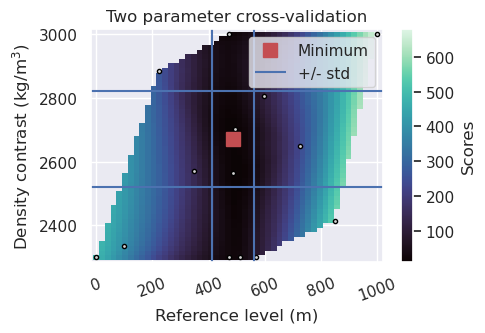
To estimate the uncertainty of the choice of Z-ref and density value, we will sample the values from random distributions.
[17]:
# to re-load the study from the saved pickle file
with pathlib.Path(
    "../tmp/08_combining_it_all_density_and_zref_optimization_study.pickle"
).open("rb") as f:
    study = pickle.load(f)

# automatically determine stdevs from the optimization results
study_df = study.trials_dataframe()
study_df = study_df.sort_values("value")
study_df["value_zscore"] = sp.stats.zscore(study_df["value"])
study_df2 = study_df[(np.abs(study_df.value_zscore) < 2)]

zref_stdev = study_df2.params_zref.std()
density_stdev = study_df2.params_density_contrast.std()

# # manually choose standard deviations for the density contrast and zref
# density_stdev = 150
# zref_stdev = 75

invert4geom.plot_2_parameter_scores_uneven(
    study,
    param_names=(
        "params_zref",
        "params_density_contrast",
    ),
    plot_param_names=(
        "Reference level (m)",
        "Density contrast (kg/m$^3$)",
    ),
)

ax = plt.gca()

# plot zref stdev
upper = inv.model.zref + zref_stdev
lower = inv.model.zref - zref_stdev
y_lims = ax.get_ylim()
ax.vlines(upper, ymin=y_lims[0], ymax=y_lims[1], label="+/- std")
ax.vlines(lower, ymin=y_lims[0], ymax=y_lims[1])
x_lims = ax.get_xlim()
ax.set_xlim(
    min(x_lims[0], lower),
    max(x_lims[1], upper),
)
print(
    "best:", inv.model.zref, "\nstd:", zref_stdev, "\n+1std:", upper, "\n-1std:", lower
)

# plot density contrast stdev
upper = inv.model.density_contrast + density_stdev
lower = inv.model.density_contrast - density_stdev
x_lims = ax.get_xlim()
ax.hlines(upper, xmin=x_lims[0], xmax=x_lims[1])
ax.hlines(lower, xmin=x_lims[0], xmax=x_lims[1])
y_lims = ax.get_ylim()
ax.set_ylim(
    min(y_lims[0], lower),
    max(y_lims[1], upper),
)
ax.legend()
print(
    "best:",
    inv.model.density_contrast,
    "\nstd:",
    density_stdev,
    "\n+1std:",
    upper,
    "\n-1std:",
    lower,
)
best: 487.596439951174
std: 226.43428018420906
+1std: 714.030720135383
-1std: 261.1621597669649
best: 2671
std: 238.55494448546133
+1std: 2909.5549444854614
-1std: 2432.4450555145386
[18]:
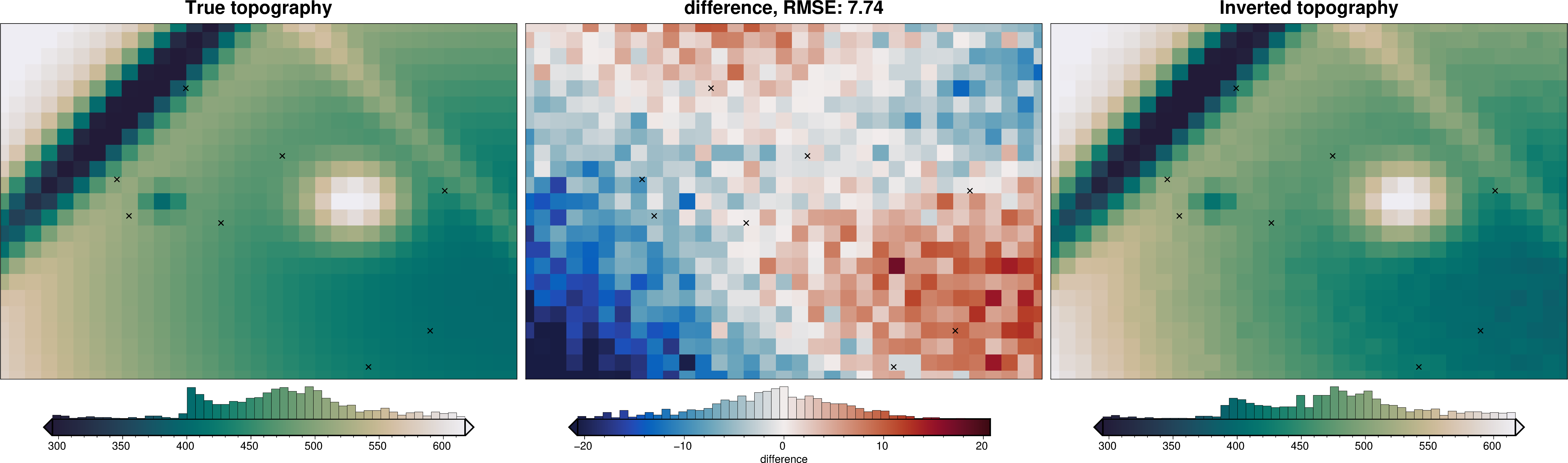
density_dict = {
    "density_contrast": {
        "distribution": "normal",
        "loc": inv.model.density_contrast,
        "scale": density_stdev,
    },
}
fname = "../tmp/10_uncertainty_density"

# delete files if already exist
for p in pathlib.Path().glob(f"{fname}*"):
    p.unlink(missing_ok=True)

uncert_density_results = invert4geom.full_workflow_uncertainty_loop(
    inv,
    fname=fname,
    runs=10,
    parameter_dict=density_dict,
    regional_grav_kwargs=new_regional_grav_kwargs,
    starting_topography_kwargs=starting_topography_kwargs,
)

stats_ds = uncert_plots(
    uncert_density_results,
    inv.data.inner_region,
    inv.data.spacing,
    true_topography,
    constraints_df=constraints_df,
    weight_by="constraints",
)
/home/mdtanker/invert4geom/.pixi/envs/default/lib/python3.13/site-packages/polartoolkit/maps.py:1820: FutureWarning: The 'barwidth' parameter has been deprecated since v0.18.0 and will be removed in v0.20.0. Please use 'bar_width' instead.
  self.histogram(
/home/mdtanker/invert4geom/.pixi/envs/default/lib/python3.13/site-packages/polartoolkit/maps.py:1820: FutureWarning: The 'barwidth' parameter has been deprecated since v0.18.0 and will be removed in v0.20.0. Please use 'bar_width' instead.
  self.histogram(
/home/mdtanker/invert4geom/.pixi/envs/default/lib/python3.13/site-packages/polartoolkit/maps.py:1820: FutureWarning: The 'barwidth' parameter has been deprecated since v0.18.0 and will be removed in v0.20.0. Please use 'bar_width' instead.
  self.histogram(
/home/mdtanker/invert4geom/.pixi/envs/default/lib/python3.13/site-packages/polartoolkit/maps.py:1820: FutureWarning: The 'barwidth' parameter has been deprecated since v0.18.0 and will be removed in v0.20.0. Please use 'bar_width' instead.
  self.histogram(
/home/mdtanker/invert4geom/.pixi/envs/default/lib/python3.13/site-packages/polartoolkit/maps.py:1820: FutureWarning: The 'barwidth' parameter has been deprecated since v0.18.0 and will be removed in v0.20.0. Please use 'bar_width' instead.
  self.histogram(
/home/mdtanker/invert4geom/.pixi/envs/default/lib/python3.13/site-packages/polartoolkit/maps.py:1820: FutureWarning: The 'barwidth' parameter has been deprecated since v0.18.0 and will be removed in v0.20.0. Please use 'bar_width' instead.
  self.histogram(
/home/mdtanker/invert4geom/.pixi/envs/default/lib/python3.13/site-packages/polartoolkit/maps.py:1820: FutureWarning: The 'barwidth' parameter has been deprecated since v0.18.0 and will be removed in v0.20.0. Please use 'bar_width' instead.
  self.histogram(
/home/mdtanker/invert4geom/.pixi/envs/default/lib/python3.13/site-packages/polartoolkit/maps.py:1820: FutureWarning: The 'barwidth' parameter has been deprecated since v0.18.0 and will be removed in v0.20.0. Please use 'bar_width' instead.
  self.histogram(
[19]:
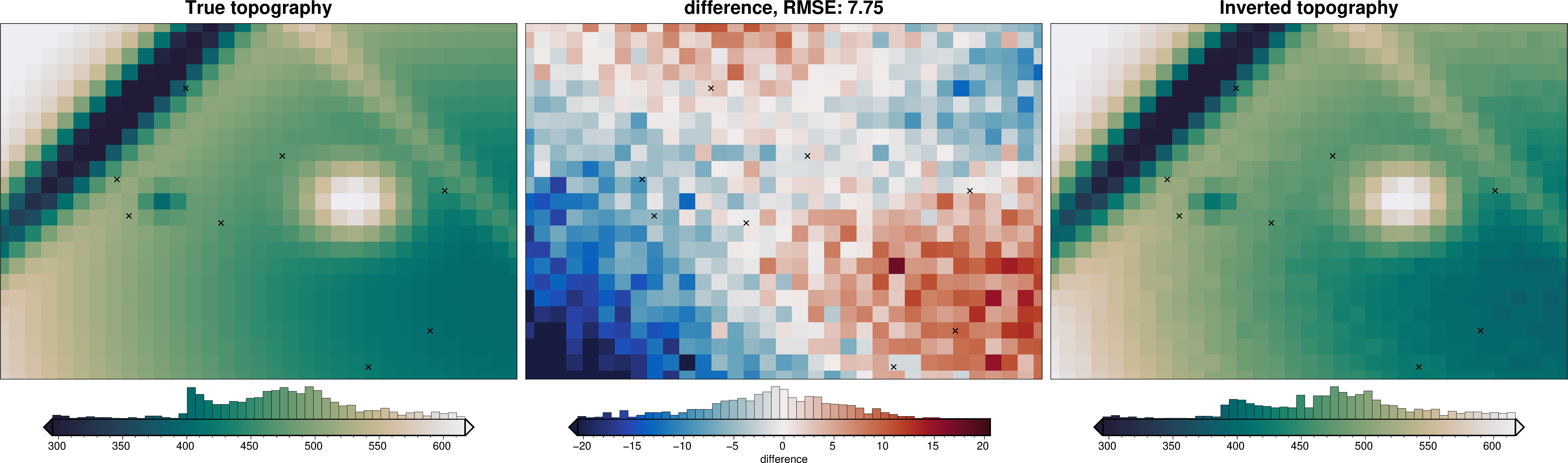
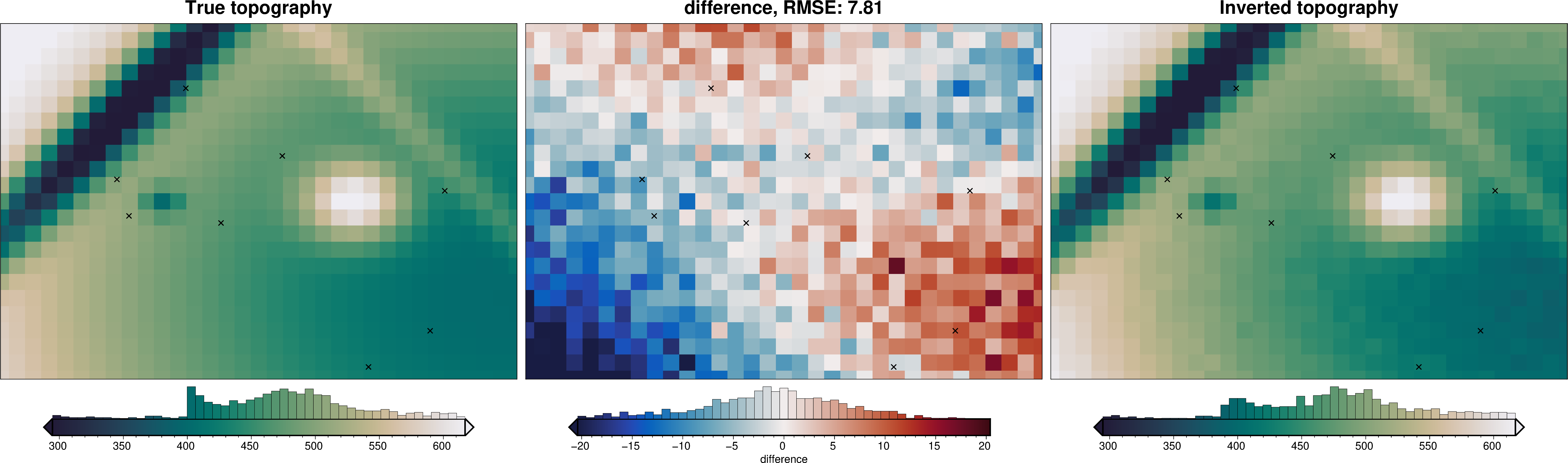
zref_dict = {
    "zref": {
        "distribution": "normal",
        "loc": inv.model.zref,
        "scale": zref_stdev,
    },
}
fname = "../tmp/10_uncertainty_zref"

# delete files if already exist
for p in pathlib.Path().glob(f"{fname}*"):
    p.unlink(missing_ok=True)

uncert_zref_results = invert4geom.full_workflow_uncertainty_loop(
    inv,
    fname=fname,
    runs=10,
    parameter_dict=zref_dict,
    regional_grav_kwargs=new_regional_grav_kwargs,
    starting_topography_kwargs=starting_topography_kwargs,
)

stats_ds = uncert_plots(
    uncert_zref_results,
    inv.data.inner_region,
    inv.data.spacing,
    true_topography,
    constraints_df=constraints_df,
    weight_by="constraints",
)
/home/mdtanker/invert4geom/.pixi/envs/default/lib/python3.13/site-packages/polartoolkit/maps.py:1820: FutureWarning: The 'barwidth' parameter has been deprecated since v0.18.0 and will be removed in v0.20.0. Please use 'bar_width' instead.
  self.histogram(
/home/mdtanker/invert4geom/.pixi/envs/default/lib/python3.13/site-packages/polartoolkit/maps.py:1820: FutureWarning: The 'barwidth' parameter has been deprecated since v0.18.0 and will be removed in v0.20.0. Please use 'bar_width' instead.
  self.histogram(
/home/mdtanker/invert4geom/.pixi/envs/default/lib/python3.13/site-packages/polartoolkit/maps.py:1820: FutureWarning: The 'barwidth' parameter has been deprecated since v0.18.0 and will be removed in v0.20.0. Please use 'bar_width' instead.
  self.histogram(
/home/mdtanker/invert4geom/.pixi/envs/default/lib/python3.13/site-packages/polartoolkit/maps.py:1820: FutureWarning: The 'barwidth' parameter has been deprecated since v0.18.0 and will be removed in v0.20.0. Please use 'bar_width' instead.
  self.histogram(
/home/mdtanker/invert4geom/.pixi/envs/default/lib/python3.13/site-packages/polartoolkit/maps.py:1820: FutureWarning: The 'barwidth' parameter has been deprecated since v0.18.0 and will be removed in v0.20.0. Please use 'bar_width' instead.
  self.histogram(
/home/mdtanker/invert4geom/.pixi/envs/default/lib/python3.13/site-packages/polartoolkit/maps.py:1820: FutureWarning: The 'barwidth' parameter has been deprecated since v0.18.0 and will be removed in v0.20.0. Please use 'bar_width' instead.
  self.histogram(
/home/mdtanker/invert4geom/.pixi/envs/default/lib/python3.13/site-packages/polartoolkit/maps.py:1820: FutureWarning: The 'barwidth' parameter has been deprecated since v0.18.0 and will be removed in v0.20.0. Please use 'bar_width' instead.
  self.histogram(
/home/mdtanker/invert4geom/.pixi/envs/default/lib/python3.13/site-packages/polartoolkit/maps.py:1820: FutureWarning: The 'barwidth' parameter has been deprecated since v0.18.0 and will be removed in v0.20.0. Please use 'bar_width' instead.
  self.histogram(
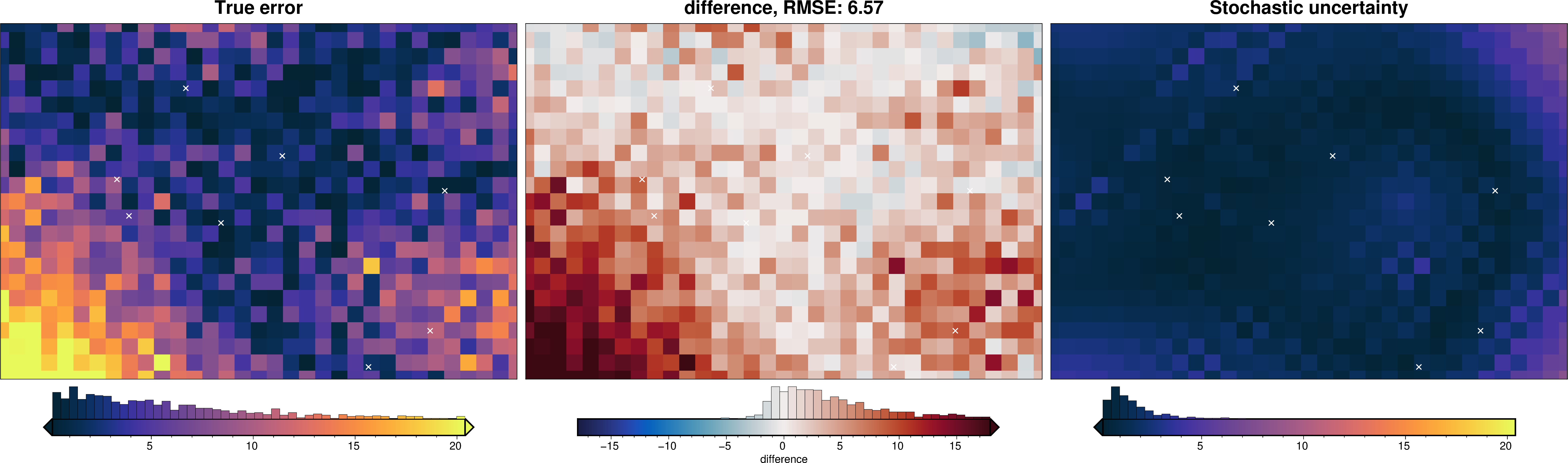
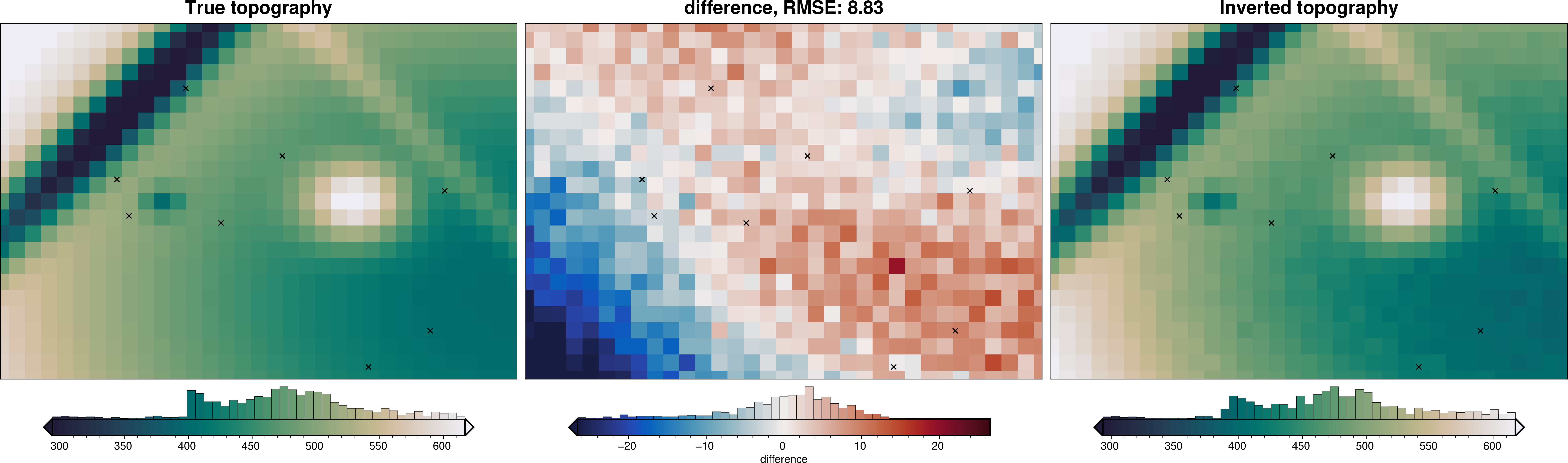
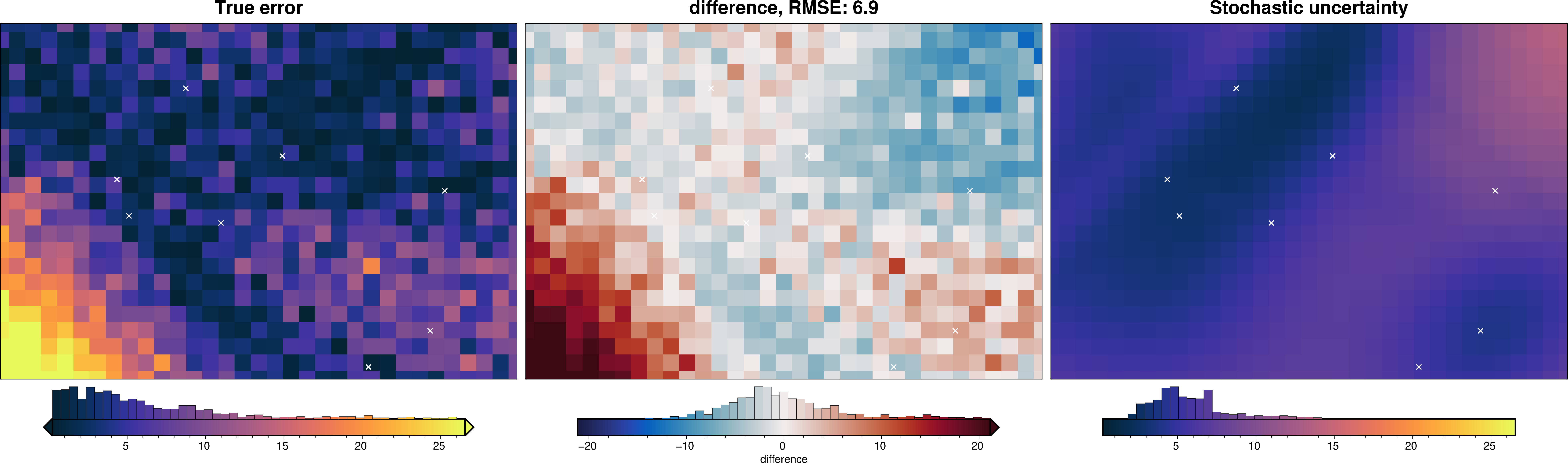
10.5.3. Constraints component#
[20]:
fname = "../tmp/10_uncertainty_constraints"

# delete files if already exist
for p in pathlib.Path().glob(f"{fname}*"):
    p.unlink(missing_ok=True)

uncert_constraints_results = invert4geom.full_workflow_uncertainty_loop(
    inv,
    fname=fname,
    sample_constraints=True,
    constraints_df=constraints_df,
    runs=10,
    regional_grav_kwargs=new_regional_grav_kwargs,
    starting_topography_kwargs=starting_topography_kwargs,
)

stats_ds = uncert_plots(
    uncert_constraints_results,
    inv.data.inner_region,
    inv.data.spacing,
    true_topography,
    constraints_df=constraints_df,
    weight_by="constraints",
)
/home/mdtanker/invert4geom/.pixi/envs/default/lib/python3.13/site-packages/polartoolkit/maps.py:1820: FutureWarning: The 'barwidth' parameter has been deprecated since v0.18.0 and will be removed in v0.20.0. Please use 'bar_width' instead.
  self.histogram(
/home/mdtanker/invert4geom/.pixi/envs/default/lib/python3.13/site-packages/polartoolkit/maps.py:1820: FutureWarning: The 'barwidth' parameter has been deprecated since v0.18.0 and will be removed in v0.20.0. Please use 'bar_width' instead.
  self.histogram(
/home/mdtanker/invert4geom/.pixi/envs/default/lib/python3.13/site-packages/polartoolkit/maps.py:1820: FutureWarning: The 'barwidth' parameter has been deprecated since v0.18.0 and will be removed in v0.20.0. Please use 'bar_width' instead.
  self.histogram(
/home/mdtanker/invert4geom/.pixi/envs/default/lib/python3.13/site-packages/polartoolkit/maps.py:1820: FutureWarning: The 'barwidth' parameter has been deprecated since v0.18.0 and will be removed in v0.20.0. Please use 'bar_width' instead.
  self.histogram(
/home/mdtanker/invert4geom/.pixi/envs/default/lib/python3.13/site-packages/polartoolkit/maps.py:1820: FutureWarning: The 'barwidth' parameter has been deprecated since v0.18.0 and will be removed in v0.20.0. Please use 'bar_width' instead.
  self.histogram(
/home/mdtanker/invert4geom/.pixi/envs/default/lib/python3.13/site-packages/polartoolkit/maps.py:1820: FutureWarning: The 'barwidth' parameter has been deprecated since v0.18.0 and will be removed in v0.20.0. Please use 'bar_width' instead.
  self.histogram(
/home/mdtanker/invert4geom/.pixi/envs/default/lib/python3.13/site-packages/polartoolkit/maps.py:1820: FutureWarning: The 'barwidth' parameter has been deprecated since v0.18.0 and will be removed in v0.20.0. Please use 'bar_width' instead.
  self.histogram(
/home/mdtanker/invert4geom/.pixi/envs/default/lib/python3.13/site-packages/polartoolkit/maps.py:1820: FutureWarning: The 'barwidth' parameter has been deprecated since v0.18.0 and will be removed in v0.20.0. Please use 'bar_width' instead.
  self.histogram(
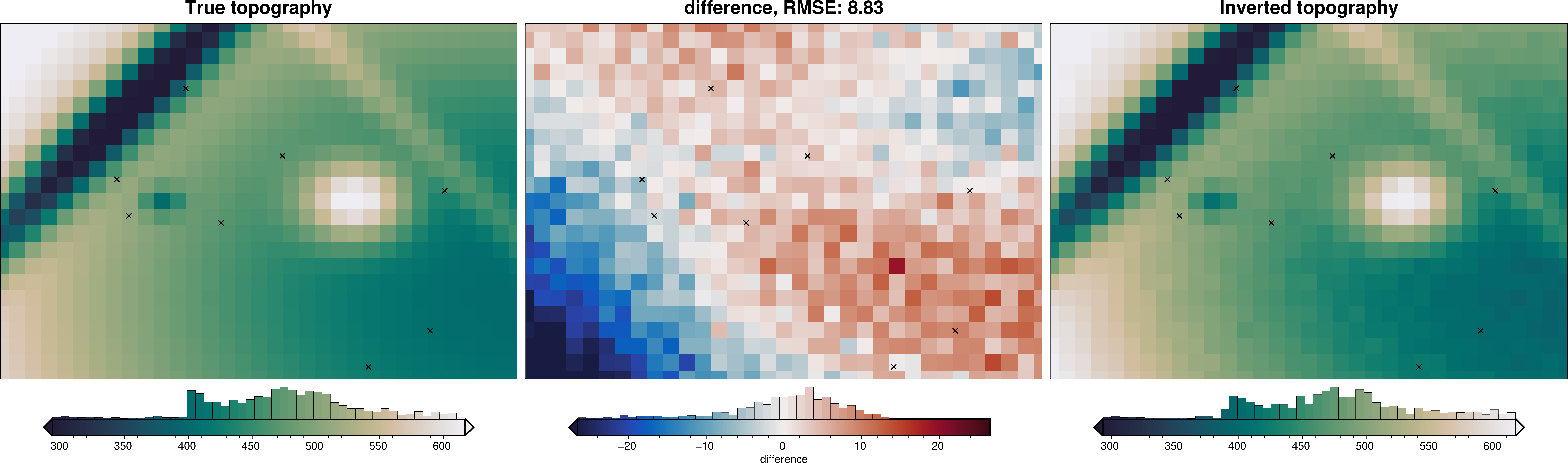
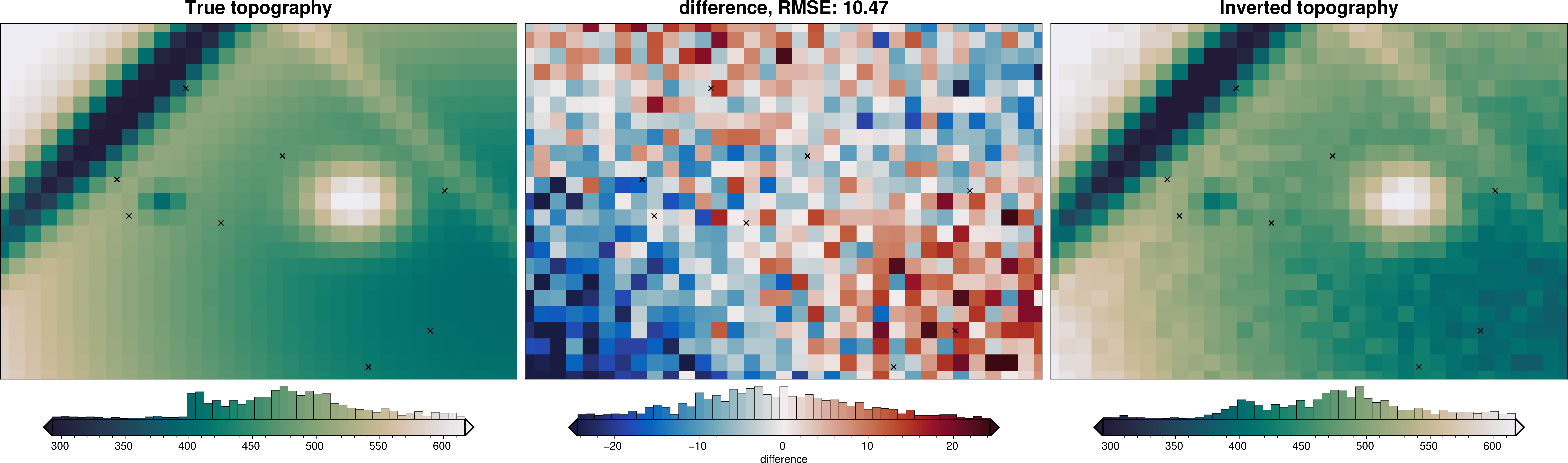
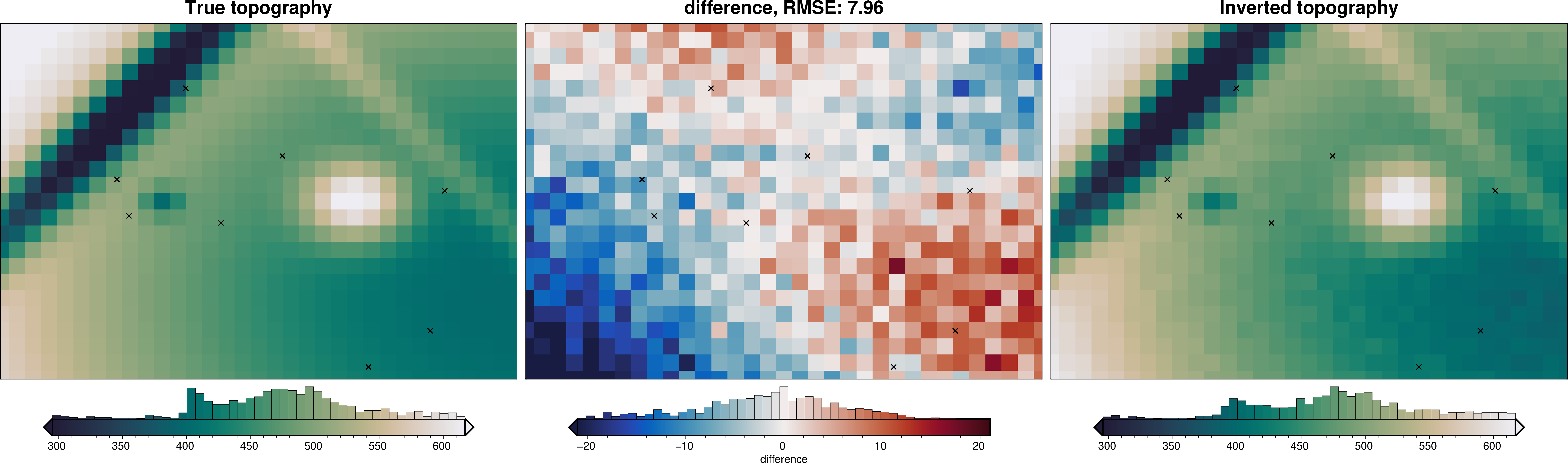
10.5.4. Gravity component#
[21]:
fname = "../tmp/10_uncertainty_grav"

# delete files if already exist
for p in pathlib.Path().glob(f"{fname}*"):
    p.unlink(missing_ok=True)

uncert_grav_results = invert4geom.full_workflow_uncertainty_loop(
    inv,
    fname=fname,
    runs=10,
    sample_gravity=True,
    regional_grav_kwargs=new_regional_grav_kwargs,
    starting_topography_kwargs=starting_topography_kwargs,
)

stats_ds = uncert_plots(
    uncert_grav_results,
    inv.data.inner_region,
    inv.data.spacing,
    true_topography,
    constraints_df=constraints_df,
    weight_by="constraints",
)
/home/mdtanker/invert4geom/.pixi/envs/default/lib/python3.13/site-packages/polartoolkit/maps.py:1820: FutureWarning: The 'barwidth' parameter has been deprecated since v0.18.0 and will be removed in v0.20.0. Please use 'bar_width' instead.
  self.histogram(
/home/mdtanker/invert4geom/.pixi/envs/default/lib/python3.13/site-packages/polartoolkit/maps.py:1820: FutureWarning: The 'barwidth' parameter has been deprecated since v0.18.0 and will be removed in v0.20.0. Please use 'bar_width' instead.
  self.histogram(
/home/mdtanker/invert4geom/.pixi/envs/default/lib/python3.13/site-packages/polartoolkit/maps.py:1820: FutureWarning: The 'barwidth' parameter has been deprecated since v0.18.0 and will be removed in v0.20.0. Please use 'bar_width' instead.
  self.histogram(
/home/mdtanker/invert4geom/.pixi/envs/default/lib/python3.13/site-packages/polartoolkit/maps.py:1820: FutureWarning: The 'barwidth' parameter has been deprecated since v0.18.0 and will be removed in v0.20.0. Please use 'bar_width' instead.
  self.histogram(
/home/mdtanker/invert4geom/.pixi/envs/default/lib/python3.13/site-packages/polartoolkit/maps.py:1820: FutureWarning: The 'barwidth' parameter has been deprecated since v0.18.0 and will be removed in v0.20.0. Please use 'bar_width' instead.
  self.histogram(
/home/mdtanker/invert4geom/.pixi/envs/default/lib/python3.13/site-packages/polartoolkit/maps.py:1820: FutureWarning: The 'barwidth' parameter has been deprecated since v0.18.0 and will be removed in v0.20.0. Please use 'bar_width' instead.
  self.histogram(
/home/mdtanker/invert4geom/.pixi/envs/default/lib/python3.13/site-packages/polartoolkit/maps.py:1820: FutureWarning: The 'barwidth' parameter has been deprecated since v0.18.0 and will be removed in v0.20.0. Please use 'bar_width' instead.
  self.histogram(
/home/mdtanker/invert4geom/.pixi/envs/default/lib/python3.13/site-packages/polartoolkit/maps.py:1820: FutureWarning: The 'barwidth' parameter has been deprecated since v0.18.0 and will be removed in v0.20.0. Please use 'bar_width' instead.
  self.histogram(
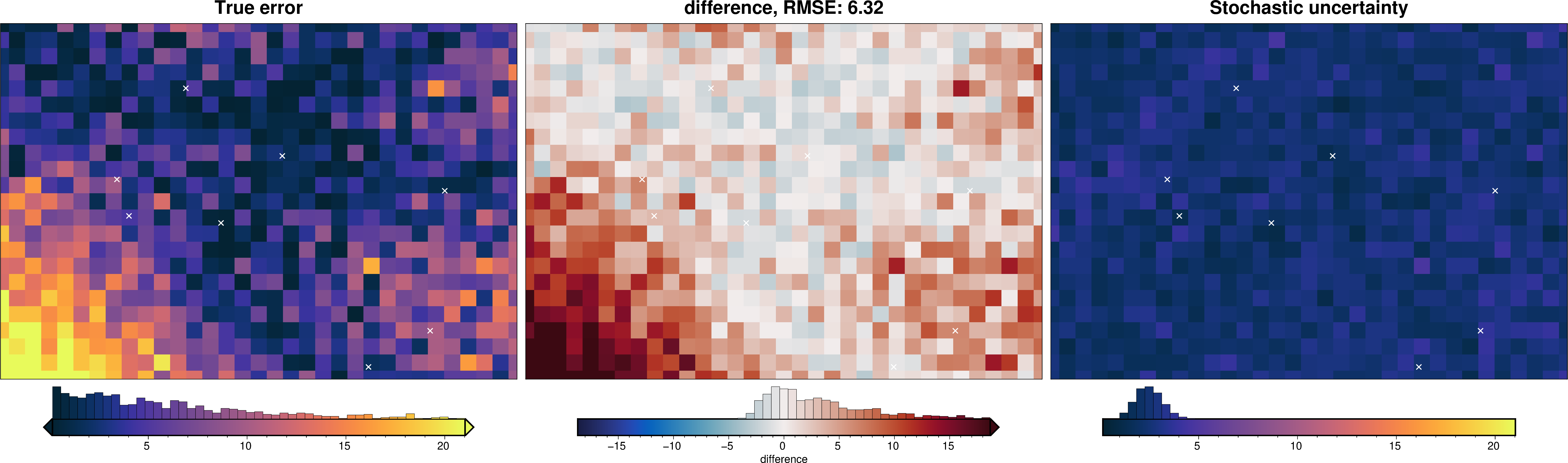
10.5.5. Regional gravity component#
[22]:
reg_eq_depth, reg_eq_damping
[22]:
(np.float64(25196.204289908077), 0.04852697025087582)
[23]:
np.abs(np.log10(reg_eq_damping))
[23]:
np.float64(1.3140168227255342)
[24]:
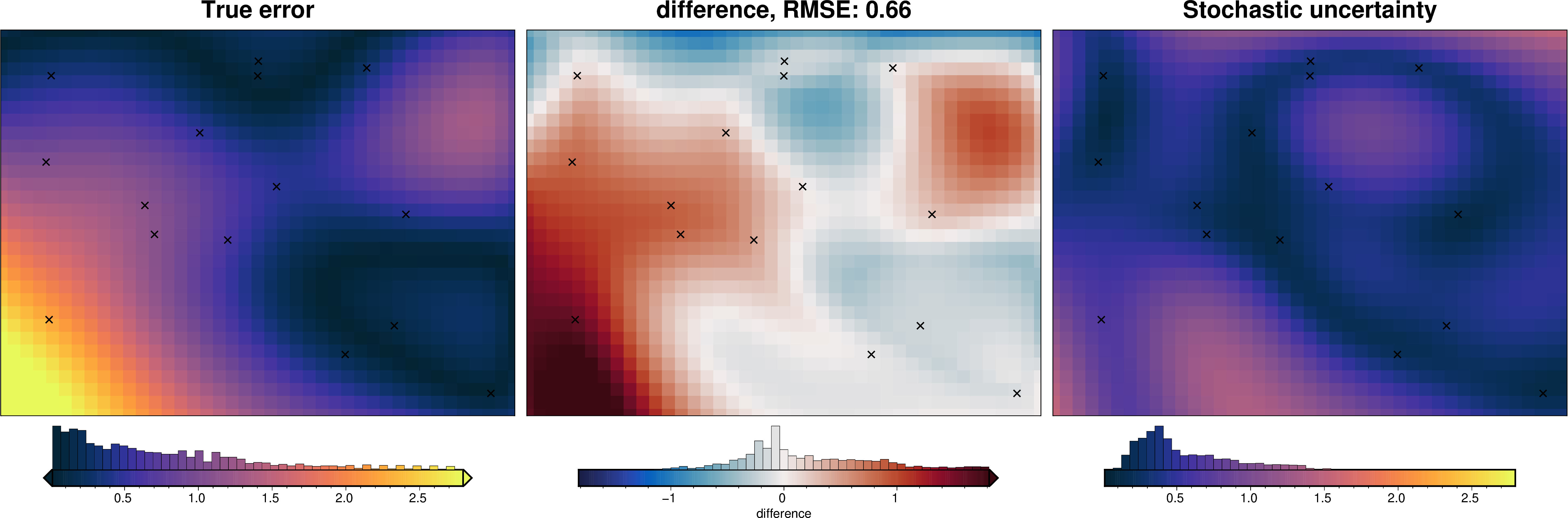
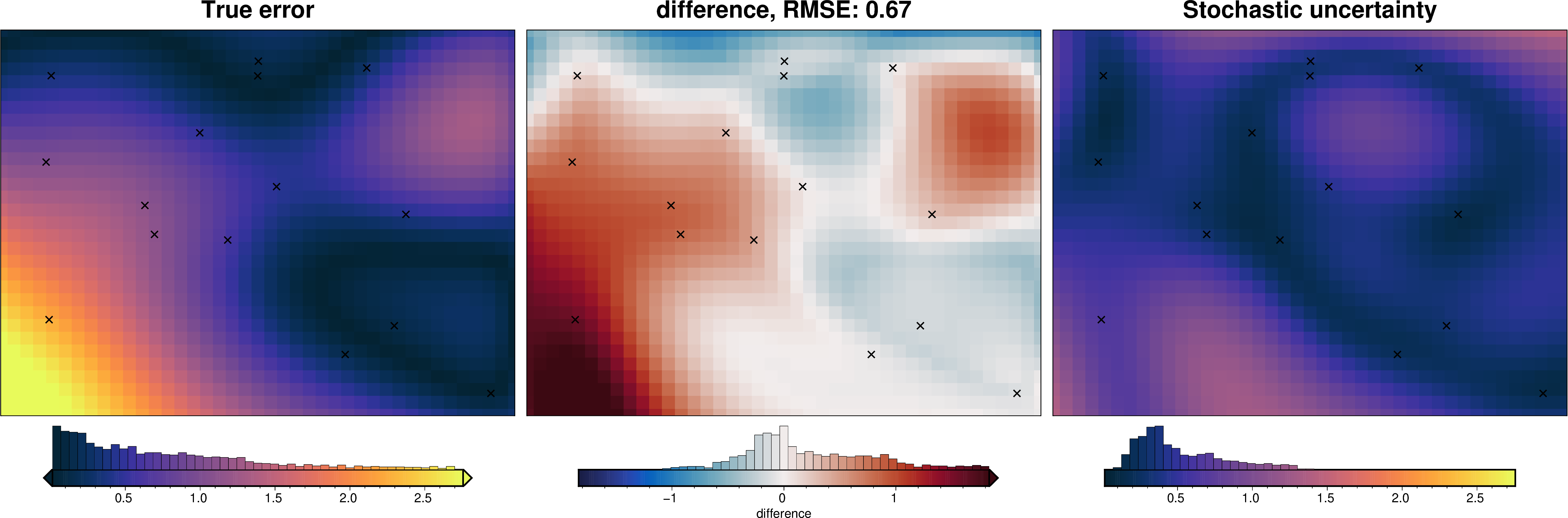
regional_misfit_parameter_dict = {
    "depth": {
        "distribution": "normal",
        "loc": reg_eq_depth,  # mean
        "scale": reg_eq_depth / 10,  # standard deviation
    },
    "damping": {
        "distribution": "normal",
        "loc": np.log10(reg_eq_damping),  # mean base 10 exponent
        # "scale": np.abs(np.log10(reg_eq_damping)),  # standard deviation of exponent
        "scale": 2,
        "log": True,
    },
}

regional_misfit_stats, _ = invert4geom.regional_misfit_uncertainty(
    runs=100,
    parameter_dict=regional_misfit_parameter_dict,
    true_regional=inv.data.lower_surface_grav,
    # weight_by="constraints",
    # weight_by="residual",
    # weight_by=None,
    grav_ds=inv.data,
    **new_regional_grav_kwargs,
)
/home/mdtanker/invert4geom/.pixi/envs/default/lib/python3.13/site-packages/polartoolkit/maps.py:1820: FutureWarning: The 'barwidth' parameter has been deprecated since v0.18.0 and will be removed in v0.20.0. Please use 'bar_width' instead.
  self.histogram(
/home/mdtanker/invert4geom/.pixi/envs/default/lib/python3.13/site-packages/polartoolkit/maps.py:1820: FutureWarning: The 'barwidth' parameter has been deprecated since v0.18.0 and will be removed in v0.20.0. Please use 'bar_width' instead.
  self.histogram(
/home/mdtanker/invert4geom/.pixi/envs/default/lib/python3.13/site-packages/polartoolkit/maps.py:1820: FutureWarning: The 'barwidth' parameter has been deprecated since v0.18.0 and will be removed in v0.20.0. Please use 'bar_width' instead.
  self.histogram(
/home/mdtanker/invert4geom/.pixi/envs/default/lib/python3.13/site-packages/polartoolkit/maps.py:1820: FutureWarning: The 'barwidth' parameter has been deprecated since v0.18.0 and will be removed in v0.20.0. Please use 'bar_width' instead.
  self.histogram(
/home/mdtanker/invert4geom/.pixi/envs/default/lib/python3.13/site-packages/polartoolkit/maps.py:1820: FutureWarning: The 'barwidth' parameter has been deprecated since v0.18.0 and will be removed in v0.20.0. Please use 'bar_width' instead.
  self.histogram(
/home/mdtanker/invert4geom/.pixi/envs/default/lib/python3.13/site-packages/polartoolkit/maps.py:1820: FutureWarning: The 'barwidth' parameter has been deprecated since v0.18.0 and will be removed in v0.20.0. Please use 'bar_width' instead.
  self.histogram(
/home/mdtanker/invert4geom/.pixi/envs/default/lib/python3.13/site-packages/polartoolkit/maps.py:1820: FutureWarning: The 'barwidth' parameter has been deprecated since v0.18.0 and will be removed in v0.20.0. Please use 'bar_width' instead.
  self.histogram(
/home/mdtanker/invert4geom/.pixi/envs/default/lib/python3.13/site-packages/polartoolkit/maps.py:1820: FutureWarning: The 'barwidth' parameter has been deprecated since v0.18.0 and will be removed in v0.20.0. Please use 'bar_width' instead.
  self.histogram(
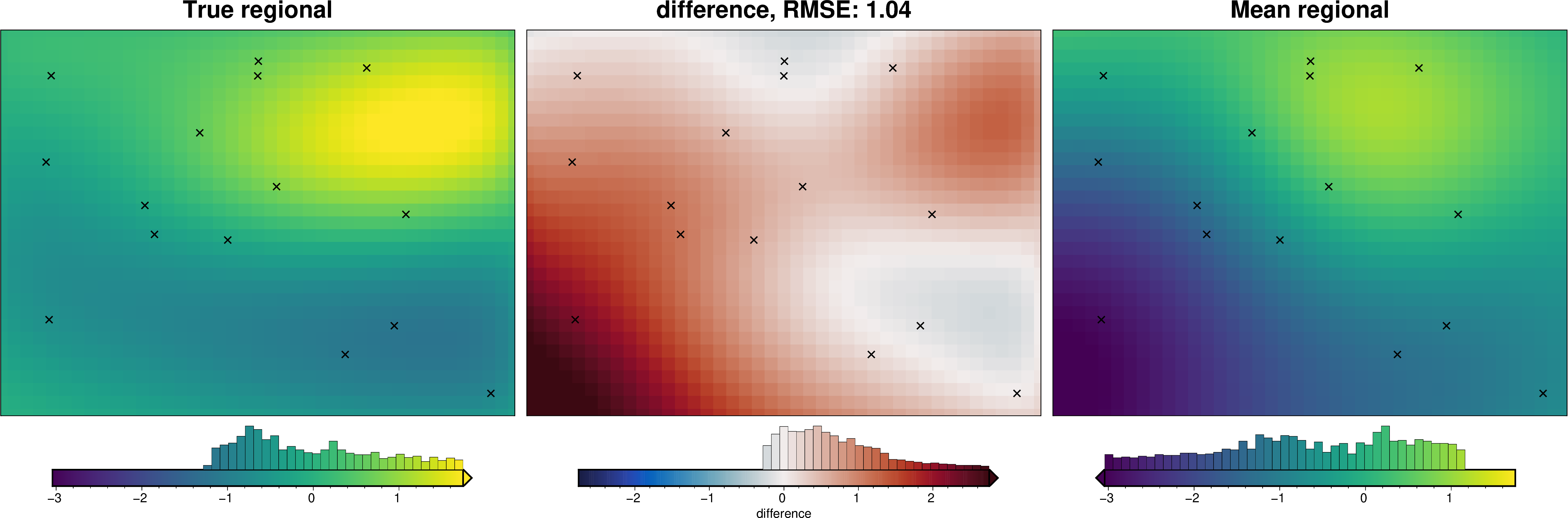
[25]:
# update grav dataset
inv.data["reg_uncert"] = regional_misfit_stats.z_stdev
[26]:
fname = "../tmp/10_uncertainty_regional"

# delete files if already exist
for p in pathlib.Path().glob(f"{fname}*"):
    p.unlink(missing_ok=True)

uncert_regional_results = invert4geom.full_workflow_uncertainty_loop(
    inv,
    fname=fname,
    runs=10,
    regional_misfit_parameter_dict=regional_misfit_parameter_dict,
    regional_grav_kwargs=new_regional_grav_kwargs,
    starting_topography_kwargs=starting_topography_kwargs,
)

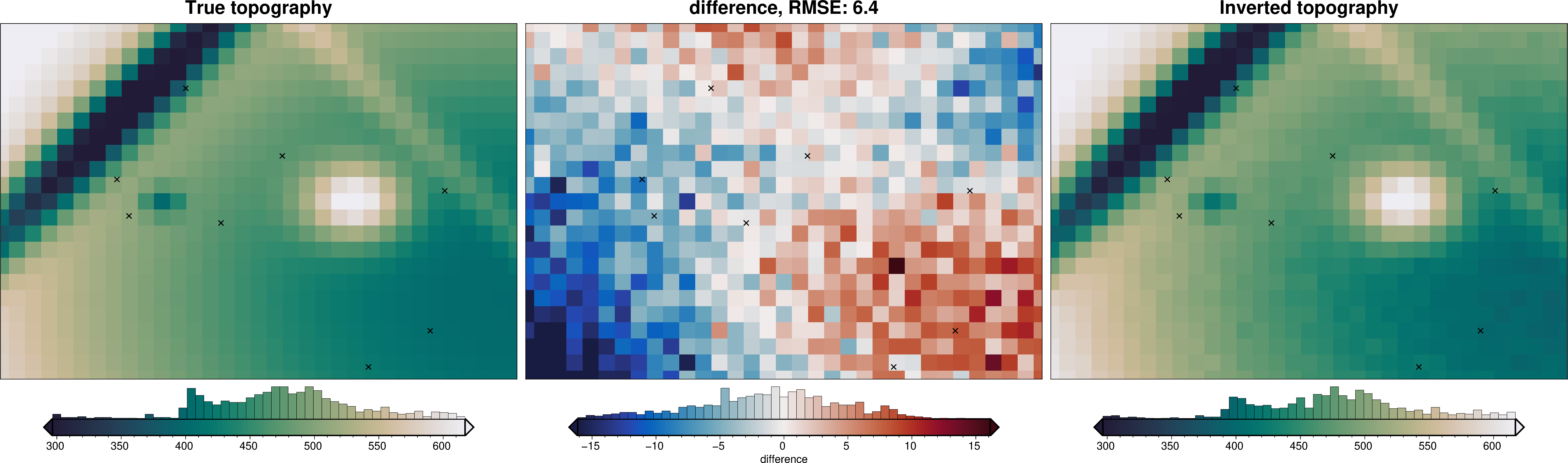
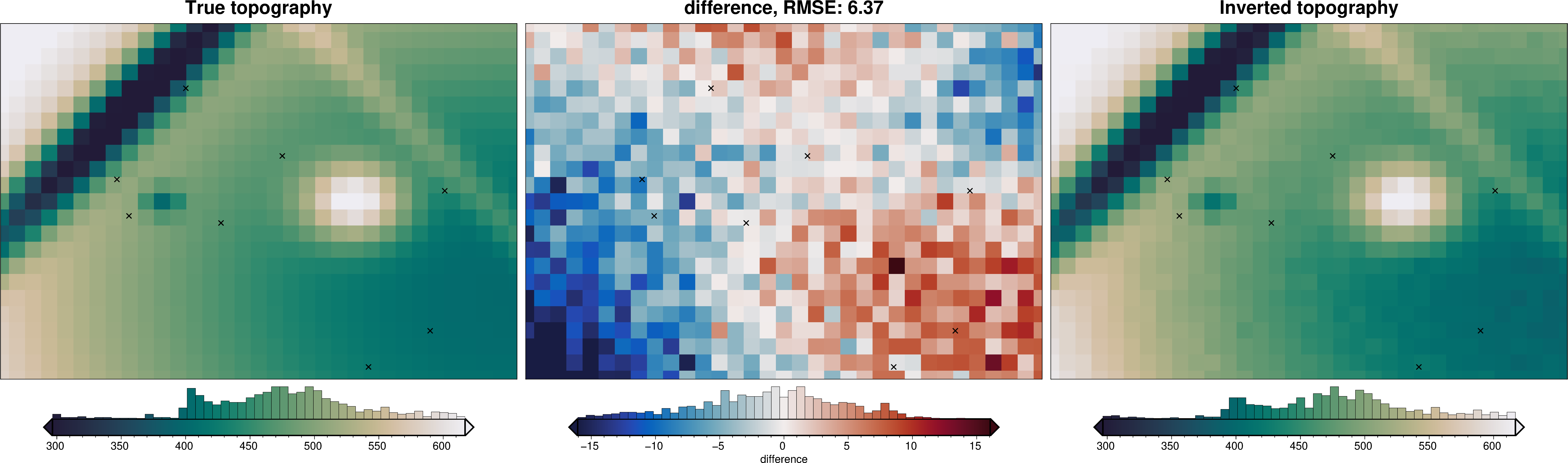
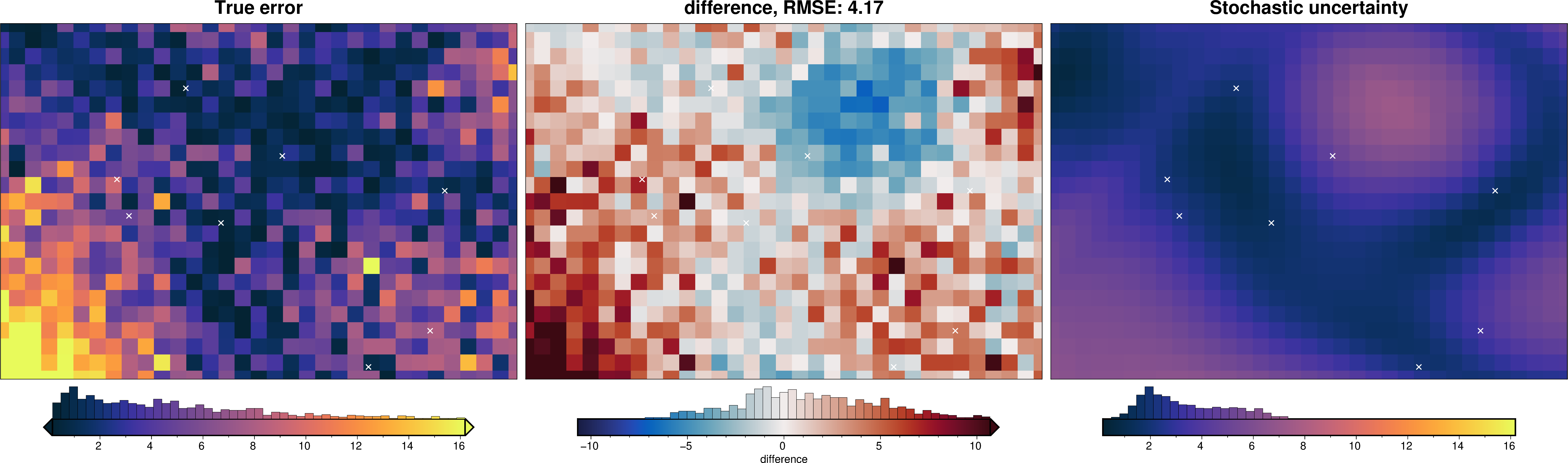
stats_ds = uncert_plots(
    uncert_regional_results,
    inv.data.inner_region,
    inv.data.spacing,
    true_topography,
    constraints_df=constraints_df,
    weight_by="constraints",
)
/home/mdtanker/invert4geom/.pixi/envs/default/lib/python3.13/site-packages/polartoolkit/maps.py:1820: FutureWarning: The 'barwidth' parameter has been deprecated since v0.18.0 and will be removed in v0.20.0. Please use 'bar_width' instead.
  self.histogram(
/home/mdtanker/invert4geom/.pixi/envs/default/lib/python3.13/site-packages/polartoolkit/maps.py:1820: FutureWarning: The 'barwidth' parameter has been deprecated since v0.18.0 and will be removed in v0.20.0. Please use 'bar_width' instead.
  self.histogram(
/home/mdtanker/invert4geom/.pixi/envs/default/lib/python3.13/site-packages/polartoolkit/maps.py:1820: FutureWarning: The 'barwidth' parameter has been deprecated since v0.18.0 and will be removed in v0.20.0. Please use 'bar_width' instead.
  self.histogram(
/home/mdtanker/invert4geom/.pixi/envs/default/lib/python3.13/site-packages/polartoolkit/maps.py:1820: FutureWarning: The 'barwidth' parameter has been deprecated since v0.18.0 and will be removed in v0.20.0. Please use 'bar_width' instead.
  self.histogram(
/home/mdtanker/invert4geom/.pixi/envs/default/lib/python3.13/site-packages/polartoolkit/maps.py:1820: FutureWarning: The 'barwidth' parameter has been deprecated since v0.18.0 and will be removed in v0.20.0. Please use 'bar_width' instead.
  self.histogram(
/home/mdtanker/invert4geom/.pixi/envs/default/lib/python3.13/site-packages/polartoolkit/maps.py:1820: FutureWarning: The 'barwidth' parameter has been deprecated since v0.18.0 and will be removed in v0.20.0. Please use 'bar_width' instead.
  self.histogram(
/home/mdtanker/invert4geom/.pixi/envs/default/lib/python3.13/site-packages/polartoolkit/maps.py:1820: FutureWarning: The 'barwidth' parameter has been deprecated since v0.18.0 and will be removed in v0.20.0. Please use 'bar_width' instead.
  self.histogram(
/home/mdtanker/invert4geom/.pixi/envs/default/lib/python3.13/site-packages/polartoolkit/maps.py:1820: FutureWarning: The 'barwidth' parameter has been deprecated since v0.18.0 and will be removed in v0.20.0. Please use 'bar_width' instead.
  self.histogram(
10.5.6. Total uncertainty#
[27]:
fname = "../tmp/10_uncertainty_full"

# delete files if already exist
for p in pathlib.Path().glob(f"{fname}*"):
    p.unlink(missing_ok=True)

uncert_results = invert4geom.full_workflow_uncertainty_loop(
    inv,
    fname=fname,
    runs=20,
    sample_gravity=True,
    sample_constraints=True,
    constraints_df=constraints_df,
    parameter_dict=solver_dict | density_dict | zref_dict,
    regional_misfit_parameter_dict=regional_misfit_parameter_dict,
    regional_grav_kwargs=new_regional_grav_kwargs,
    starting_topography_kwargs=starting_topography_kwargs,
)

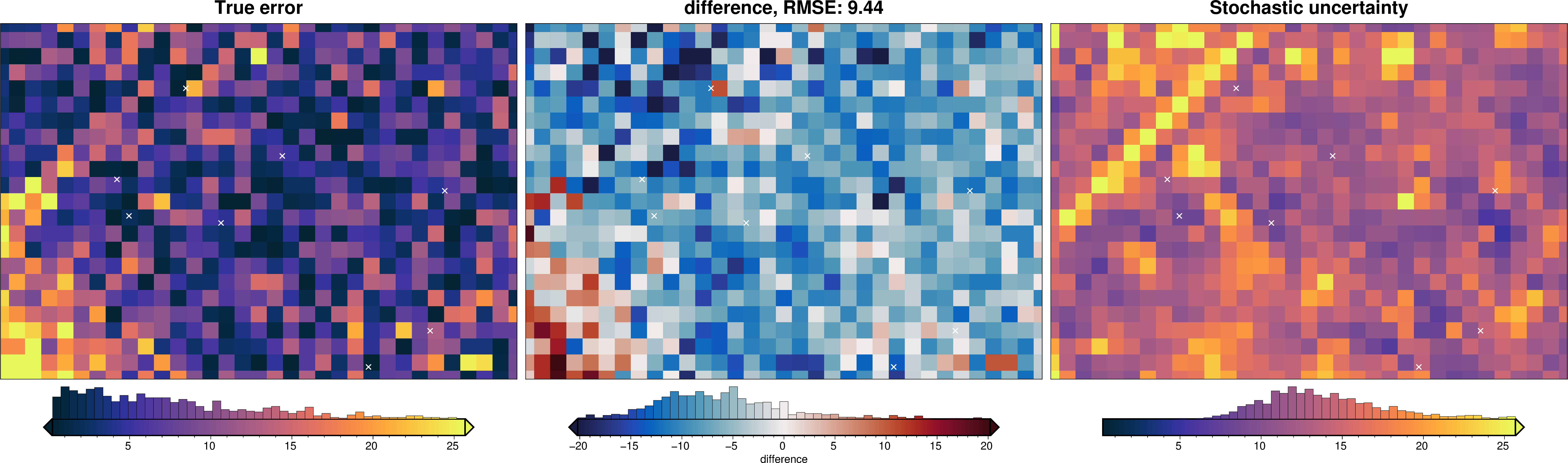
stats_ds = uncert_plots(
    uncert_results,
    inv.data.inner_region,
    inv.data.spacing,
    true_topography,
    constraints_df=constraints_df,
    weight_by="constraints",
)
Inversion terminated due to max_iterations limit. Consider increasing this limit.
/home/mdtanker/invert4geom/.pixi/envs/default/lib/python3.13/site-packages/polartoolkit/maps.py:1820: FutureWarning: The 'barwidth' parameter has been deprecated since v0.18.0 and will be removed in v0.20.0. Please use 'bar_width' instead.
  self.histogram(
/home/mdtanker/invert4geom/.pixi/envs/default/lib/python3.13/site-packages/polartoolkit/maps.py:1820: FutureWarning: The 'barwidth' parameter has been deprecated since v0.18.0 and will be removed in v0.20.0. Please use 'bar_width' instead.
  self.histogram(
/home/mdtanker/invert4geom/.pixi/envs/default/lib/python3.13/site-packages/polartoolkit/maps.py:1820: FutureWarning: The 'barwidth' parameter has been deprecated since v0.18.0 and will be removed in v0.20.0. Please use 'bar_width' instead.
  self.histogram(
/home/mdtanker/invert4geom/.pixi/envs/default/lib/python3.13/site-packages/polartoolkit/maps.py:1820: FutureWarning: The 'barwidth' parameter has been deprecated since v0.18.0 and will be removed in v0.20.0. Please use 'bar_width' instead.
  self.histogram(
/home/mdtanker/invert4geom/.pixi/envs/default/lib/python3.13/site-packages/polartoolkit/maps.py:1820: FutureWarning: The 'barwidth' parameter has been deprecated since v0.18.0 and will be removed in v0.20.0. Please use 'bar_width' instead.
  self.histogram(
/home/mdtanker/invert4geom/.pixi/envs/default/lib/python3.13/site-packages/polartoolkit/maps.py:1820: FutureWarning: The 'barwidth' parameter has been deprecated since v0.18.0 and will be removed in v0.20.0. Please use 'bar_width' instead.
  self.histogram(
/home/mdtanker/invert4geom/.pixi/envs/default/lib/python3.13/site-packages/polartoolkit/maps.py:1820: FutureWarning: The 'barwidth' parameter has been deprecated since v0.18.0 and will be removed in v0.20.0. Please use 'bar_width' instead.
  self.histogram(
/home/mdtanker/invert4geom/.pixi/envs/default/lib/python3.13/site-packages/polartoolkit/maps.py:1820: FutureWarning: The 'barwidth' parameter has been deprecated since v0.18.0 and will be removed in v0.20.0. Please use 'bar_width' instead.
  self.histogram(
10.5.7. Comparing results#
[28]:
results = [
    uncert_results,
    uncert_regional_results,
    uncert_grav_results,
    uncert_constraints_results,
    uncert_density_results,
    uncert_zref_results,
    uncert_damping_results,
]
names = [
    "full",
    "regional",
    "grav",
    "constraints",
    "density",
    "zref",
    "damping",
]
# get cell-wise stats for each ensemble
stats = []
for r in results:
    ds = invert4geom.merged_stats(
        results=r,
        plot=False,
        constraints_df=constraints_df,
        weight_by="constraints",
        region=inv.data.inner_region,
    )
    stats.append(ds)
[29]:
# get the standard deviation of the ensemble of ensembles
stdevs = []
for i, s in enumerate(stats):
    stdevs.append(s.weighted_stdev.rename(f"{names[i]}_stdev"))

merged = xr.merge(stdevs, compat="override")
merged
[29]:
<xarray.Dataset> Size: 63kB
Dimensions:            (northing: 25, easting: 35)
Coordinates:
  * northing           (northing) float64 200B 3e+03 4e+03 ... 2.6e+04 2.7e+04
  * easting            (easting) float64 280B 3e+03 4e+03 ... 3.6e+04 3.7e+04
    top                (northing, easting) float64 7kB 645.0 622.9 ... 512.1
    bottom             (northing, easting) float64 7kB 415.4 415.4 ... 415.4
Data variables:
    full_stdev         (northing, easting) float64 7kB 19.1 14.71 ... 16.92
    regional_stdev     (northing, easting) float64 7kB 7.116 6.744 ... 6.748
    grav_stdev         (northing, easting) float64 7kB 2.155 1.203 ... 2.415
    constraints_stdev  (northing, easting) float64 7kB 6.81 6.687 ... 14.4 14.68
    density_stdev      (northing, easting) float64 7kB 2.557 2.64 ... 2.842
    zref_stdev         (northing, easting) float64 7kB 3.631 3.929 ... 8.749
damping_stdev (northing, easting) float64 7kB 2.256 2.292 ... 6.504[30]:
titles = [
    "True error",
    "Total uncertainty",
    "Uncertainty from regional estimation",
    "Uncertainty from gravity",
    "Uncertainty from constraints",
    "Uncertainty from density",
    "Uncertainty from reference level",
    "Uncertainty from damping",
]
grids = list(merged.data_vars.values())

grids.insert(0, np.abs(stats[0].weighted_mean - true_topography))

cpt_lims = ptk.get_min_max(
    grids[0],
    robust=True,
)

fig_height = 9
for i, g in enumerate(grids):
    xshift_amount = 1
    if i == 0:
        fig = None
        origin_shift = "initialize"
    elif i == 4:
        origin_shift = "both"
        xshift_amount = -3
    else:
        origin_shift = "x"

    fig = ptk.plot_grid(
        grid=g,
        fig_height=fig_height,
        title=titles[i],
        title_font="16p,Helvetica,black",
        cmap="thermal",
        cpt_lims=cpt_lims,
        robust=True,
        cbar_label=f"standard deviation (m), mean: {int(np.nanmean(g))}",
        hist=True,
        hist_bin_num=50,
        fig=fig,
        origin_shift=origin_shift,
        xshift_amount=xshift_amount,
    )
    if i == 0:
        # plot profile location, and endpoints on map
        start = [inv.data.inner_region[0], inv.data.inner_region[3]]
        stop = [inv.data.inner_region[1], inv.data.inner_region[2]]
        fig.plot(
            vd.line_coordinates(start, stop, size=100),
            pen="2p,black",
        )
        fig.text(
            x=start[0],
            y=start[1],
            text="A",
            fill="white",
            font="12p,Helvetica,black",
            justify="CM",
            clearance="+tO",
            no_clip=True,
        )
        fig.text(
            x=stop[0],
            y=stop[1],
            text="A' ",
            fill="white",
            font="12p,Helvetica,black",
            justify="CM",
            clearance="+tO",
            no_clip=True,
        )
    fig.plot(
        x=constraints_df.easting,
        y=constraints_df.northing,
        style="x.2c",
        pen="1.5p,white",
        fill="white",
    )
    fig.text(
        position="TL",
        text=f"{string.ascii_lowercase[i]}",
        fill="white",
        pen=True,
        font="16p,Helvetica,black",
        offset="j.6/.2",
        clearance="+tO",
        no_clip=True,
    )
fig.show()
/home/mdtanker/invert4geom/.pixi/envs/default/lib/python3.13/site-packages/polartoolkit/maps.py:3414: UserWarning: origin_shift 'initialize' is deprecated, use None instead.
  fig.shift_figure(
/home/mdtanker/invert4geom/.pixi/envs/default/lib/python3.13/site-packages/polartoolkit/maps.py:1424: UserWarning: Since limits were passed to `cpt_lims`, parameter `robust` is unused.
  cmap, colorbar, cpt_lims = set_cmap(
/home/mdtanker/invert4geom/.pixi/envs/default/lib/python3.13/site-packages/polartoolkit/maps.py:1820: FutureWarning: The 'barwidth' parameter has been deprecated since v0.18.0 and will be removed in v0.20.0. Please use 'bar_width' instead.
  self.histogram(
/home/mdtanker/invert4geom/.pixi/envs/default/lib/python3.13/site-packages/polartoolkit/maps.py:1424: UserWarning: Since limits were passed to `cpt_lims`, parameter `robust` is unused.
  cmap, colorbar, cpt_lims = set_cmap(
/home/mdtanker/invert4geom/.pixi/envs/default/lib/python3.13/site-packages/polartoolkit/maps.py:1820: FutureWarning: The 'barwidth' parameter has been deprecated since v0.18.0 and will be removed in v0.20.0. Please use 'bar_width' instead.
  self.histogram(
/home/mdtanker/invert4geom/.pixi/envs/default/lib/python3.13/site-packages/polartoolkit/maps.py:1424: UserWarning: Since limits were passed to `cpt_lims`, parameter `robust` is unused.
  cmap, colorbar, cpt_lims = set_cmap(
/home/mdtanker/invert4geom/.pixi/envs/default/lib/python3.13/site-packages/polartoolkit/maps.py:1820: FutureWarning: The 'barwidth' parameter has been deprecated since v0.18.0 and will be removed in v0.20.0. Please use 'bar_width' instead.
  self.histogram(
/home/mdtanker/invert4geom/.pixi/envs/default/lib/python3.13/site-packages/polartoolkit/maps.py:1424: UserWarning: Since limits were passed to `cpt_lims`, parameter `robust` is unused.
  cmap, colorbar, cpt_lims = set_cmap(
/home/mdtanker/invert4geom/.pixi/envs/default/lib/python3.13/site-packages/polartoolkit/maps.py:1820: FutureWarning: The 'barwidth' parameter has been deprecated since v0.18.0 and will be removed in v0.20.0. Please use 'bar_width' instead.
  self.histogram(
/home/mdtanker/invert4geom/.pixi/envs/default/lib/python3.13/site-packages/polartoolkit/maps.py:1424: UserWarning: Since limits were passed to `cpt_lims`, parameter `robust` is unused.
  cmap, colorbar, cpt_lims = set_cmap(
/home/mdtanker/invert4geom/.pixi/envs/default/lib/python3.13/site-packages/polartoolkit/maps.py:1820: FutureWarning: The 'barwidth' parameter has been deprecated since v0.18.0 and will be removed in v0.20.0. Please use 'bar_width' instead.
  self.histogram(
/home/mdtanker/invert4geom/.pixi/envs/default/lib/python3.13/site-packages/polartoolkit/maps.py:1424: UserWarning: Since limits were passed to `cpt_lims`, parameter `robust` is unused.
  cmap, colorbar, cpt_lims = set_cmap(
/home/mdtanker/invert4geom/.pixi/envs/default/lib/python3.13/site-packages/polartoolkit/maps.py:1820: FutureWarning: The 'barwidth' parameter has been deprecated since v0.18.0 and will be removed in v0.20.0. Please use 'bar_width' instead.
  self.histogram(
/home/mdtanker/invert4geom/.pixi/envs/default/lib/python3.13/site-packages/polartoolkit/maps.py:1424: UserWarning: Since limits were passed to `cpt_lims`, parameter `robust` is unused.
  cmap, colorbar, cpt_lims = set_cmap(
/home/mdtanker/invert4geom/.pixi/envs/default/lib/python3.13/site-packages/polartoolkit/maps.py:1820: FutureWarning: The 'barwidth' parameter has been deprecated since v0.18.0 and will be removed in v0.20.0. Please use 'bar_width' instead.
  self.histogram(
/home/mdtanker/invert4geom/.pixi/envs/default/lib/python3.13/site-packages/polartoolkit/maps.py:1424: UserWarning: Since limits were passed to `cpt_lims`, parameter `robust` is unused.
  cmap, colorbar, cpt_lims = set_cmap(
/home/mdtanker/invert4geom/.pixi/envs/default/lib/python3.13/site-packages/polartoolkit/maps.py:1820: FutureWarning: The 'barwidth' parameter has been deprecated since v0.18.0 and will be removed in v0.20.0. Please use 'bar_width' instead.
  self.histogram(
[31]:
data_dict = ptk.make_data_dict(
    names=titles,
    grids=grids,
    colors=[
        "red",
        "black",
        "blue",
        "magenta",
        "cyan",
        "green",
        "purple",
        "orange",
    ],
)

fig, df_data = ptk.plot_data(
    "points",
    start=[inv.data.inner_region[0], inv.data.inner_region[3]],
    stop=[inv.data.inner_region[1], inv.data.inner_region[2]],
    num=10000,
    fig_height=4,
    fig_width=15,
    data_dict=data_dict,
    data_legend_loc="jTR+jTL",
    data_legend_box="+gwhite",
    data_buffer=0.01,
    data_frame=["neSW", "xafg+lDistance (m)", "yag+luncertainty (m)"],
    # data_pen_style=[None,None,"4_2:2p"],
    # data_pen_thickness=[1, 1.5, 1],
    share_yaxis=True,
    start_label="A",
    end_label="A' ",
)
fig.show()
/home/mdtanker/invert4geom/.pixi/envs/default/lib/python3.13/site-packages/pygmt/src/legend.py:160: SyntaxWarning: Short-form parameter 'S' is not recommended. Use long-form parameter 'scale' instead.
  aliasdict.merge(kwargs)